Documentation
research
Research & Documentation
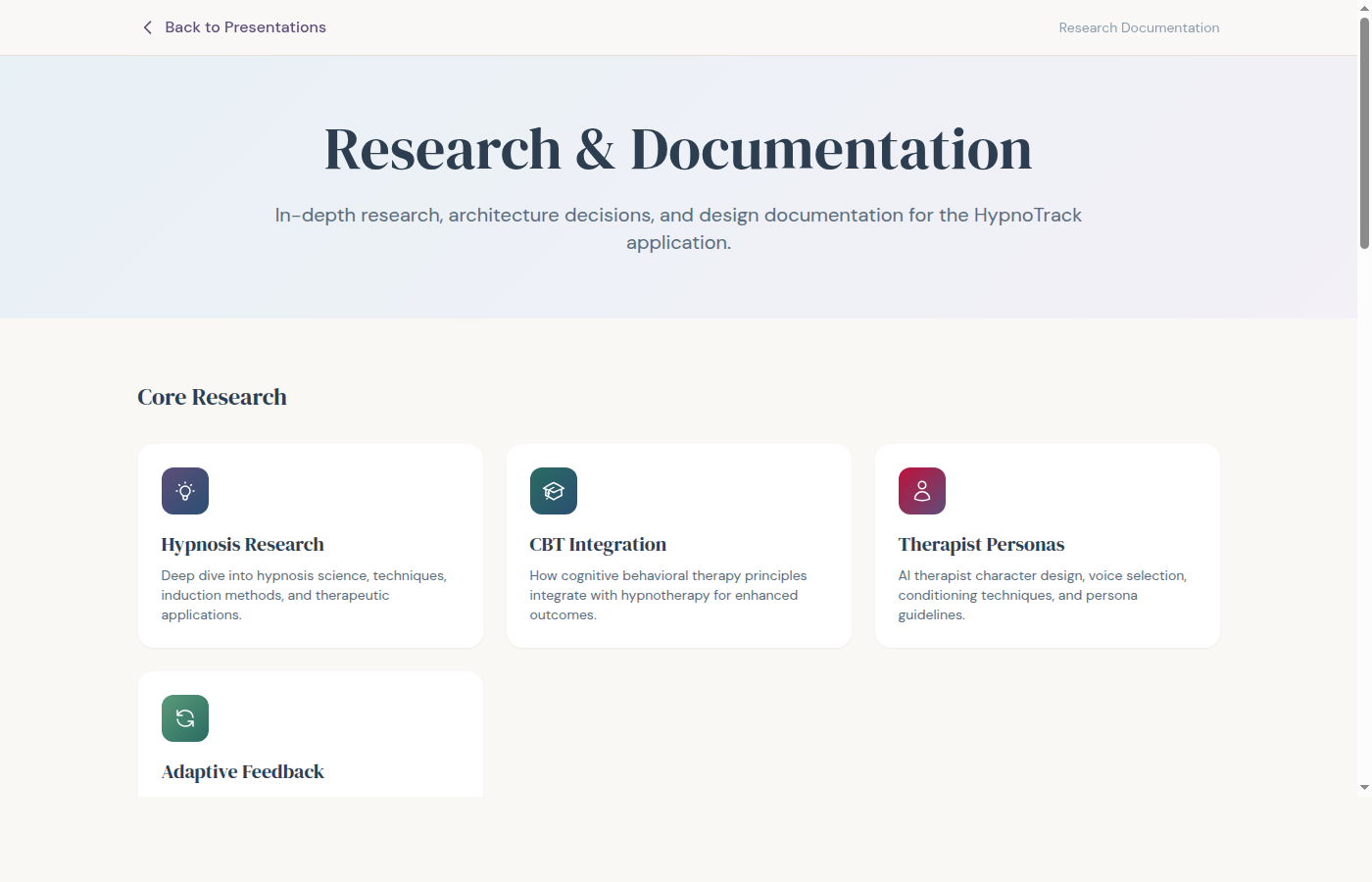
Every product decision in HypnoTrack traces back to a research document. This isn't filler — these are the actual analyses that shaped the architecture, pricing, UX, and clinical structure of the app. Sixteen documents across four categories, each one interactive and browsable as a standalone web page.
Core Research
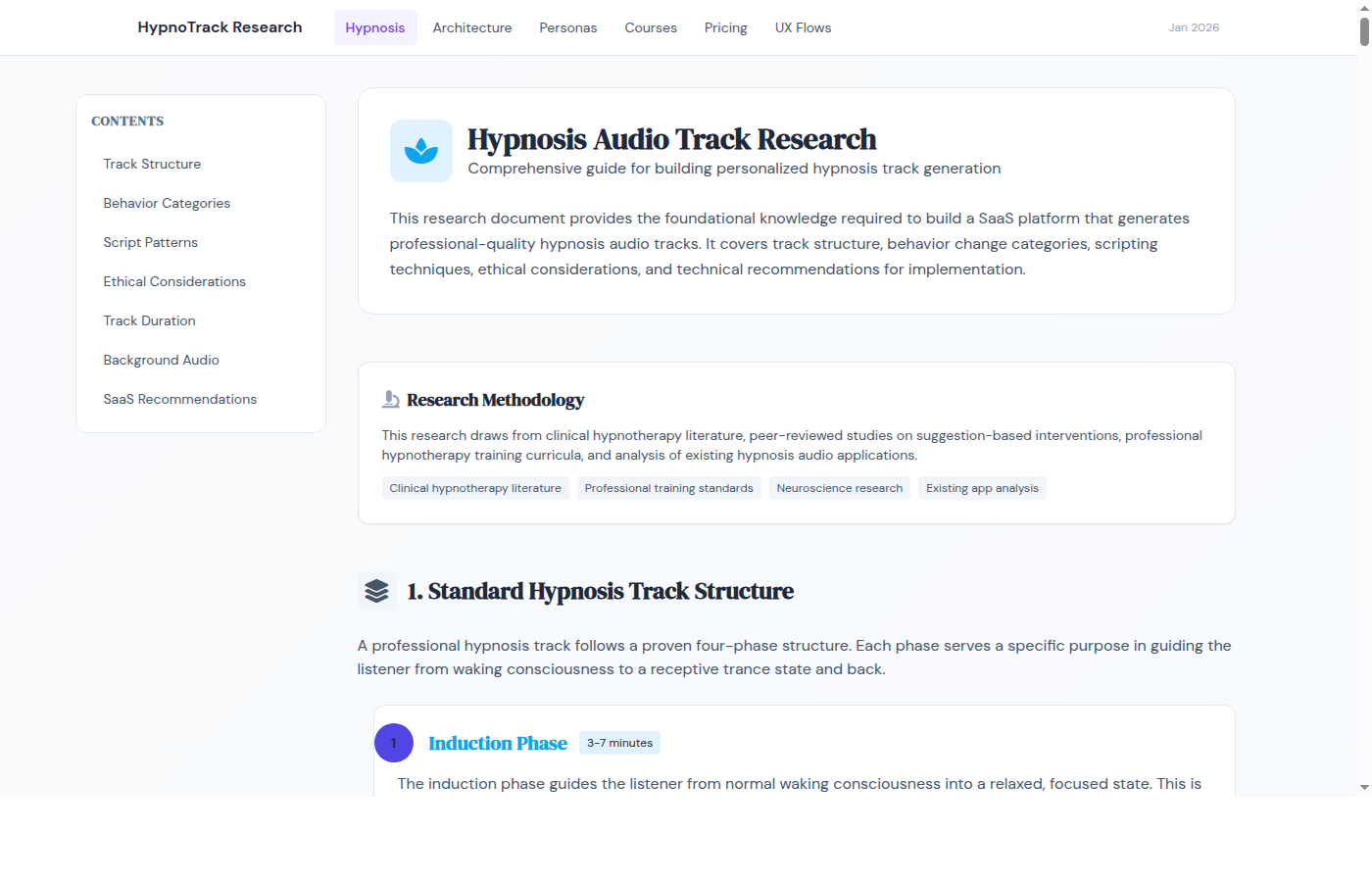
Hypnosis Audio Track Research
The foundation of the entire product. This document covers the standard four-phase hypnosis track structure, behavior change categories (sleep, anxiety, habits, fears), script patterns that work for each category, ethical considerations around clinical claims, and background audio recommendations.
It's the document that answers "what exactly goes into a hypnosis track and why?" — from induction techniques to deepening methods to the specific language patterns that make suggestions effective.
CBT Integration
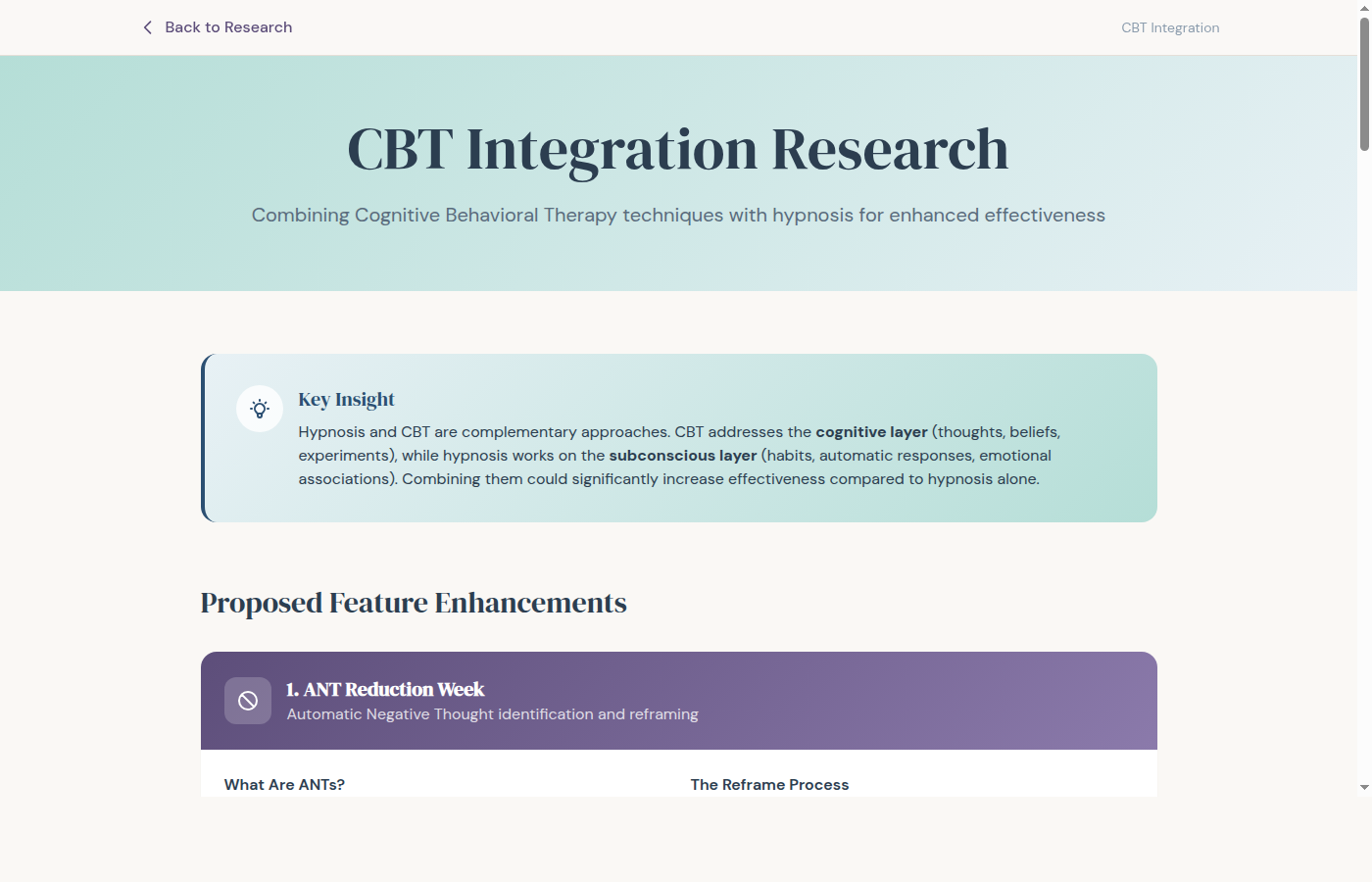
Hypnotherapy alone is effective. Combined with CBT, it's significantly more so — research shows a 70% improvement rate for the combined approach. This document breaks down how cognitive behavioral therapy principles integrate with hypnosis: identifying thought patterns during the conscious questionnaire phase, then addressing them during the trance suggestion phase.
The practical outcome is that HypnoTrack sessions don't just relax you — they actively work on restructuring the thought patterns behind your issue.
Therapist Personas
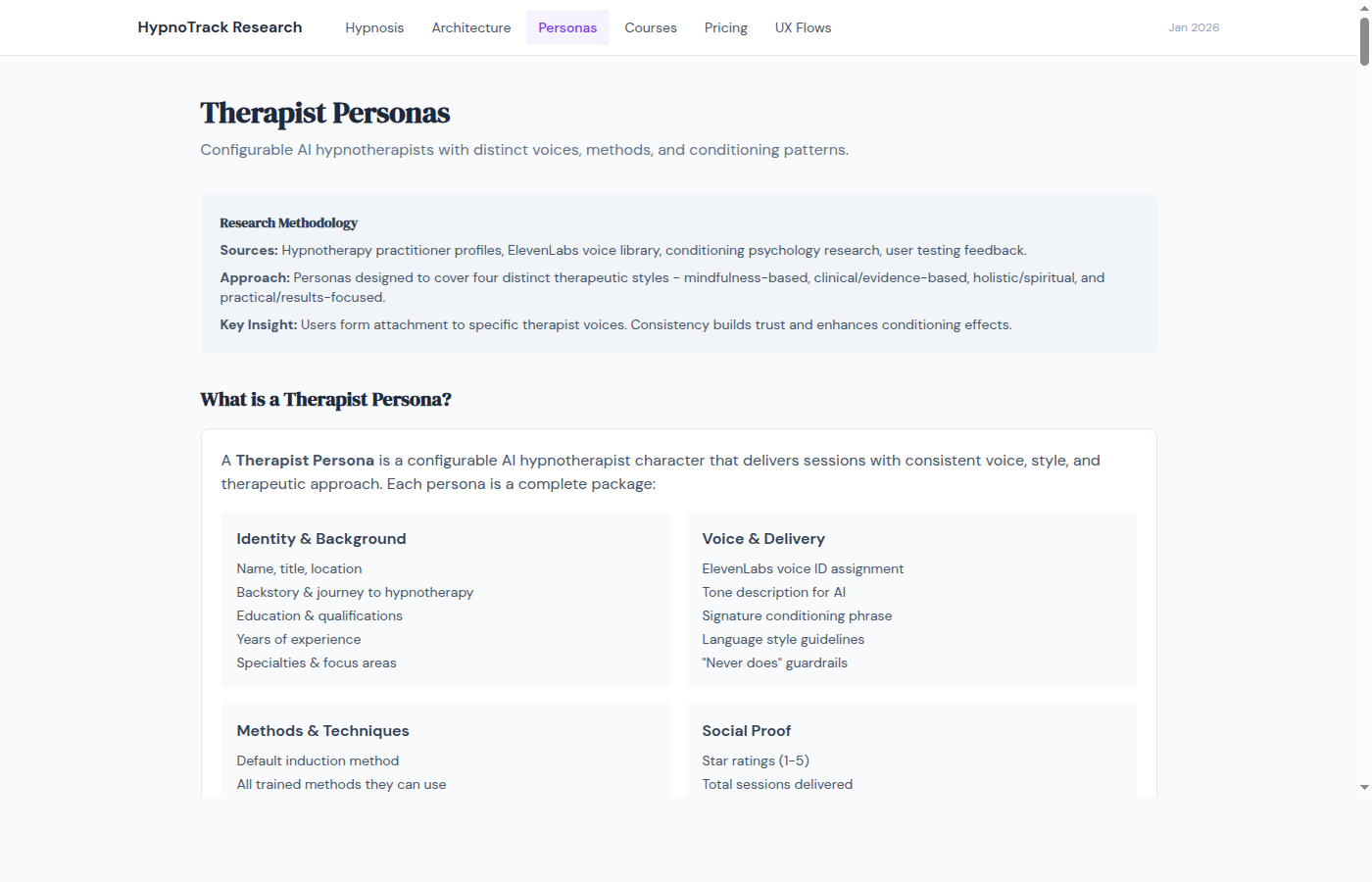
The persona system is more than a UI feature. This research covers how voice selection, pacing, and language style affect hypnotic suggestibility. Each persona was designed with distinct induction methods, cadence patterns (tempo, pause style, breath cues), core therapeutic qualities, and areas of specialization.
The document includes guidelines for character consistency — signature phrases, language to avoid, and how each persona's approach maps to different user needs.
Adaptive Feedback
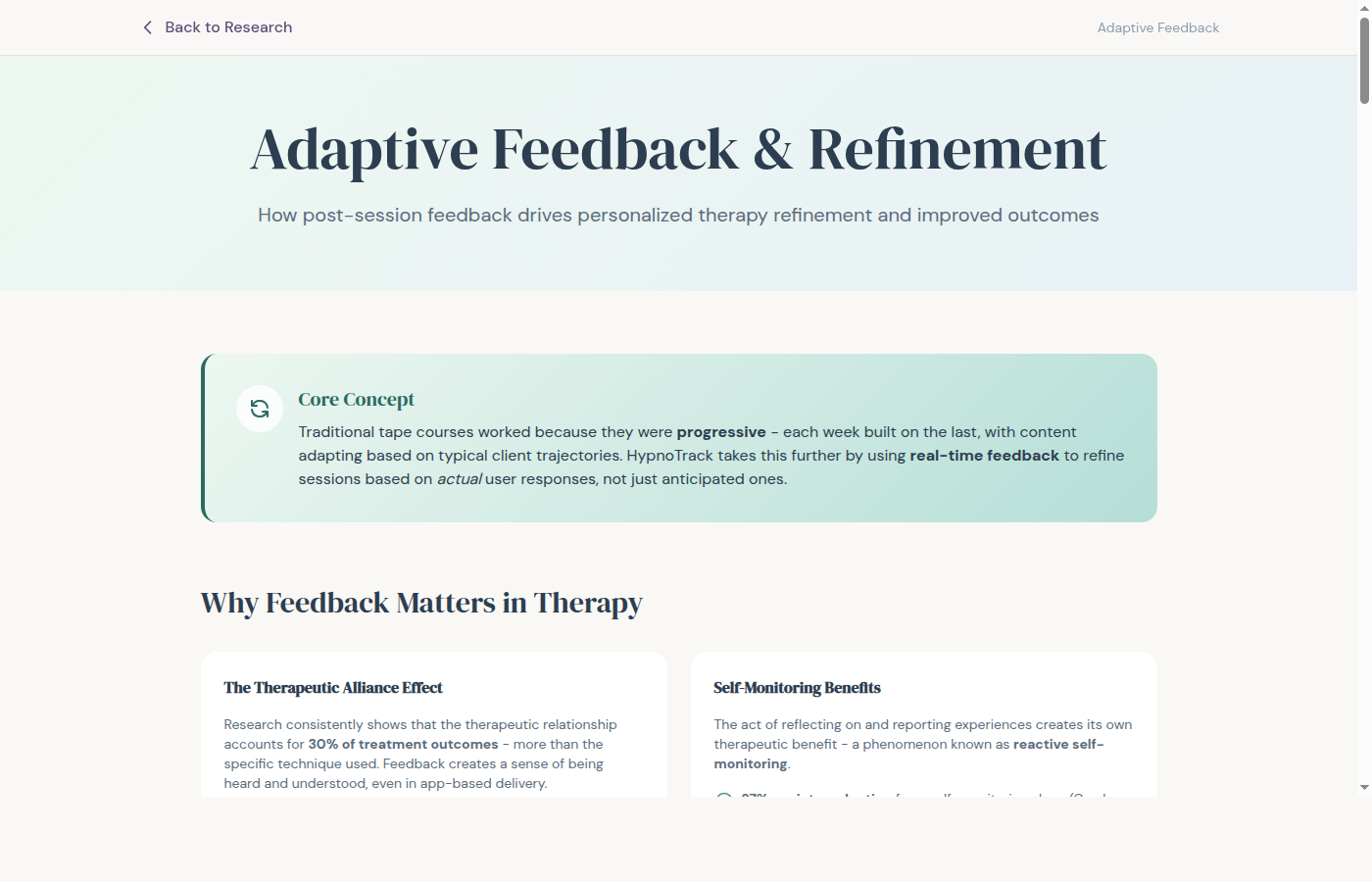
The feature that separates HypnoTrack from a static audio library. After each session, users rate what worked and what didn't. The AI refines subsequent sessions based on this feedback — adjusting pacing, depth, metaphor style, and suggestion intensity.
This research covers the feedback loop design, how ratings translate to script adjustments, and the balance between adaptation and clinical consistency.
Product & Business
Architecture
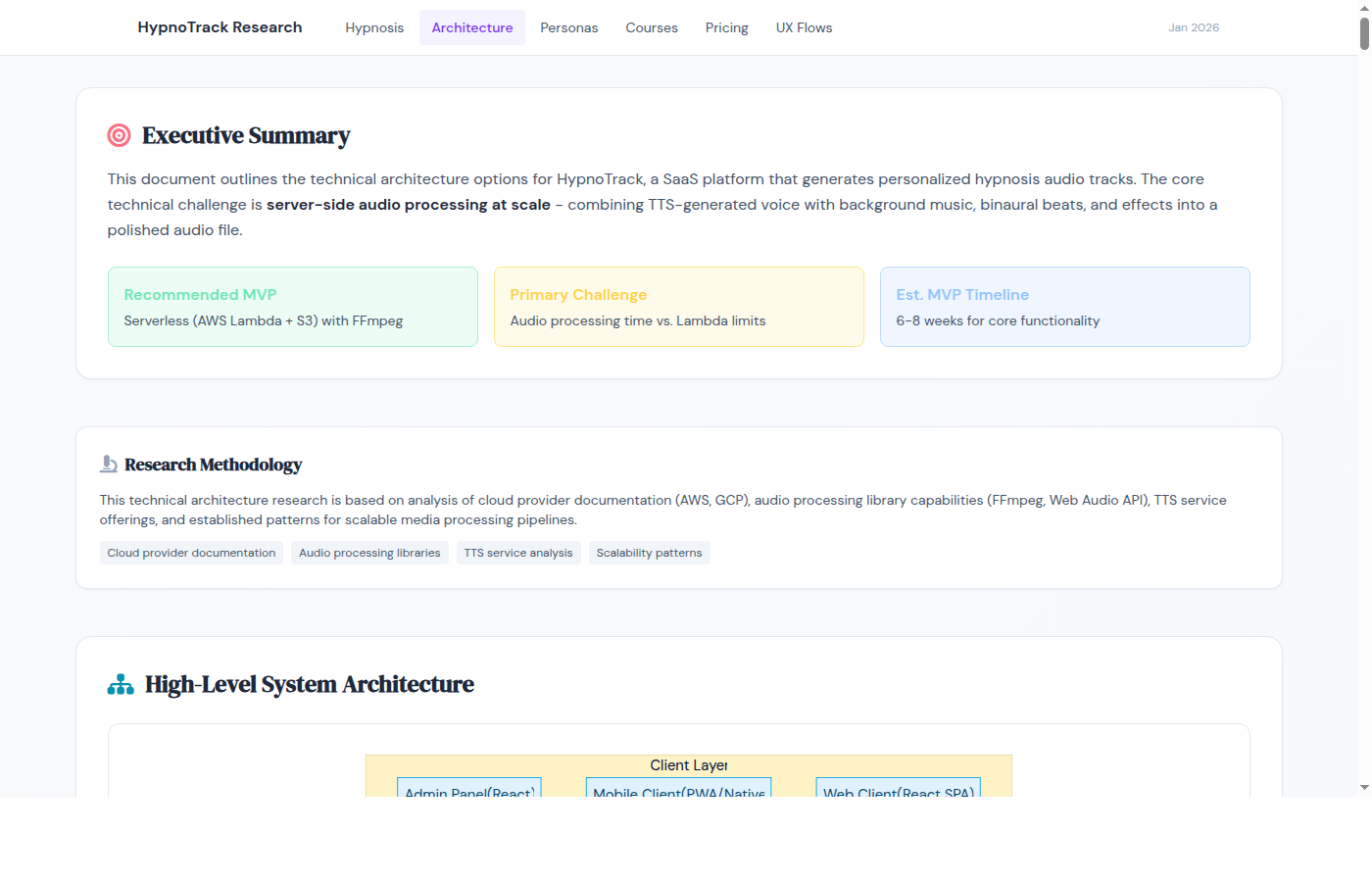
The technical architecture analysis, covering the core challenge: server-side audio processing at scale. How do you combine TTS-generated voice with background music, binaural beats, and silence injection into a polished audio file — and do it affordably?
The document evaluates serverless (AWS Lambda + S3) vs. traditional server approaches, estimates processing times, and maps out the full pipeline from script generation through to final audio delivery.
Pricing & Monetization
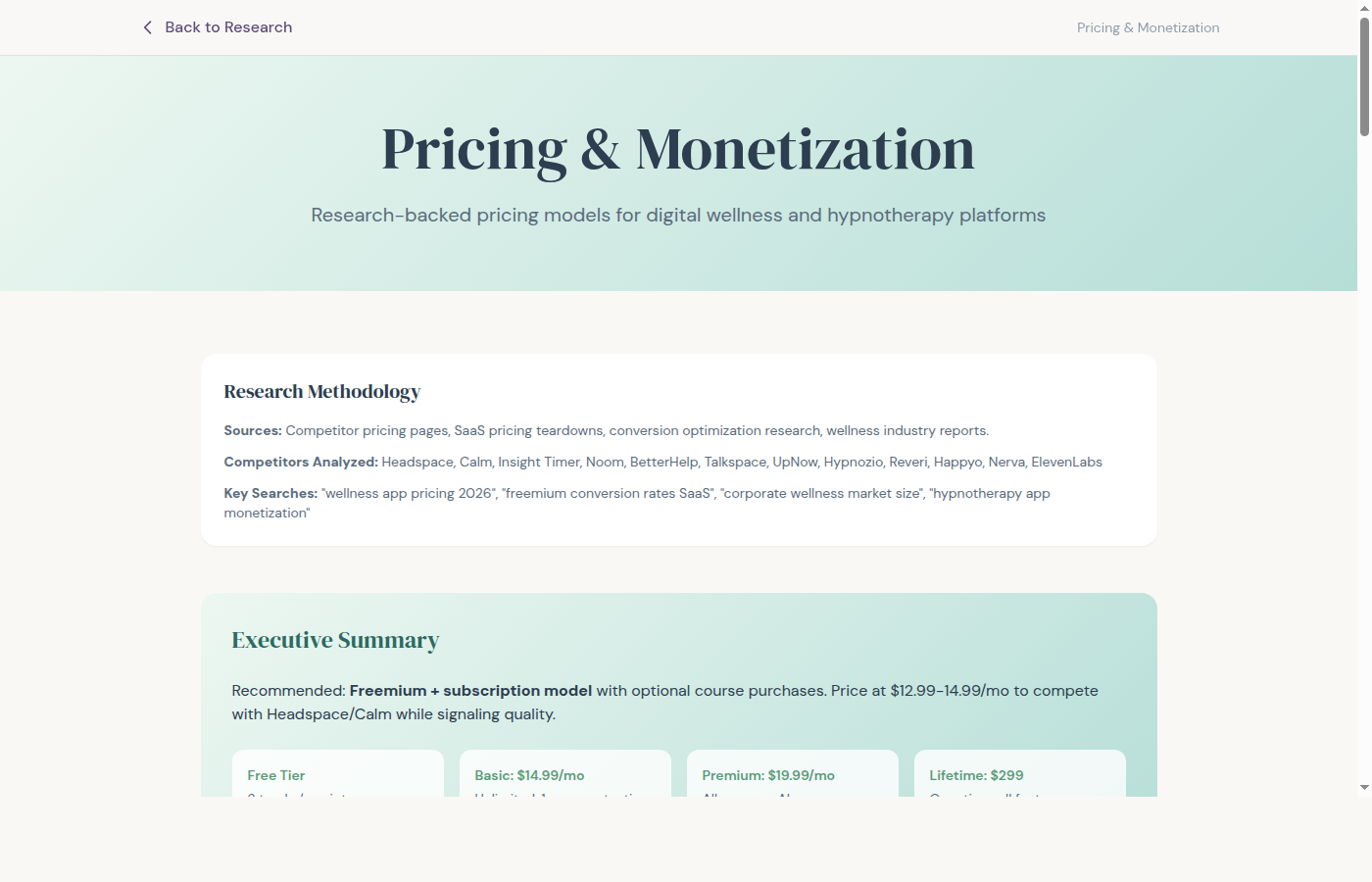
A thorough teardown of competitor pricing (Headspace, Calm, BetterHelp, Talkspace, Noom, and others) leading to the recommended model: freemium + subscription at $12.99-14.99/month. The analysis covers conversion rate benchmarks, the psychology of free tiers, course-based upsells, and lifetime deal strategies.
The key insight: price high enough to signal quality (this isn't a meditation timer) but below the therapy threshold that triggers "I should just see a real therapist" thinking.
Case Studies
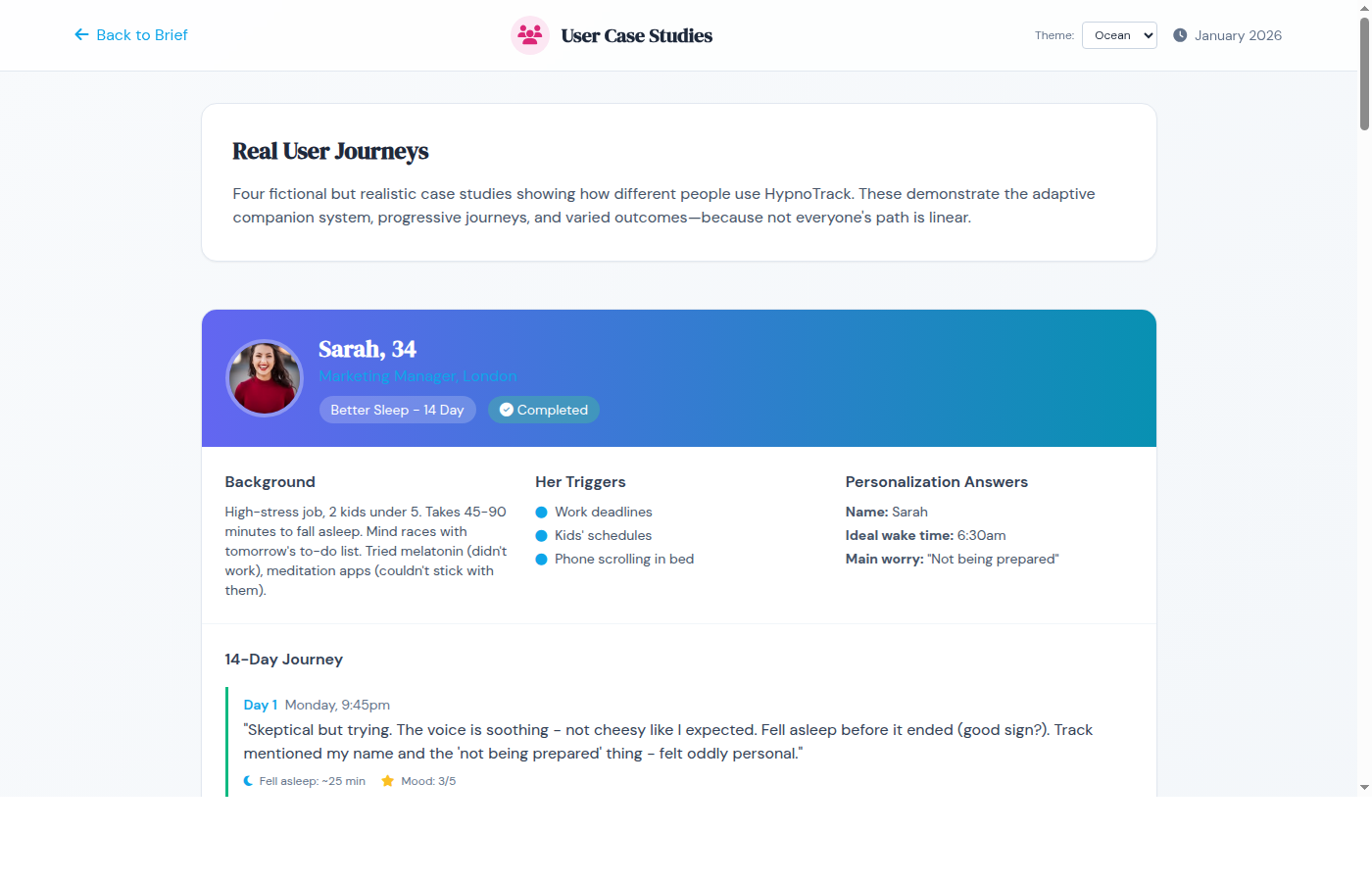
Four fictional but realistic user journeys showing how different people use HypnoTrack over a 14-day program. Sarah (34, sleep issues, stressed parent), Marcus (52, quit smoking), and others. Each case study tracks day-by-day progress with mood scores, session feedback, and the adaptive system's responses.
These aren't marketing personas — they're product design tools showing how the adaptive feedback loop plays out over time.
Onboarding Flow
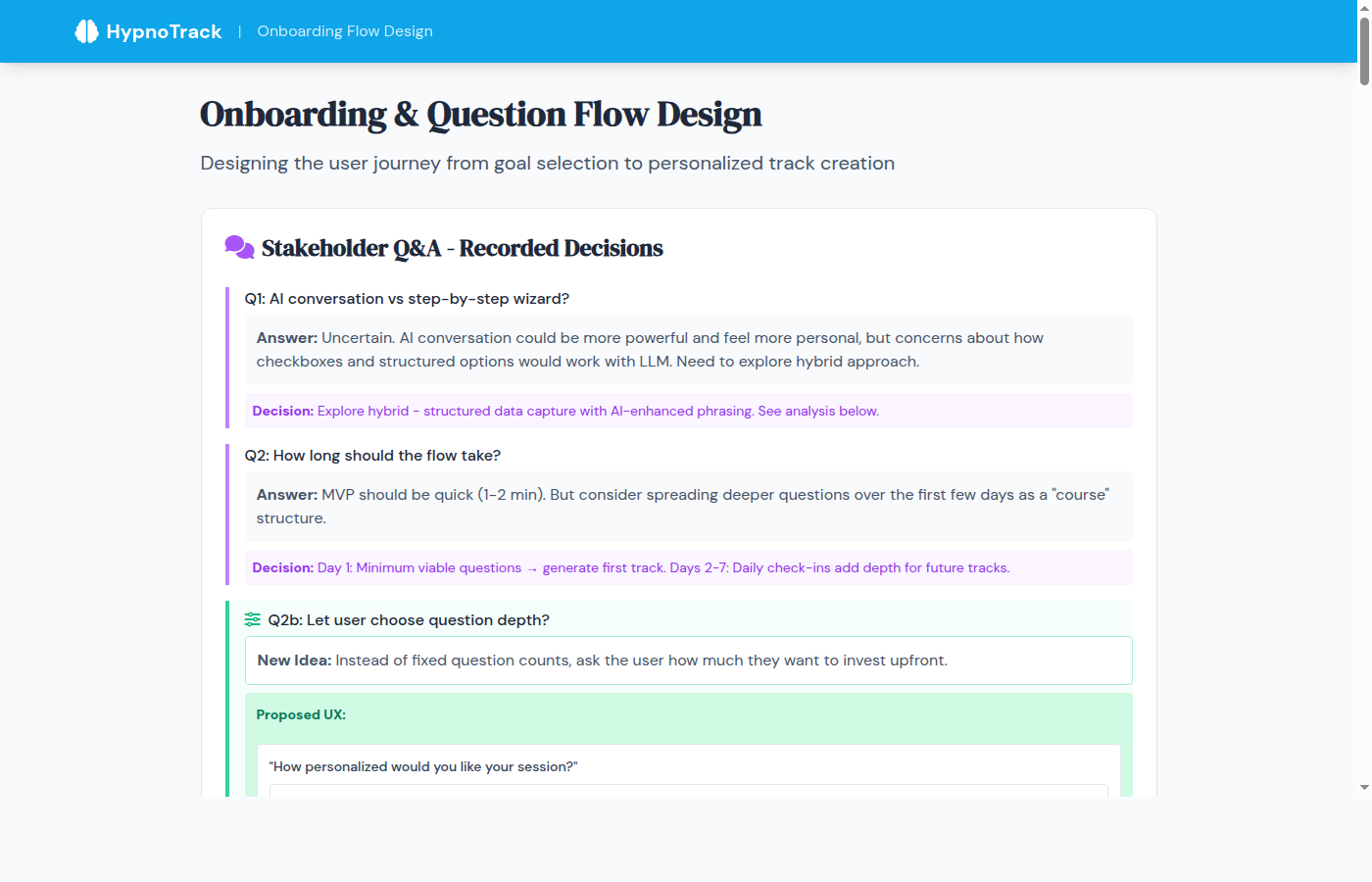
Research into how mental health and wellness apps handle first-time users. Analyzed BetterHelp, Talkspace, Headspace, Calm, Aura, Reveri, and others. The key finding: lead with the issue ("What would you like to change?") rather than the practitioner, but offer both paths.
The document maps three onboarding paradigms — Issue-First, Therapist-First, and Hybrid — and explains why HypnoTrack uses Goal-First with optional therapist browsing.
Course Design
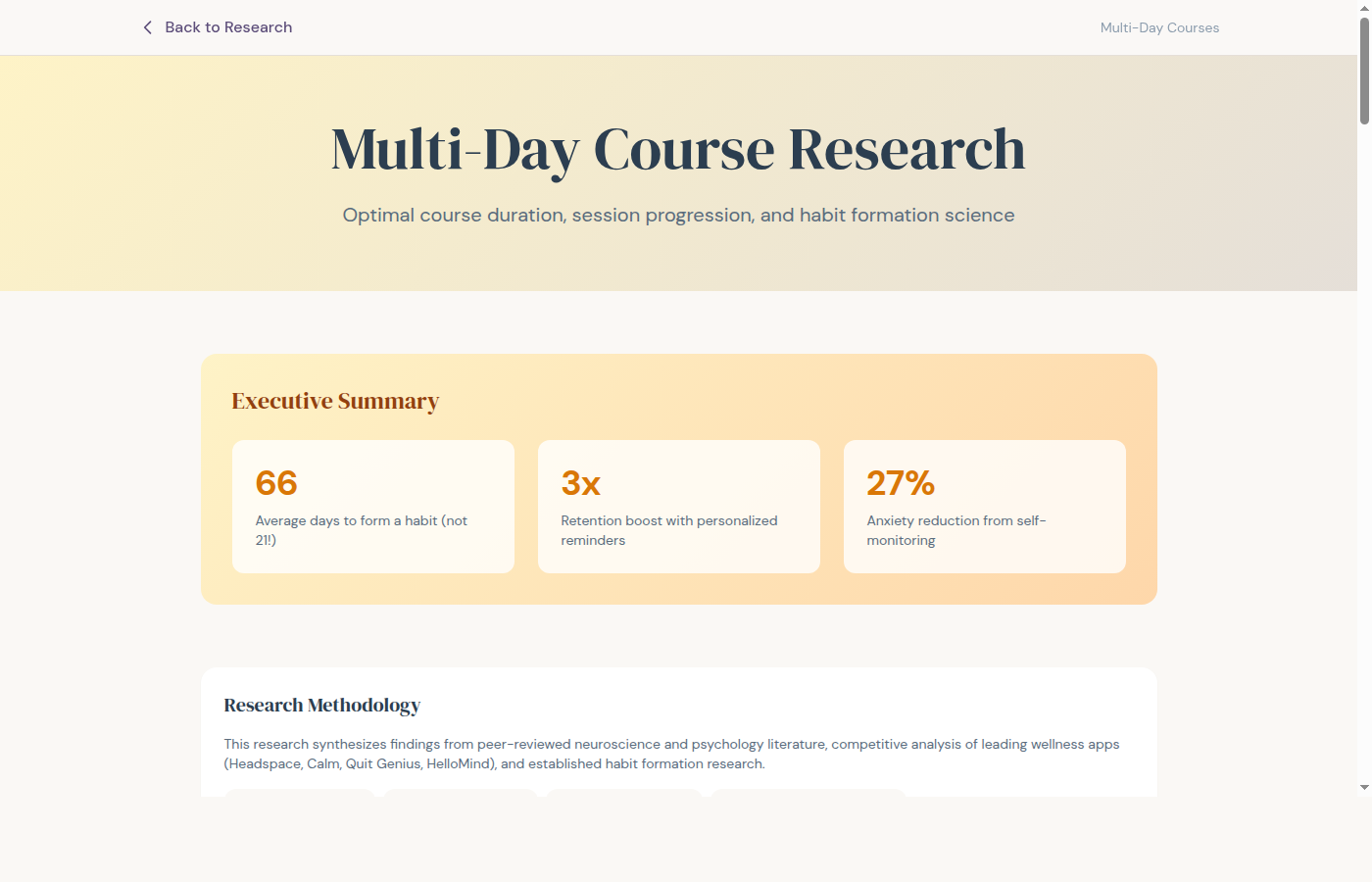
How to structure multi-week therapeutic programs. Covers session sequencing (foundation weeks, core work, identity shift, maintenance), progressive difficulty curves, and how daily check-ins feed into adaptive content. The practical output was the 14-day program structure planned for Phase 2.
Decision Log
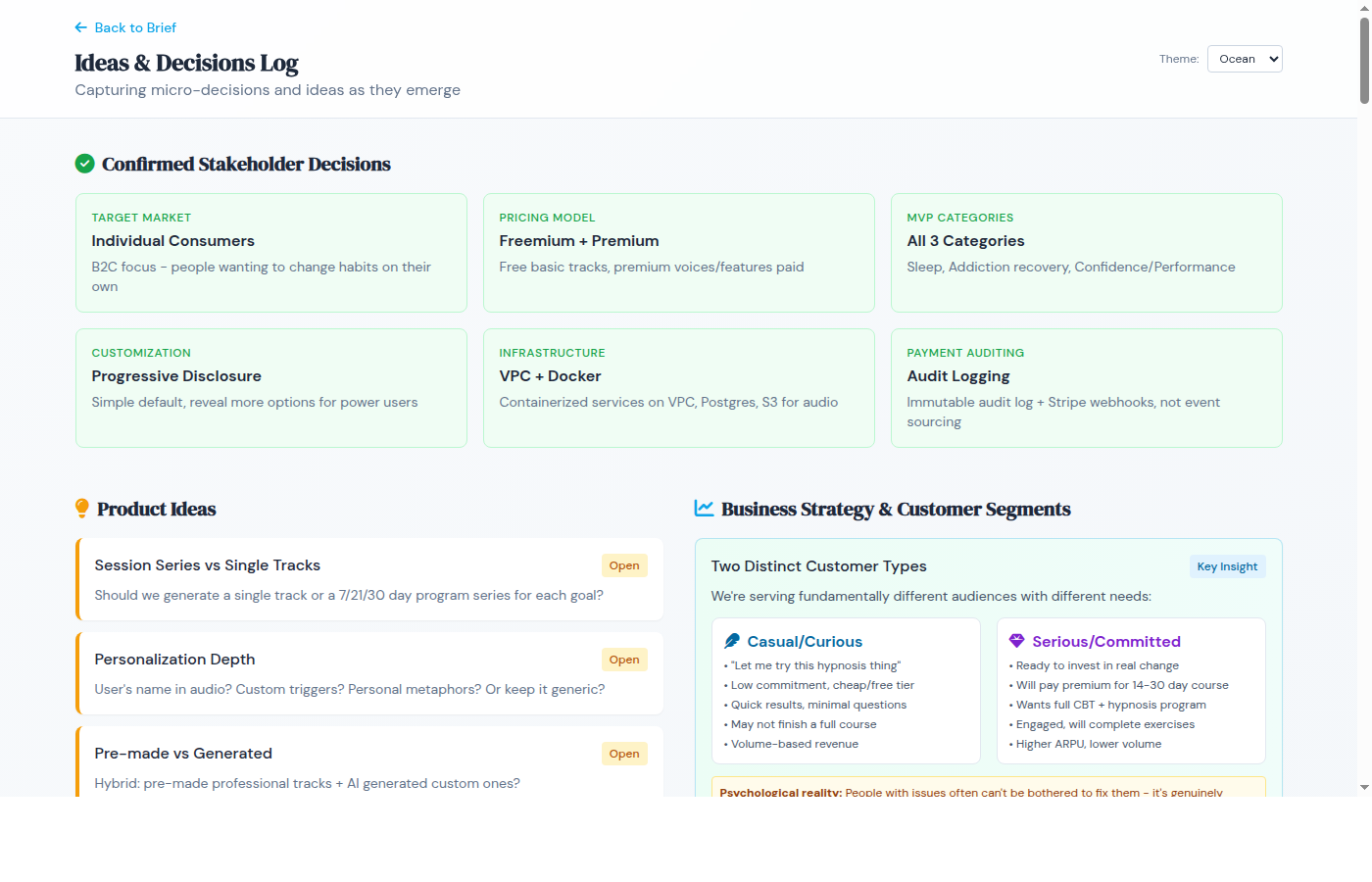
A running record of every significant product decision — what was chosen, what was rejected, and why. TTS provider selection, AI model choice, MVP scope, mobile strategy, target user definition. Useful for understanding the reasoning behind the current state of things.
Prioritization
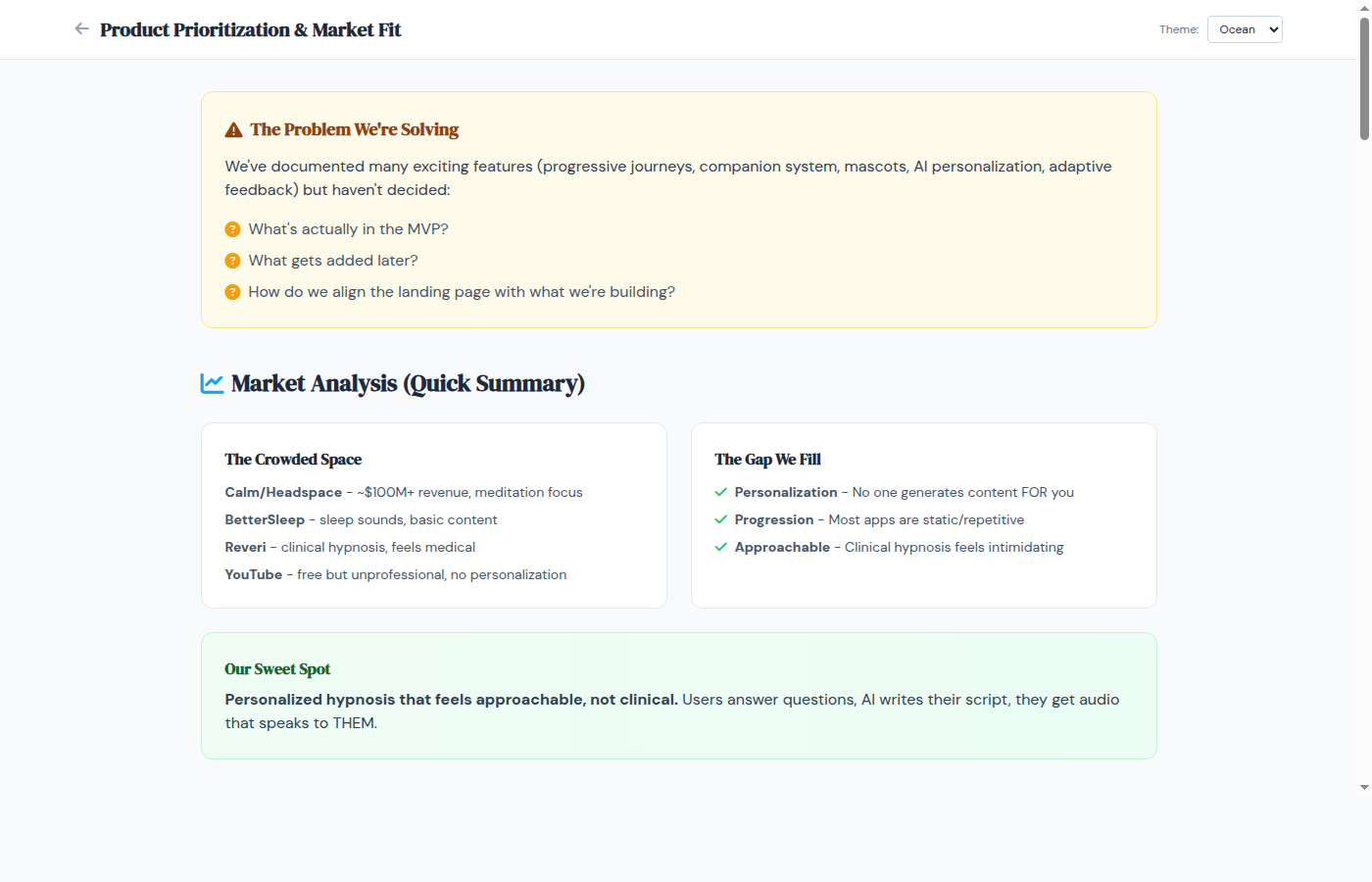
The MVP vs. Phase 2 scoping document. What absolutely has to ship in the weekend MVP (single track generation, goal selection, personalization, audio player) versus what can wait (14-day programs, PWA, push notifications, companion system, progress analytics).
UX & Design
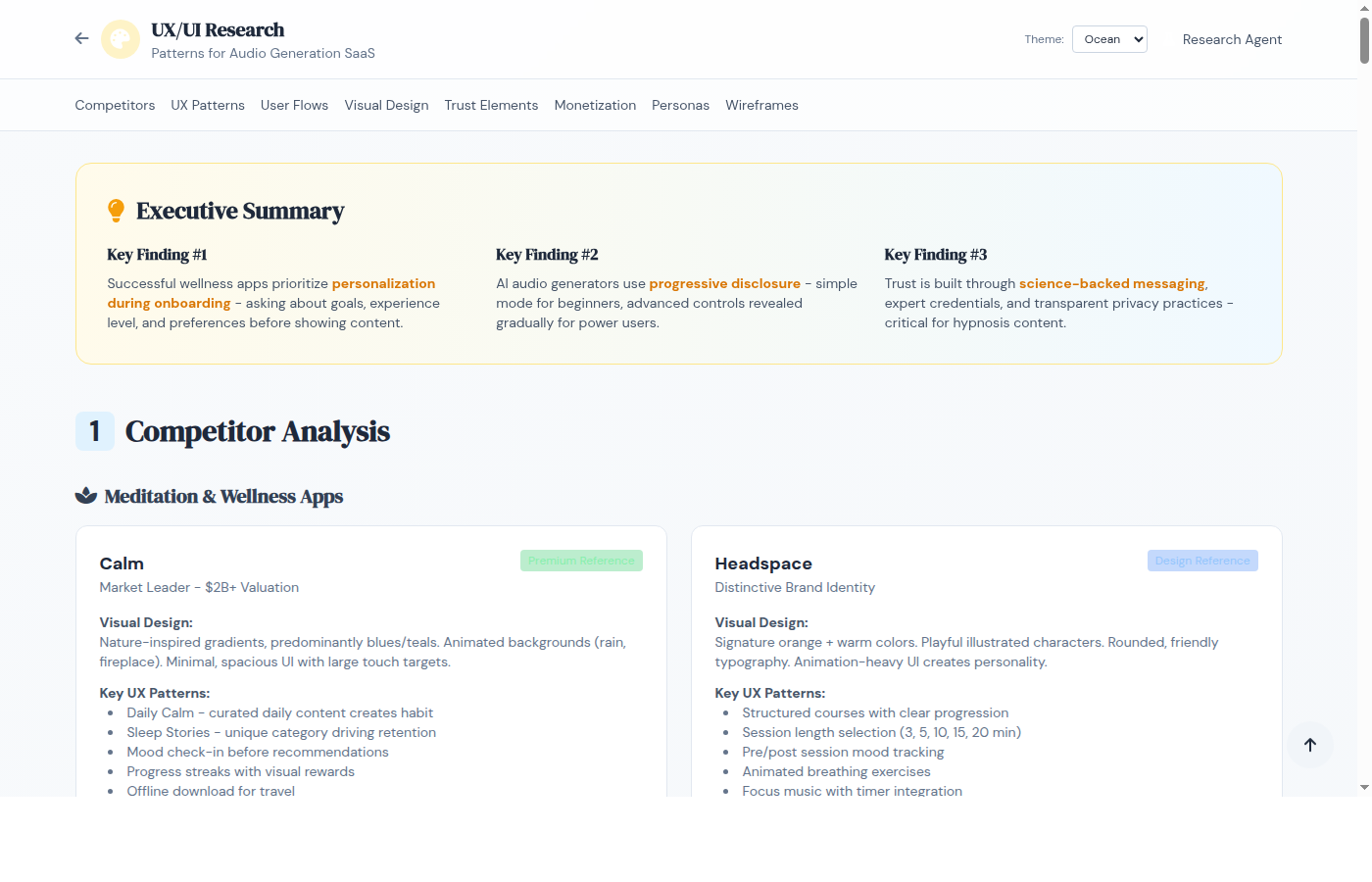
UX Patterns
Interface design decisions for a wellness app targeting non-technical users aged 35-55. Covers visual hierarchy, the importance of soft gradients over hard edges, why certain color palettes promote trust in health contexts, and navigation patterns that reduce cognitive load for anxious users.
UX Flows
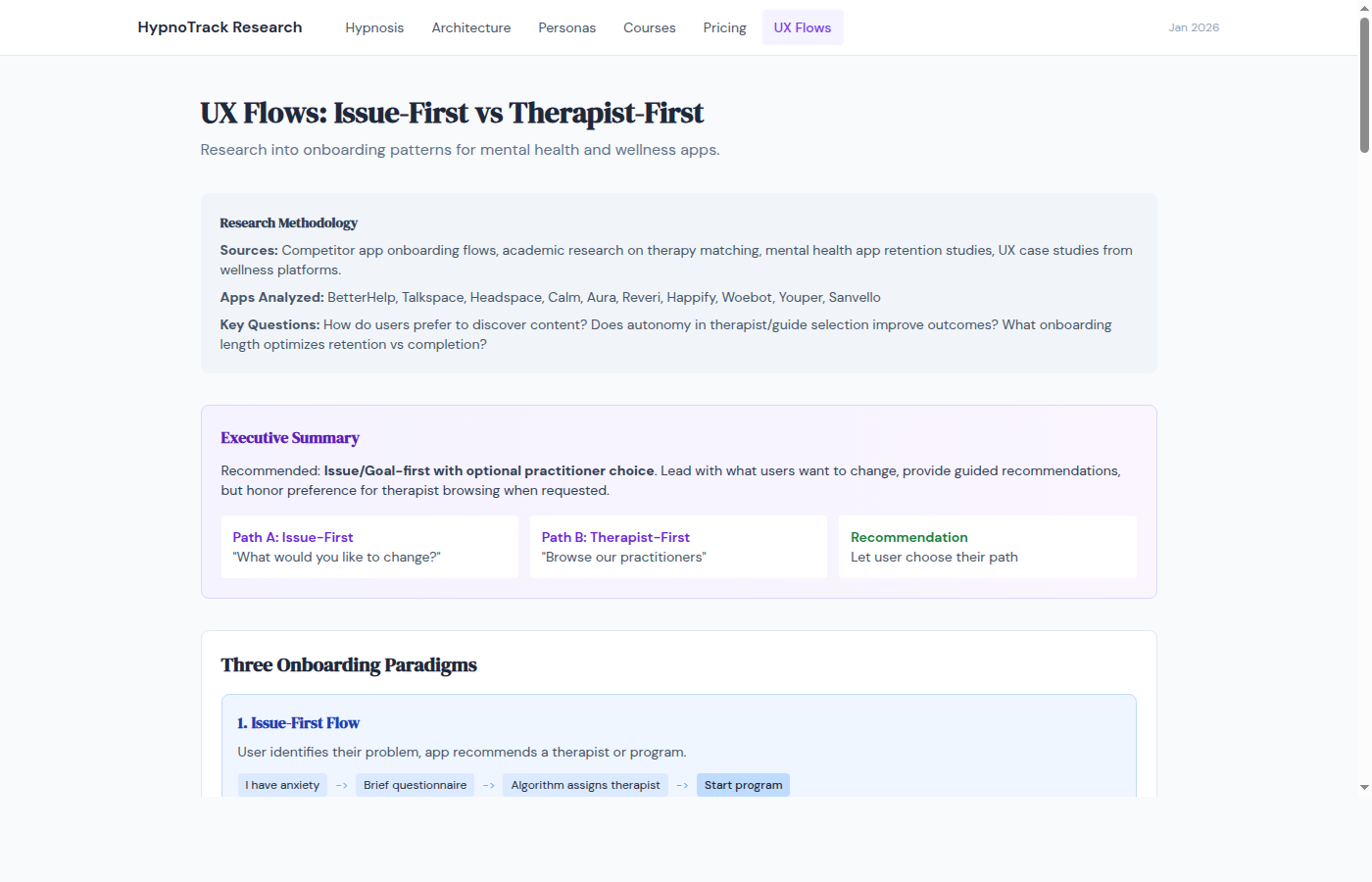
The dual-path user flow research. Should users start by choosing their issue or by choosing their therapist? The document analyzes both paradigms with competitive examples, user psychology research, and flow diagrams for each approach.
Conclusion: let the user choose their path. Some people know exactly what they want to fix; others want to browse practitioners first. Support both.
Content Architecture
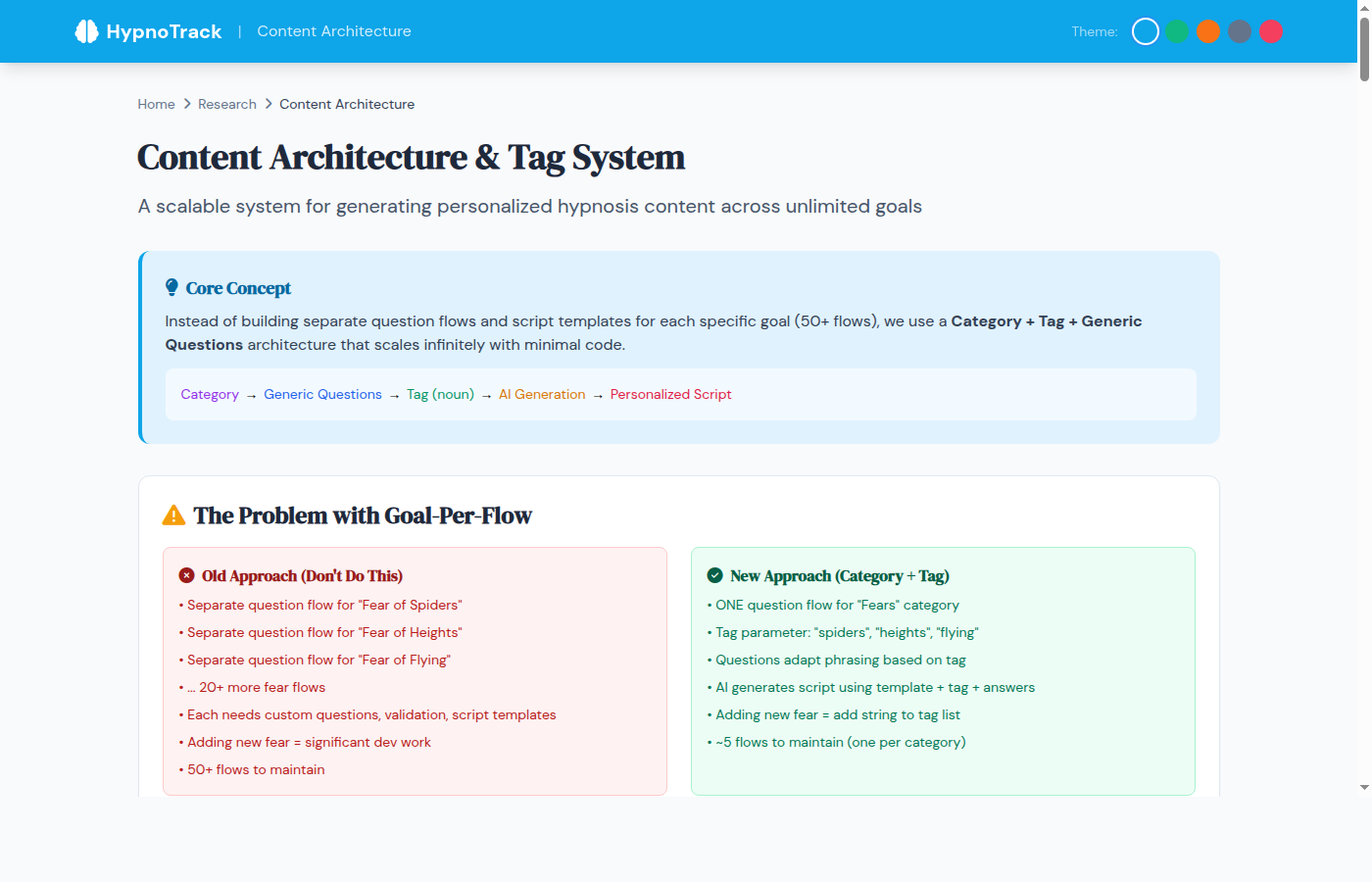
How the app's content is structured internally — categories, tags, questions, scripts, and how they all connect. The taxonomy that makes personalization work: a "Fear of Flying" session needs different induction pacing than "Quit Smoking," different background audio suggestions, different metaphor libraries.
Technical
AI Models
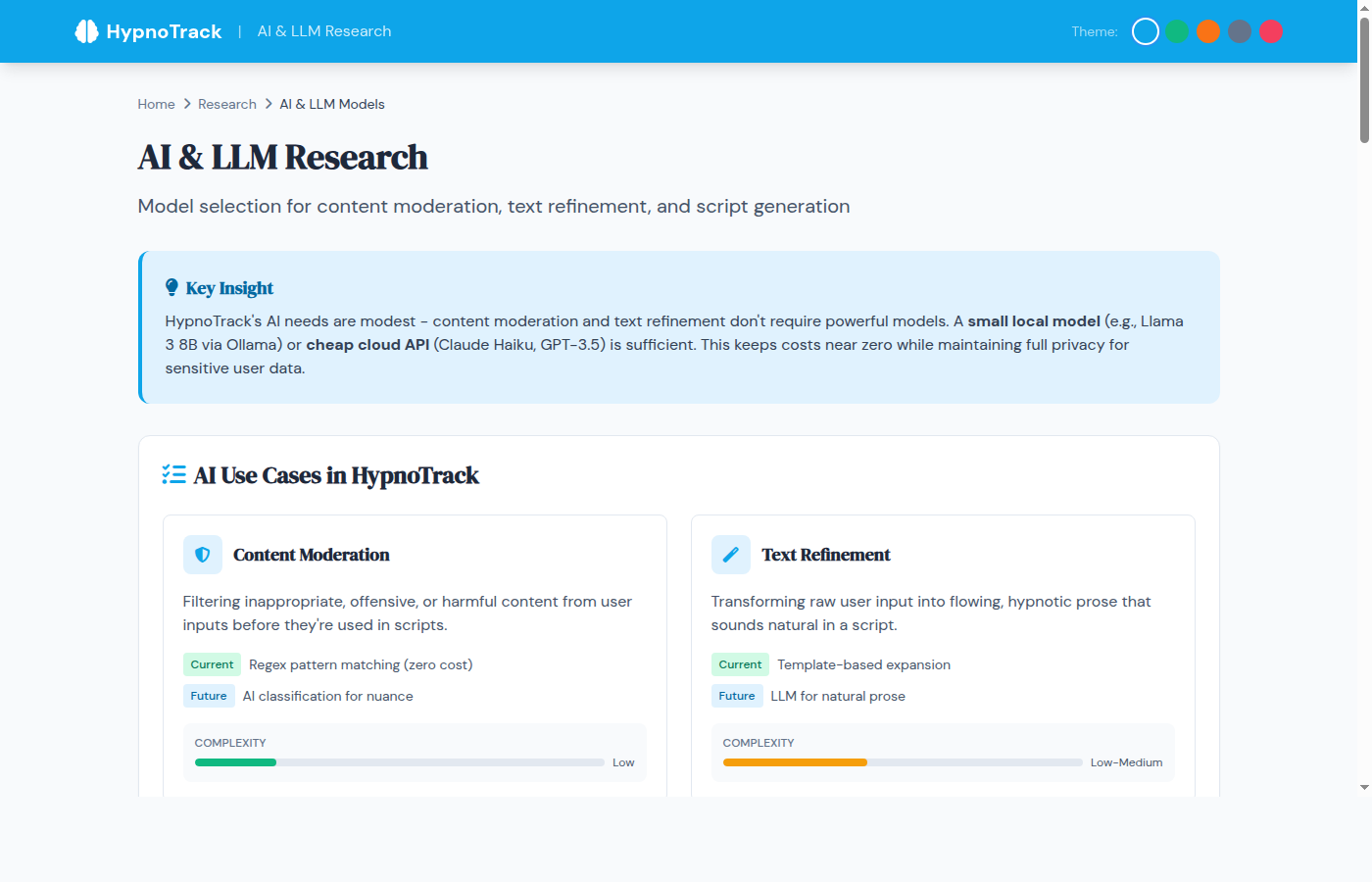
Claude vs. GPT for script generation. Evaluates output quality, cost per generation, consistency across sessions, ability to maintain clinical accuracy, and how each model handles the specific constraints of hypnosis scripts (pacing markers, pause notation, personalization token insertion).
TTS Provider Research
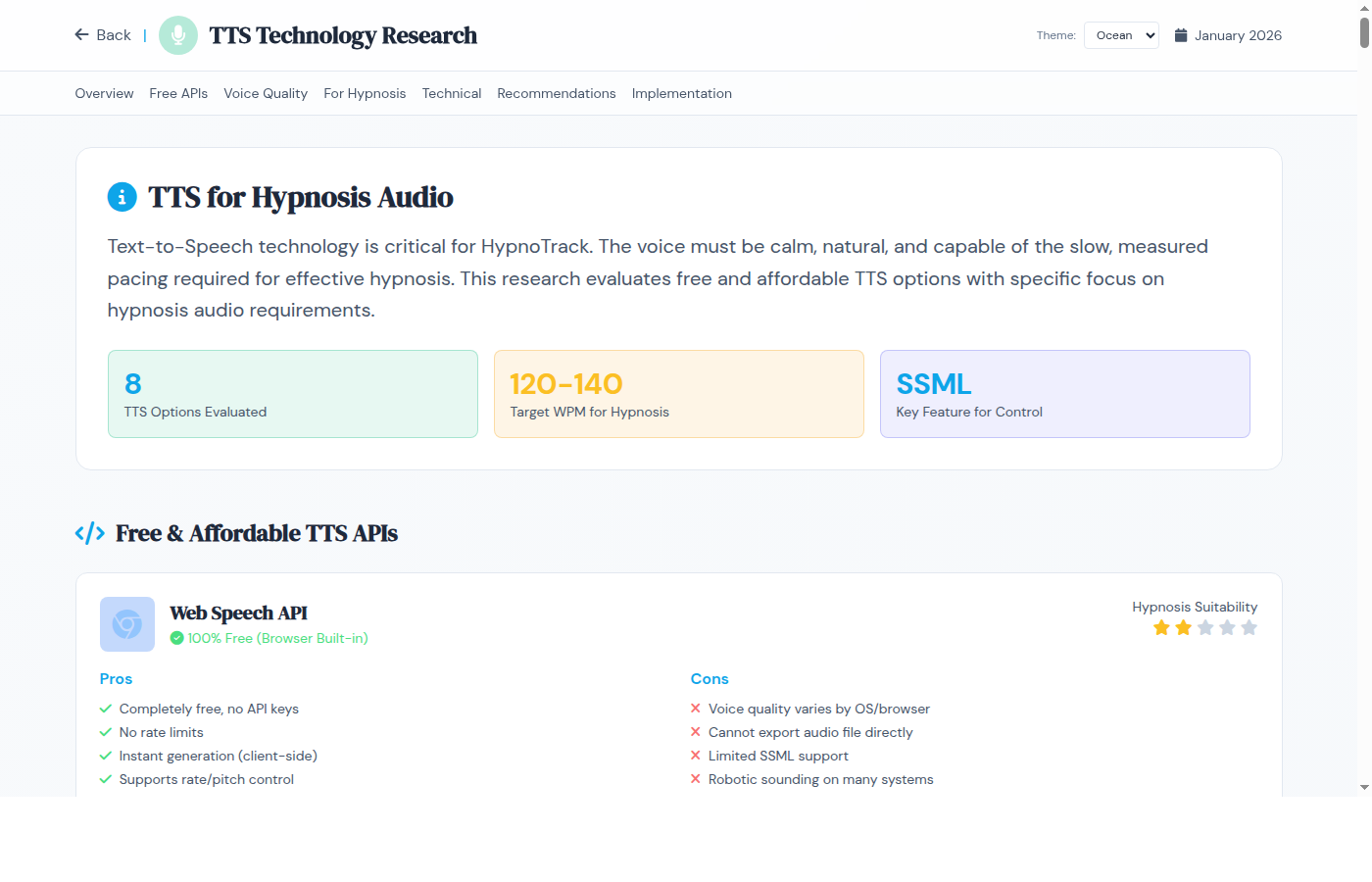
Eight text-to-speech options evaluated specifically for hypnosis suitability. The requirements are unusual: the voice must be calm, natural, and capable of slow measured pacing at 120-140 words per minute. SSML support is critical for controlling pauses and emphasis.
Covers Web Speech API, Google Cloud TTS, Amazon Polly, ElevenLabs, and others, with star ratings for hypnosis suitability. ElevenLabs won on quality; the document explains the cost tradeoffs.
Presentations
Beyond the research documents, four interactive presentations communicate the project to different audiences.
AI Therapy Debate
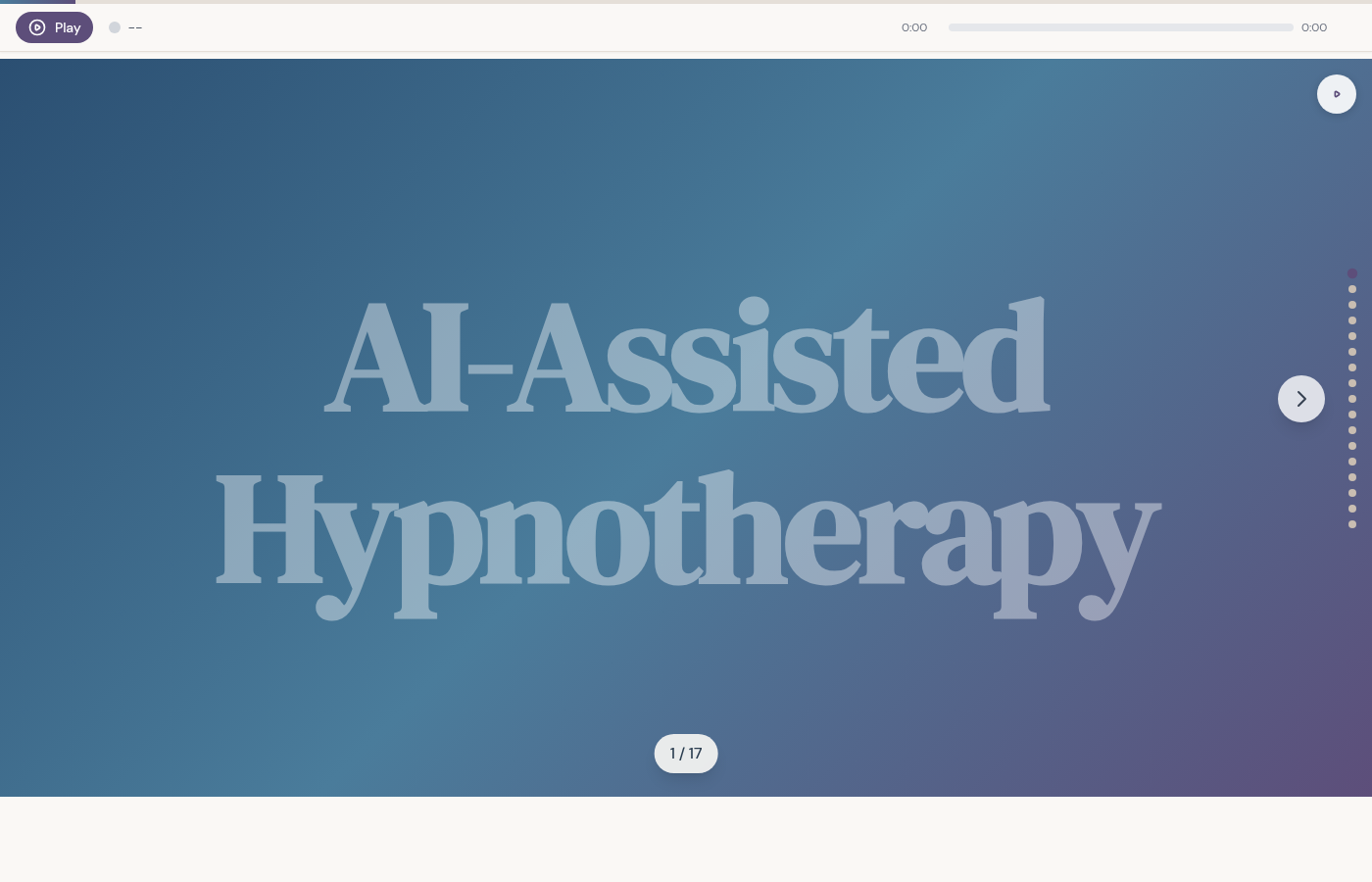
A 17-slide pitch deck with two speakers debating AI's role in mental health. Full audio narration on every slide, synced subtitles, and visual data storytelling. The argument builds from the access gap (77 million Europeans) through the cost barrier to the proposed hybrid model.
Hypnotherapy Guide
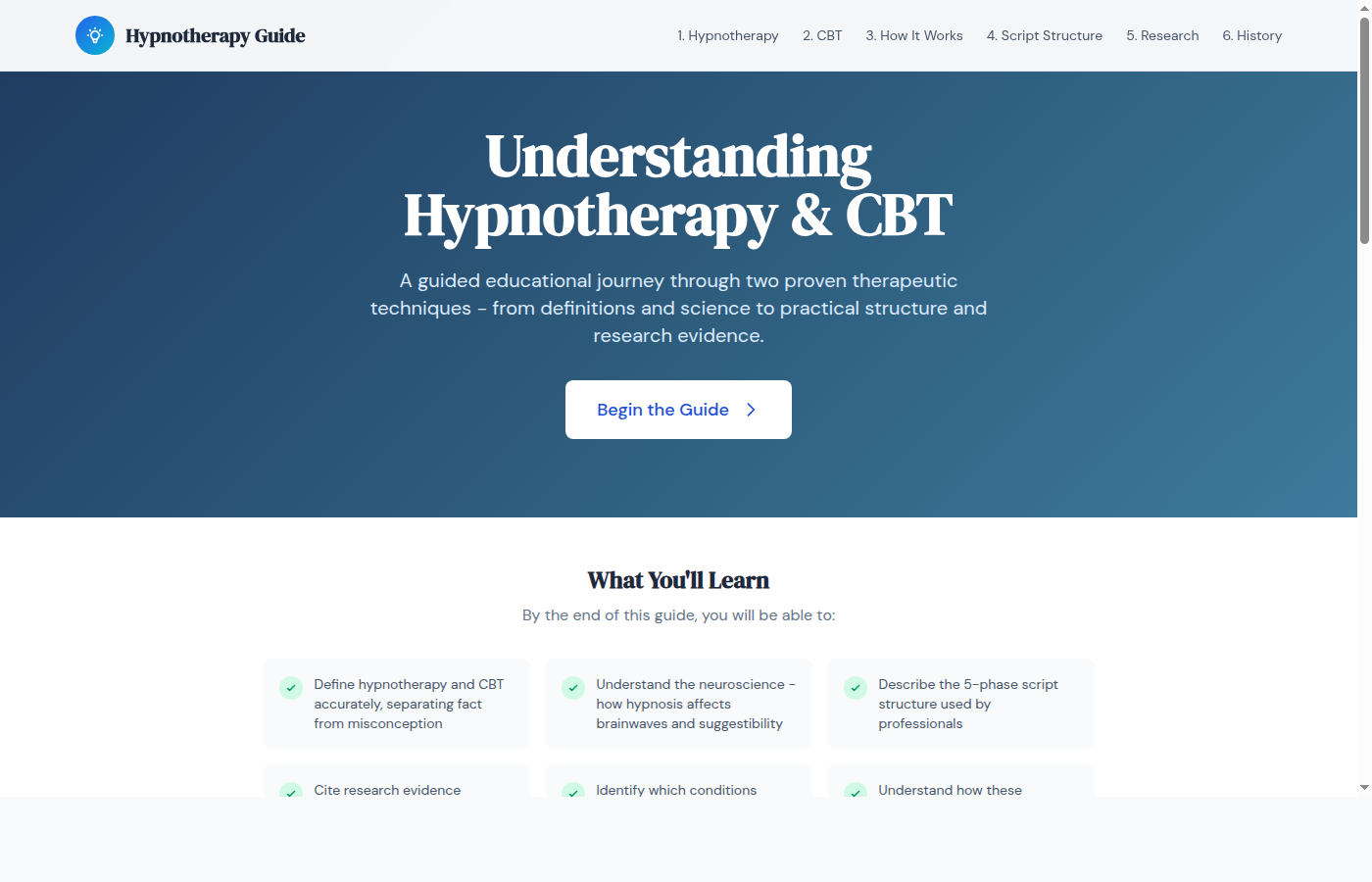
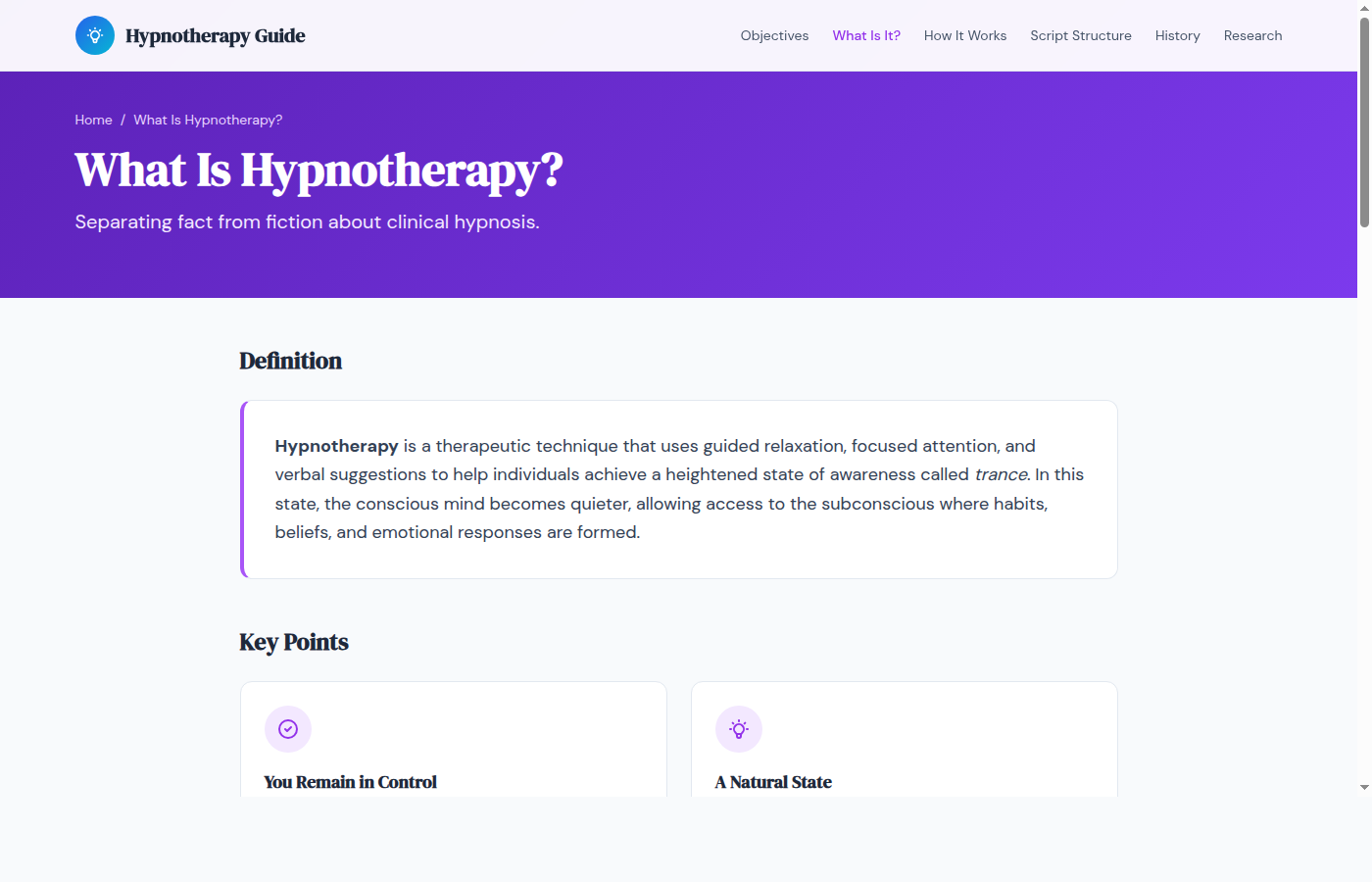
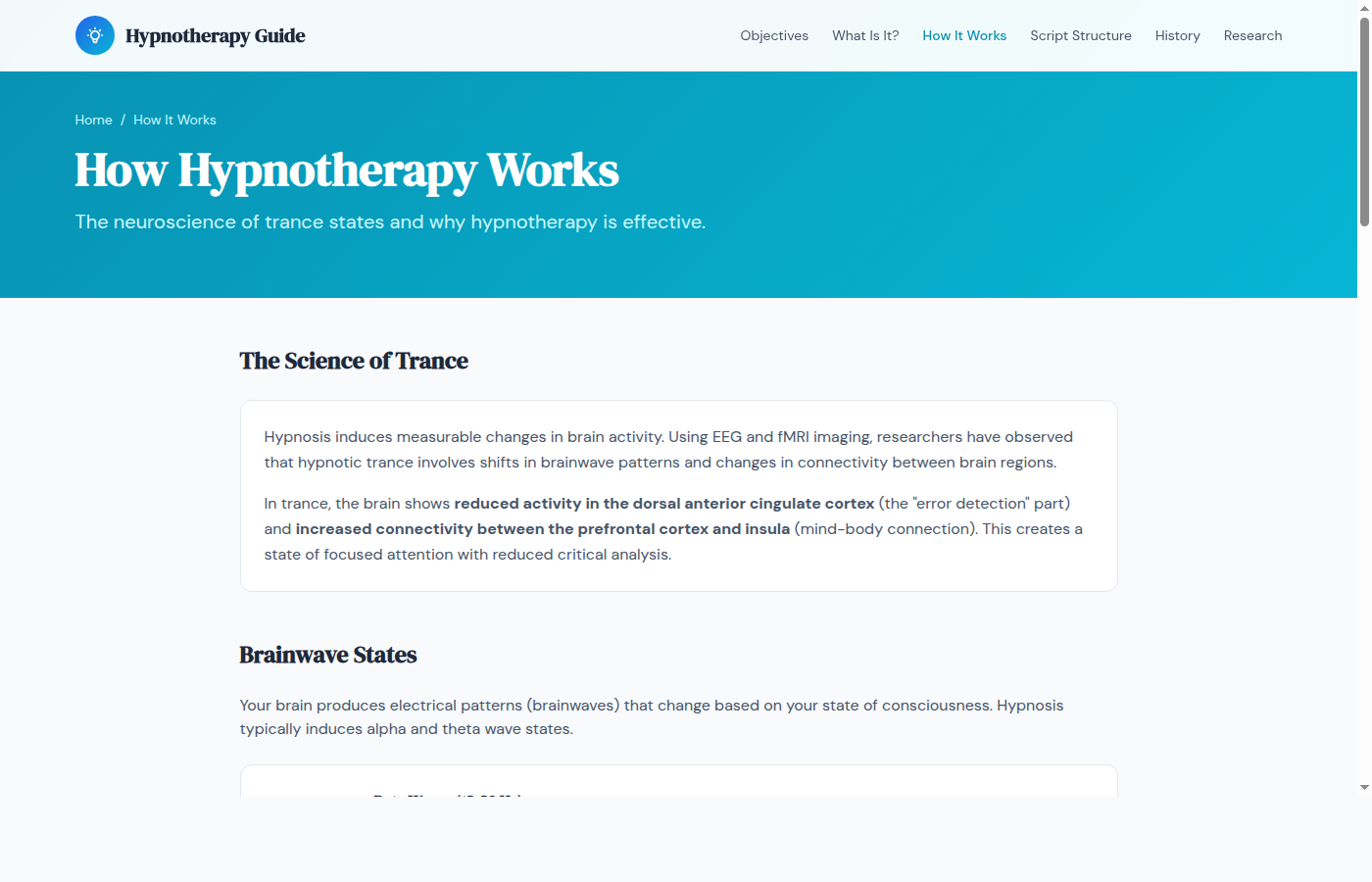
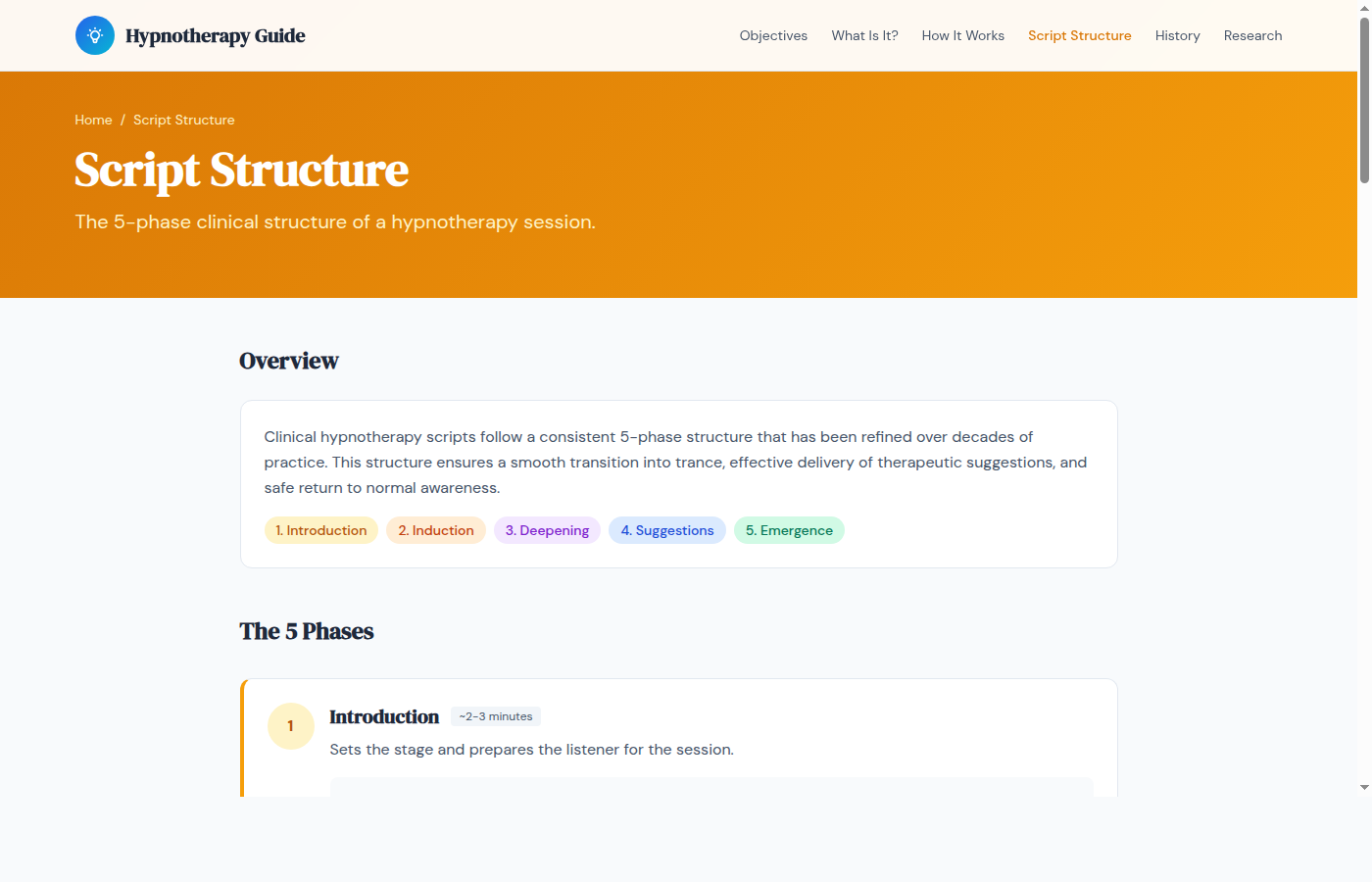
Six interconnected educational pages covering the science. What hypnotherapy actually is (not stage shows), what CBT is, how trance states work in the brain, the five-phase script structure, research evidence, and the history from Mesmer to modern clinical practice.
The guide is designed to be sent to skeptics who ask "does this actually work?" — thorough enough to be convincing, accessible enough to not require a medical background.
App Guide
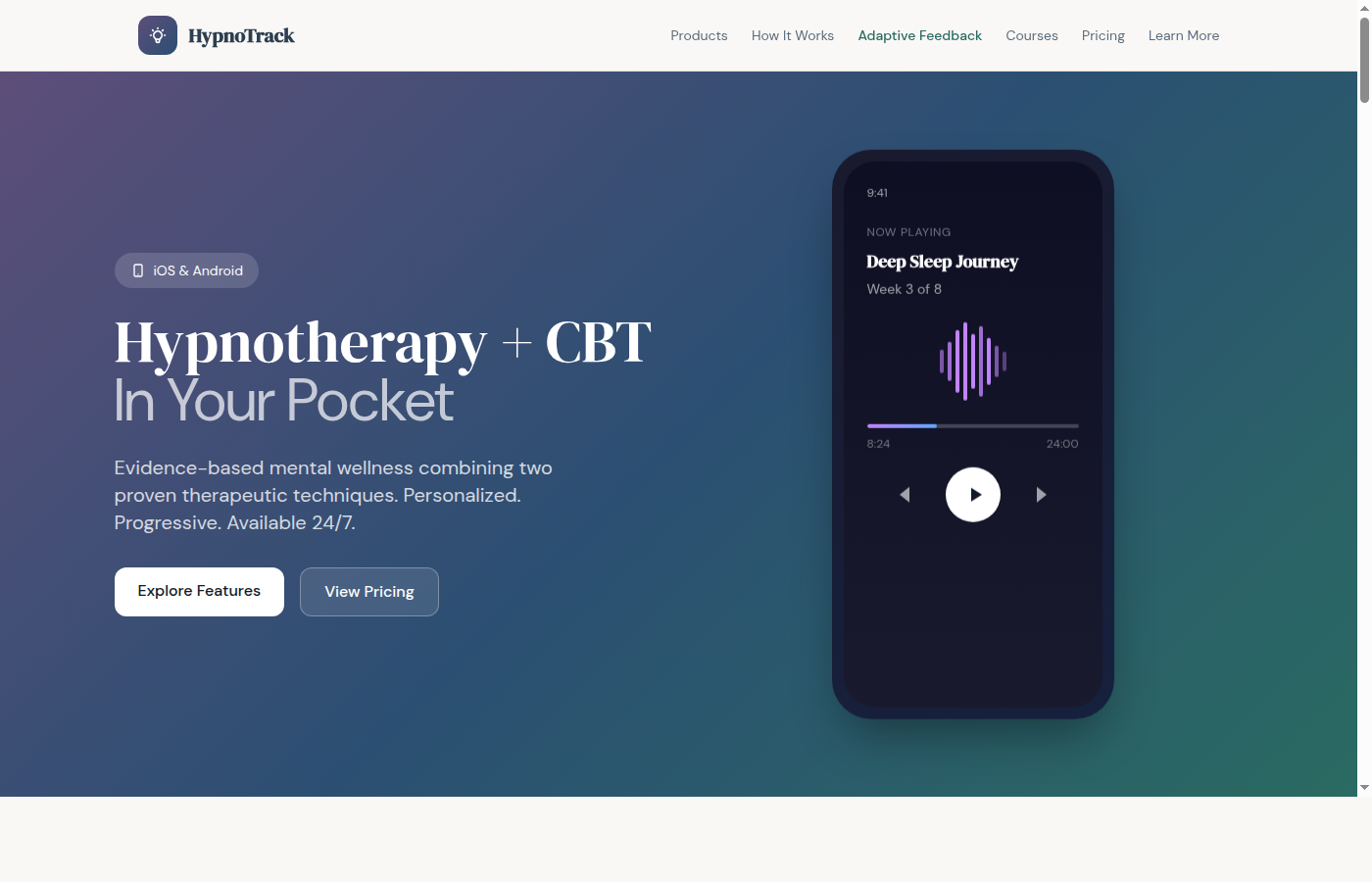
The product marketing page. Features, pricing ($0 free tier / $12/month premium), the adaptive feedback loop, available courses, and a phone mockup showing the session player. Designed to convert interest into signups.
Research Hub
The starting point for all research documents. Organized into Core Research, Product & Business, UX & Design, and Technical sections. Each card links to its full interactive document.