The second build
It is Tuesday morning. The factory has finished overnight.
Six months ago, gy-queue v0.1.2 was a Node + SvelteKit product running on a single VPS, deployed by a fragile script, debugged by a person staring at a stuck Loading… screen at midnight. The blueprint at that point was thin. A paragraph of brief, a half-dozen Playwright specs, a contract test for two routes.
Then the bugs came in. Each one carried a deliverable clause; each clause landed in spec.json; each rebuild emitted the corresponding test. Six months later, the blueprint carries 312 clauses across uiPages, apiContracts, authFlow, jobLifecycle, tenantBoundary, observability. The Playwright suite is 480 specs strong. The contract suite covers every route with a Zod schema. There are 41 lifecycle assertions over the Job entity, 17 multi-tenant boundary tests, and 9 cross-system flows.
This morning the factory has built it again.
Same brief. Same blueprint. Different stack: Go backend, HTMX frontend, Postgres unchanged. The AI agent burned its way through spec.json, emitted the test stack first (RED), then implemented until every test was green. CI ran. Deploy fired. The new gy-queue is live at https://gy-queue.gyrum.ai.
The operator opens it. Logs in. Submits a job. Watches it run. The dashboard shows status counters within ten seconds. There are no stuck loaders, no path mismatches, no silent build-tool strips of an onMount block. None of these are possible, because each was a clause in spec.json and each clause emitted a test that the new build had to pass before deploy.
Same product. Different codebase. Same operator-facing behaviour, asserted by the same tests.
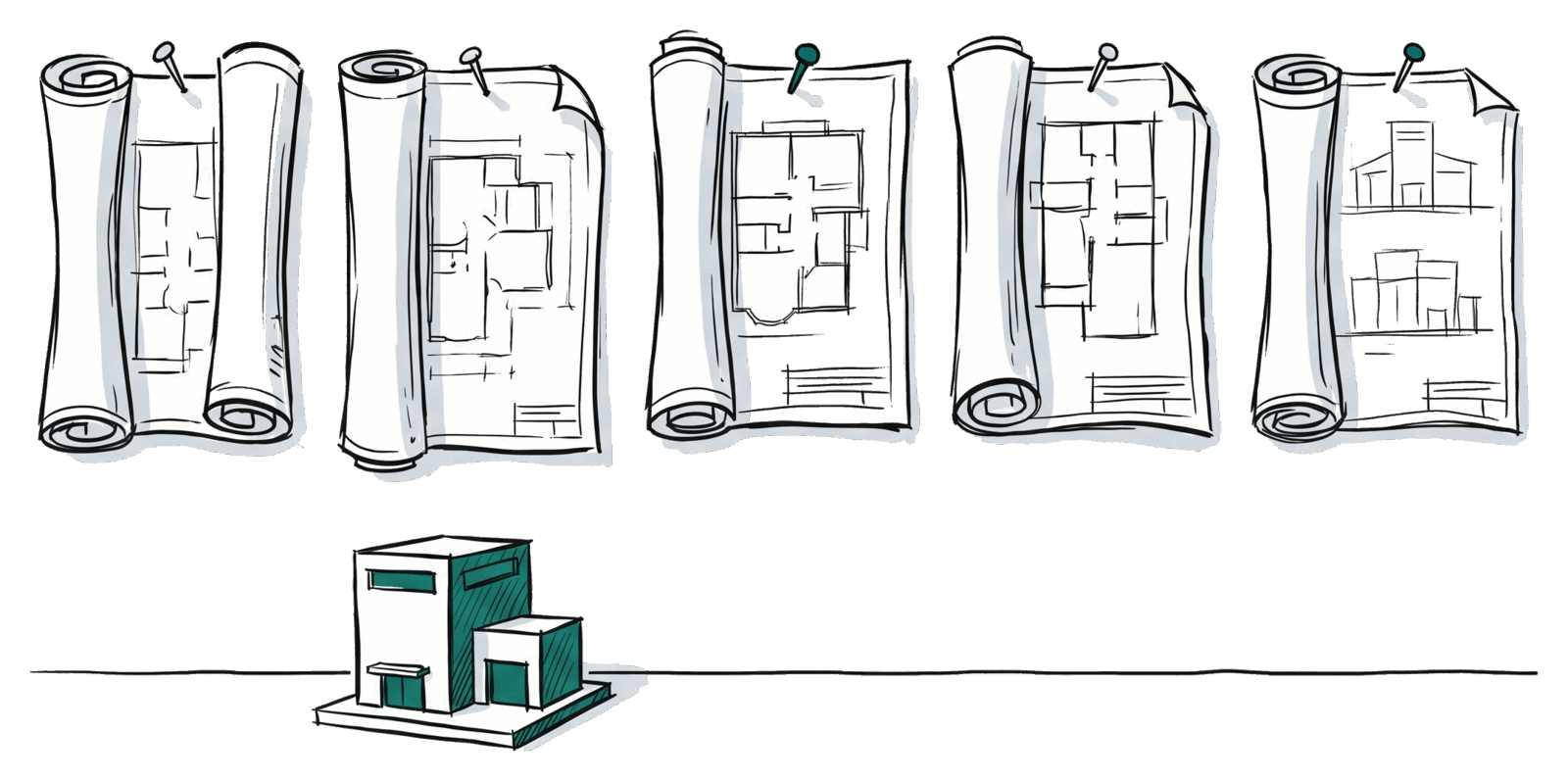
This is the world Architect culture is for. The codebase is interchangeable. The blueprint persists. The factory is the means.
Walk one clause through the gap to see what "the blueprint persists" actually buys. Six months earlier, a user hit the silent bug the Prologue opened on: a job submitted on the Svelte frontend showed "Loading..." for minutes, not because the job was running but because the client-side onMount handler had been stripped during the build. The operator filed the bug as a clause: given a job is claimed, when the frontend route loads, the dashboard displays the job's status within ten seconds and never shows a stuck loader. The test was a Playwright journey: submit, wait for the claim, navigate to the dashboard, assert the status appears inside ten seconds. The Svelte codebase got its fix and the clause landed in spec.json. Over the next six months operations added more assertions against the same clause: the status must be live, refreshing while the job runs; the page must not block on fetching the full history; a status update must not re-render the whole route. The Svelte implementation held all of that in hand-tuned onMount hooks, ordered Promise chaining, and a specific sequence of client-side cache invalidation.
The factory did not copy any of those details. It read the clauses. When the blueprint was regenerated onto a Go backend, the dashboard shipped as an HTMX form that polls a status endpoint every few hundred milliseconds and patches a fragment into the DOM. No JavaScript framework, no onMount, no build step that could strip it. The Playwright journey passes unchanged. From the operator's chair the behaviour is identical; the way it is achieved is unrecognisable. That is the gap doing its work: the operator wrote the boundary condition in three lines of brief, the test team turned it into a journey and a contract, the clause captured it, and the regenerator had to satisfy it in whatever stack the blueprint chose. Everything below the clause was the factory's problem, and the factory solved it twice, differently, against the one assertion that stayed fixed.
"The hardest single part of building a software system is deciding precisely what to build." Fred Brooks, No Silver Bullet, 1986 "The codebase is rented. The blueprint is owned. The blueprint is precisely what to build." this paper
Right now, your codebase is what your team can ship today. In five years, the codebase your competitor ships will be what their AI authored against their blueprint last week. This chapter is about what survives the gap.
5.1 What the blueprint is
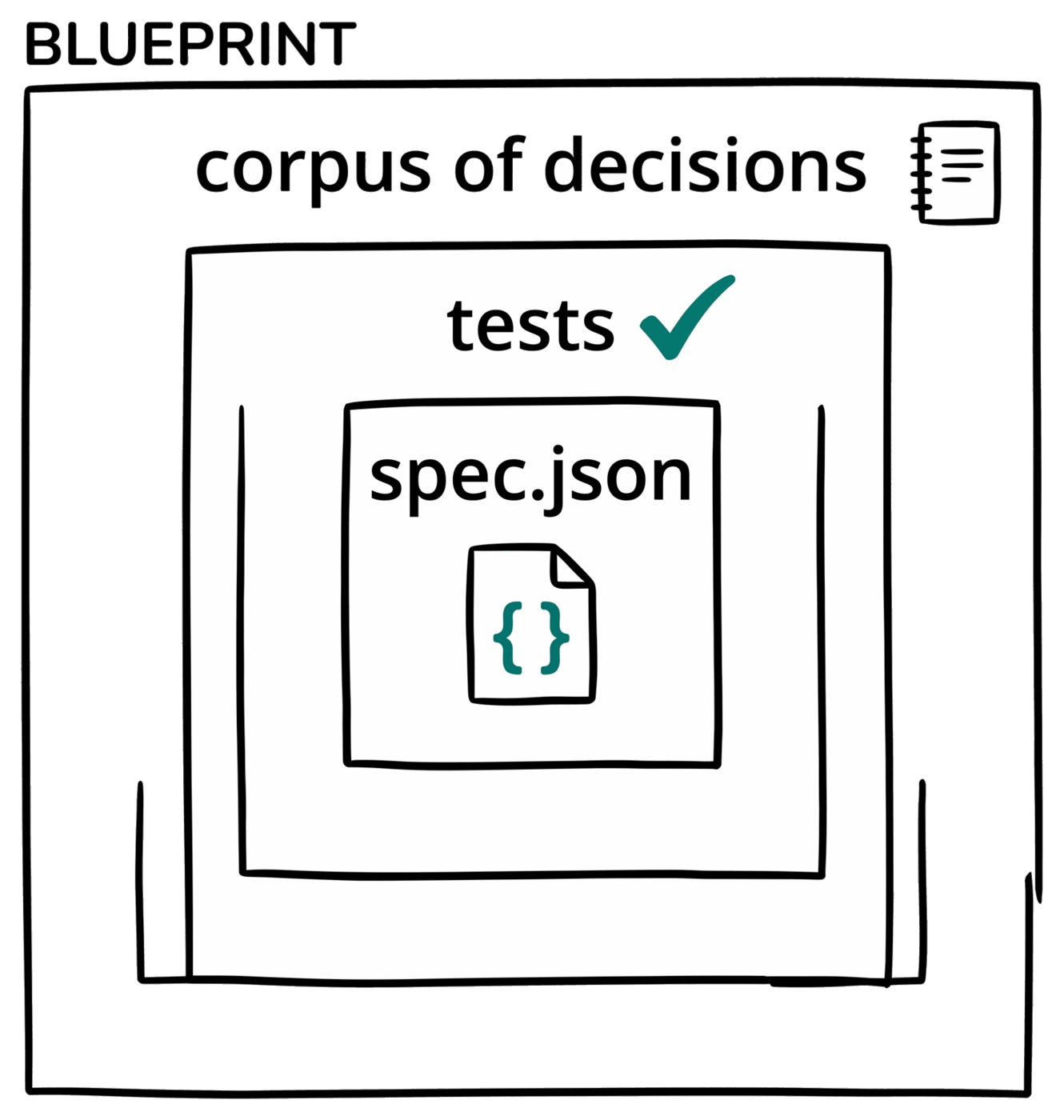
A blueprint is the union of:
1. spec.json. The structured intent. Brief, success criteria, content hints, route maps, journeys, contracts, lifecycle states, tenant model, observability hooks. Every clause is provenanced (brief / bug:warp#NNN / operator-request:YYYY-MM-DD). 2. The test suite. The executable form. Every clause in spec.json has at least one test. Every test traces back to one or more clauses. The suite spans the seven corners (Chapter 4). 3. The corpus of decisions. The ADRs and runbooks that explain why the blueprint is shaped the way it is. The blueprint encodes intent; the corpus encodes rationale.
These three together are what the operator owns. None of them are the codebase. The codebase is what the factory produces, given the three. If a better factory comes along, faster runtime, cheaper hosting, new framework, the operator points it at the blueprint and gets a regenerated codebase that satisfies the same blueprint.
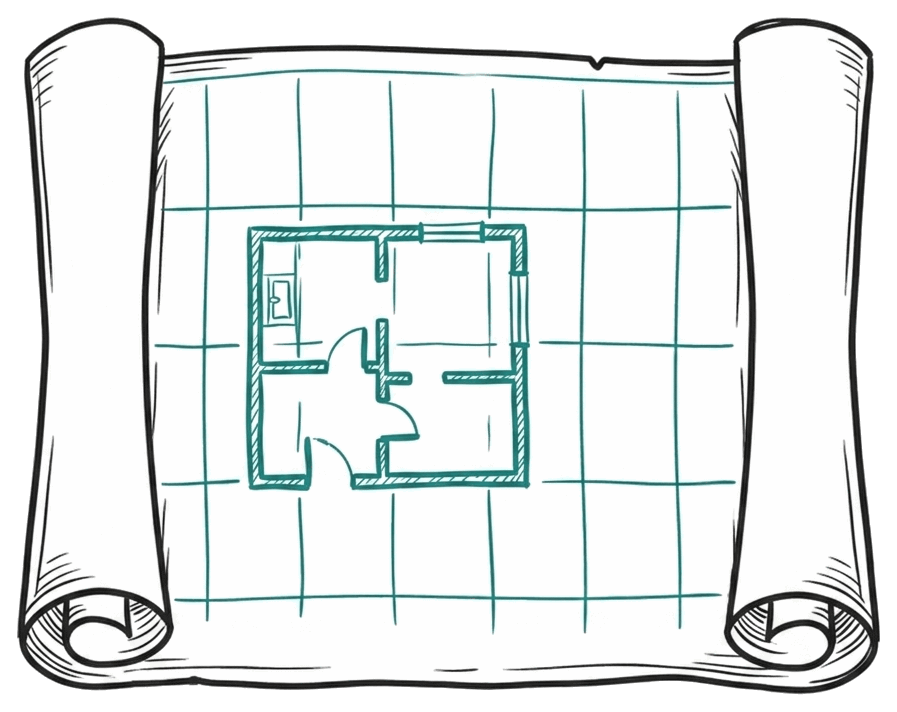
Said differently: the codebase is the artefact, not the asset. The asset is the blueprint. The artefact is whatever the factory most recently emitted.
The codebase is the artefact, not the asset.
This is the inversion the AI deliverable shift forces. It is not a posture. It is what becomes economically rational once factories exist.
The cost thesis behind the inversion is rarely stated out loud, because the book has so far sold the creation moment, the afternoon in which the factory ships a working SaaS to the public internet. The afternoon is the cheap part. The years afterwards are the expensive part. Software is maintained, not shipped, and maintenance dominates lifecycle cost. AI collapses creation cost toward zero and leaves maintenance untouched, so the ratio inverts violently. A codebase that was a third of the cost of the team in 2024 becomes a tenth, and then nearly nothing in compute terms; the cost of the team to maintain it does not move.
The blueprint's payoff is not that it makes the afternoon faster (everything makes the afternoon faster now). The payoff is that it makes maintenance a regeneration rather than an archaeology. When the spec is the asset, the question "what does this system do?" is answered by reading three hundred clauses; in the codebase-as-asset world, the same question is answered by an engineer holding the whole system in their head for a quarter and re-deriving the answer from a million lines. Once a factory exists, the cost of regeneration drops below the cost of maintenance, and Section 6.3 frames the corollary: Architect culture is the economically rational response to that crossover, not a posture about it.
A structural-debt note. The thesis above is scoped to systems where the blueprint can be authored alongside the codebase, which is most new product work and most AI-authored code. The harder case is the brownfield system you inherited without a blueprint and cannot rewrite. That case is the subject of Section 6.3's fifth scope clause: the blueprint must be recovered from the live system, one bug-as-clause and one characterisation test at a time, until enough of it exists to regenerate a module at a time. Until that crossover, "the codebase is rented" is a destination, not a starting state.
5.2 What the operator's day looks like
In Builder culture, an operator with a multi-tenant SaaS spends their day in the codebase. They review PRs against the implementation. They debug stack traces. They ask "why is this function slow?" and read the source. The codebase is where they live.
In Architect culture, the operator spends their day on the blueprint. They review PRs against spec.json and the test suite. They debug failing journeys. They ask "what behaviour is this product missing?" and read the spec. The codebase is where the factory works, not where the operator works.
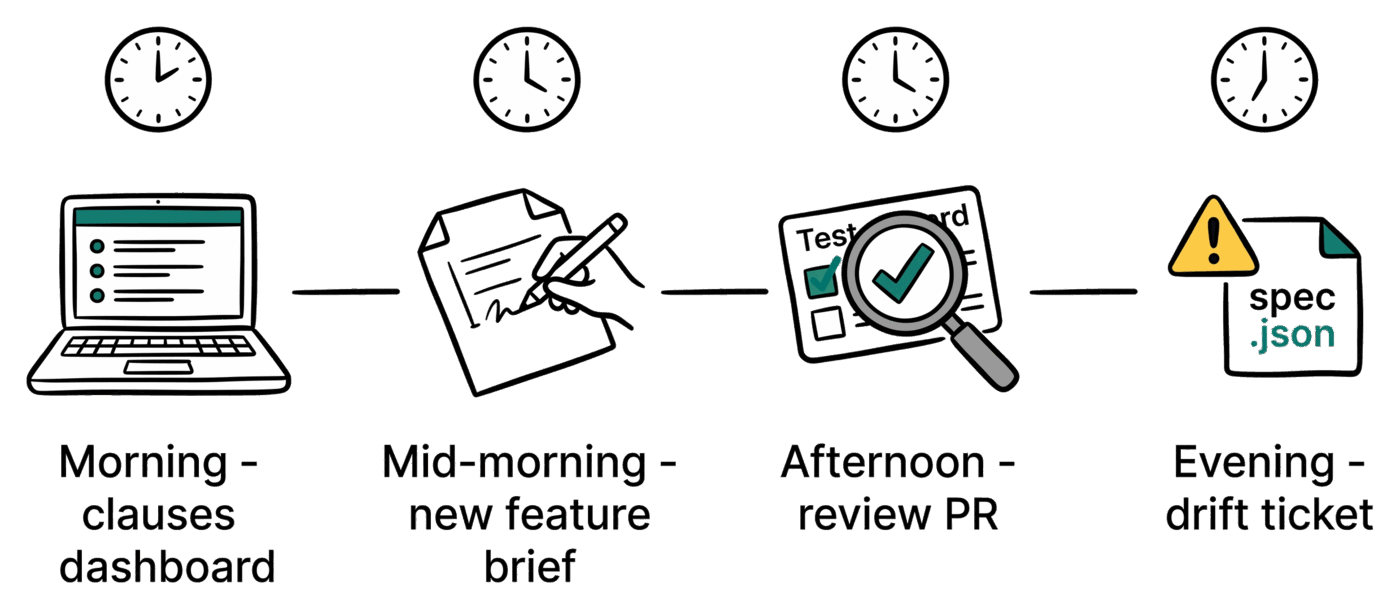
A typical day:
Morning. Open the operator dashboard. See the overnight clauses. Bugs filed by users, regressions caught by canary, drift caught by the seven-corner stack. For each, read the clause: given X, when Y, then Z. Validate the clause is what was meant. Approve.
Mid-morning. A new feature lands as a brief. Operator drafts the success criteria. Three lines, in operator-facing terms. Two journey clauses. One contract clause. Done. Hand it to the factory. Watch the factory emit the test stack RED, run, fail, implement, run, pass. Twenty minutes later, the feature is in staging with the tests proving it satisfies the criteria the operator wrote.
In pseudo-code. The same flow, dev-readable:
```python brief = read_brief("export jobs to CSV") clauses = operator_drafts_clauses(brief) # 3 lines, given/when/then spec = spec_load("spec.json") spec = spec_append(spec, clauses) # provenance: operator-2026-05-03
tests = emit_tests(spec, target=clauses) # tests in RED assert run(tests).status == "RED" # gate: must fail first
impl = factory_implement(spec, until=tests) # AI authors against the spec assert run(tests).status == "GREEN" # gate: must pass before deploy
deploy(impl, env="staging") spec_commit(spec) # blueprint accretes the clauses ```
Three things to notice. The operator never touches impl. The factory never invents a clause that wasn't in spec. The deploy is gated on tests that the operator's own clauses emitted. So the deploy passing IS the proof that the operator's intent shipped.
Afternoon. Review a PR. The PR claims to add export-to-CSV. Operator does not read the implementation. They read the journey test, the contract test for GET /api/v1/jobs/export.csv, and the lifecycle assertion that says "exporting does not mutate any Job state." If those three are present and pass, the PR is correct. The implementation is a detail.
A clarity note. This is only true if the tests read. A journey test whose assertion is expect(response.data[0].field_x).toBeTruthy() doesn't tell the operator what the product does. It tells them which property exists in the wire shape, which is half the story. The test that earns the operator's read time has assertions phrased the way the operator would describe the behaviour aloud. The dashboard shows status counters within ten seconds. That sentence is the contract. The code under it is just how the contract gets executed.Evening. A regression-corpus drift detector files a ticket. A clause that passed yesterday fails today. The operator reads the diff: someone changed the auth flow upstream. The blueprint catches it before any user does. The operator routes the ticket back to the upstream change. The product itself is fine; the blueprint flagged a real risk.
The operator's job is guarding the blueprint, not guarding the codebase. Their power is the spec, not the source. The factory does the source.
This is what makes Architect culture economically different. An operator with a Builder-culture team has a fixed-size team relative to the codebase: more code, more humans. An operator with an Architect-culture team has a fixed-size team relative to the blueprint: more clauses, more tests, but the codebase scales with the factory's throughput, not the team's. The team is bounded by the blueprint, not by the source.
A spec-author or test-wright hitting this in their first week asks the obvious question: where does a given thing belong, in spec.json or in the codebase? The answer is a judgement, not a bright line. A clause belongs in the spec if the operator needs to reason about it, if it changes often, if violating it is a customer-facing failure, if a regeneration that breaks it is a build that failed and must be rejected. It stays out of the spec if it is a pure implementation detail the operator never writes, never reads in an issue, never checks in a review. The hard calls live in the middle. Page size: the operator probably does not care, unless a usability study were to say, illustratively, that users expect exactly twenty-five items and reject fifty, at which point it becomes a clause. Cache TTL: a codebase detail, until a user perceives the staleness, at which point it is a clause. The export rate limit: a clause if a customer contract names a number, a codebase detail if it is only defence against abuse the factory can re-tune on its own. The test-wright pushes back on clauses too specific to the implementation: we do not need to assert the exact query the database runs, only that the export completes inside ten seconds. The operator pushes back the other way: if we cannot say what the dashboard shows, how will we know a rebuild is correct? The threshold is experience. The culture trains people to over-specify at first, then watch what actually changes and cull the rest, until most spec-authors can feel the boundary by touch.
5.3 What engineering teams look like
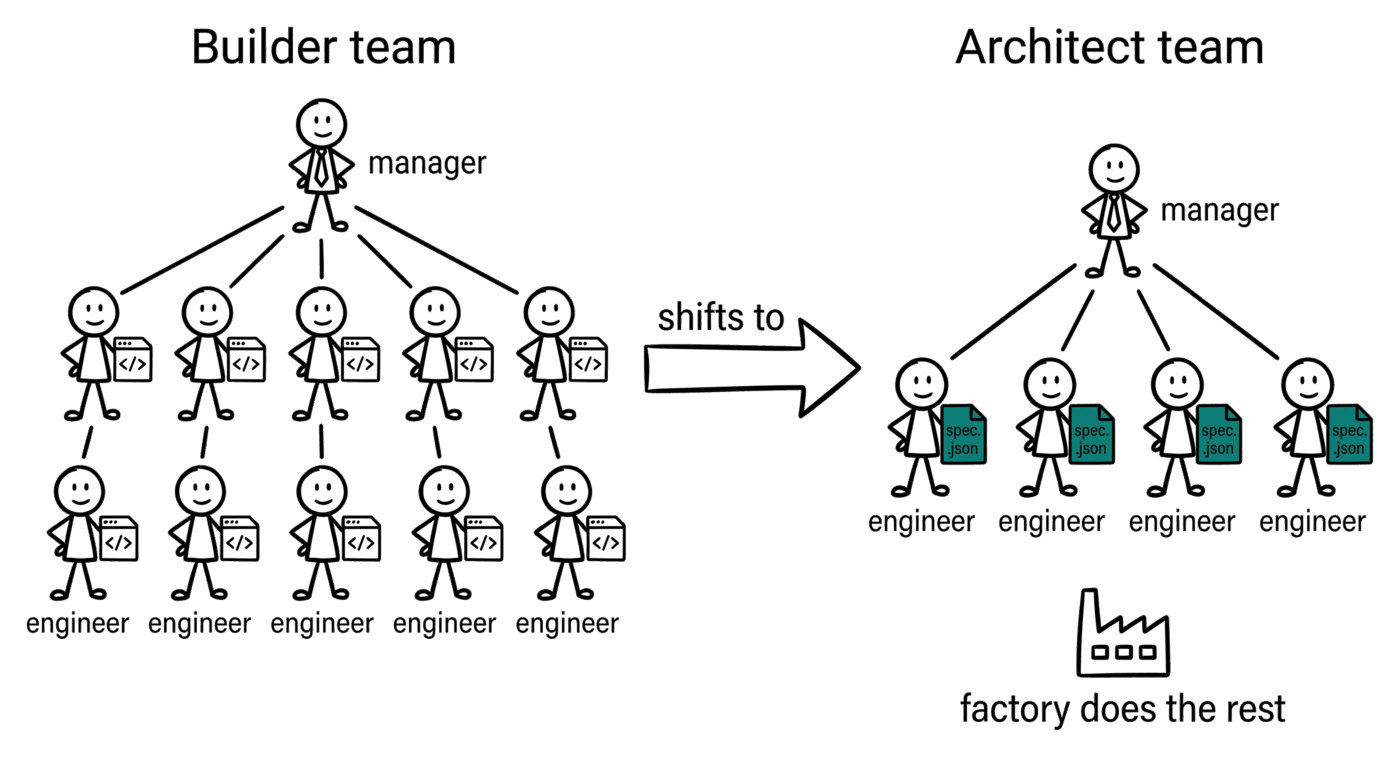
In Builder culture, engineering teams are organised around the codebase. There is a frontend team, a backend team, an infra team. People specialise in implementation surfaces. Hires are filtered by language fluency. Performance reviews ask "what did you ship to the codebase?"
In Architect culture, the teams reorganise around the blueprint:
- Spec authors. Senior engineers and product-facing operators who write clauses. The skill is precision in operator-facing language. Being able to phrase a behaviour as a given/when/then in a way that survives a rewrite. This is a thinking skill, not a coding skill.
- Test wrights. Engineers who build the seven-corner stack. They write contract test scaffolds, journey-test fixtures, lifecycle matrices, multi-tenant boundary harnesses. The skill is seeing the bug class before the bug ships. They author less code than a Builder-culture engineer but the code they author is load-bearing.
- Factory operators. Engineers who maintain the build pipeline. Gen-crud emit logic, the tests-first gate, the deploy verifier. They are not building the product. They are building the machine that builds the product.
- Reviewers. Personas (per ADR-115), human or AI, who read PRs against the blueprint and ask: does the change fit the spec, do the tests assert what the brief claims, are any clauses orphaned. The work is judgement, not authorship.
- Operators. The operator role does not disappear; it gets bigger. They are the ones whose intent the blueprint captures.
Notably absent: a "frontend team" and a "backend team." The factory builds whichever surface the spec demands. The team's job is the spec, not the surface. A junior who cannot write Svelte but can write a precise journey clause is more valuable than a senior who can write Svelte but cannot phrase the journey clause that says what the page must do.
This is one of the harder cultural transitions. Engineers identify with the codebase. The language they know, the framework they prefer. Architect culture asks them to identify with the blueprint instead. Some will. Some will not. The ones who do find that their reach grows with the factory's throughput; the ones who do not find themselves doing manual work the factory has already automated.
5.3b Where the architecture goes
Engineering teams don't just reorganise. The systems they ship reorganise too. And the cause is the same.
For fifty years, software architecture has been driven by two forces in tension. The first is behaviour, what the system needs to do, what its boundaries actually are, where data flows separate naturally. The second is organisation, how many engineers can simultaneously hold the codebase in their heads, how many people can land changes without merging on top of each other, how many teams can ship independently without coordinating every release.
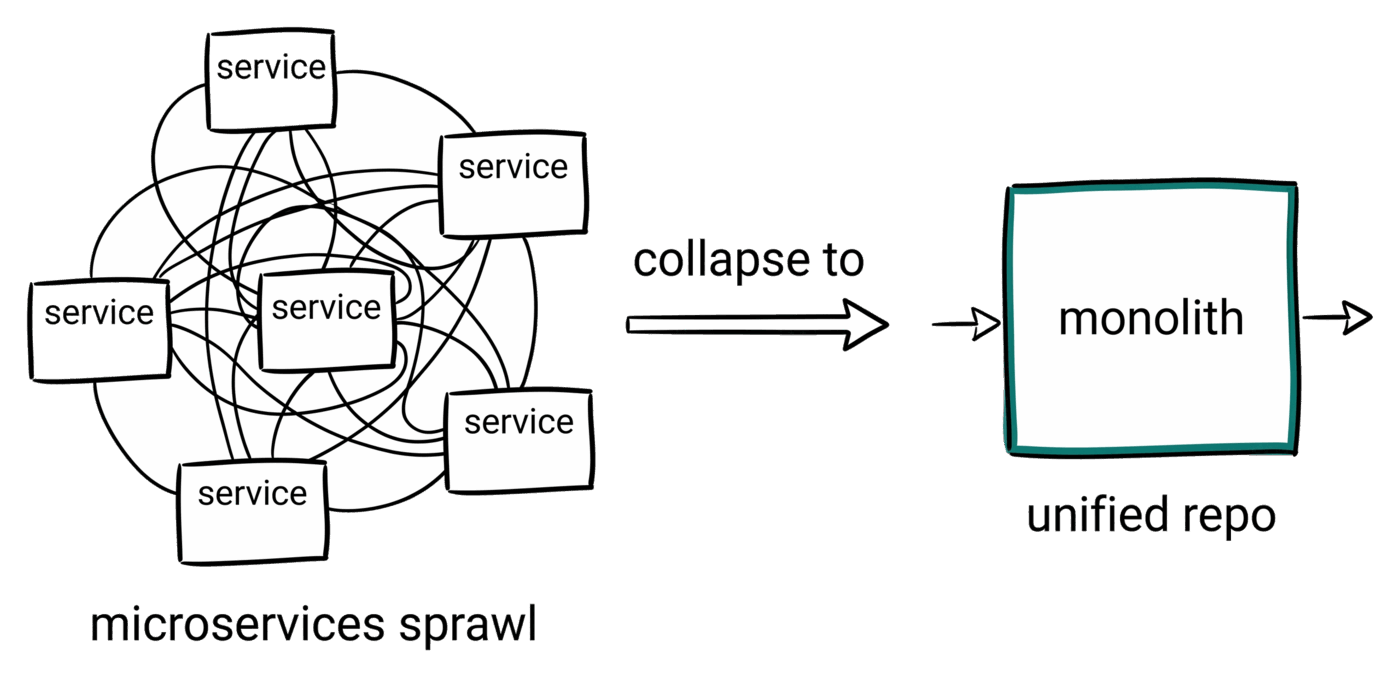
Conway's Law says the second force usually wins. "Organisations design systems that mirror their communication structures." When a company has six teams, it tends to ship six services, even when behaviour would have been simpler as one. The microservices movement, in its honest form, was the explicit acknowledgement that team-size was the driver. Split the system by team, give each team its own service, its own deploy, its own data store, and you eliminate the coordination costs that grow super-linearly with team size on a single codebase.
The cost was distributed-systems complexity: network failures, eventual consistency, observability fragmentation, deploy orchestration, the whole tax of running fifty things instead of one. Many systems paid this tax not because their behaviour required it but because their organisation did.
Microservices were often a coordination solution to a team-size problem. AI removes the team-size problem. The coordination solution can stop.
AI authoring breaks this. One AI agent, holding the whole codebase in 1M context, does not fight other agents at merge time. The team-scaling pressure that produced the silo-as-architecture pattern goes away, because there is no longer a single-codebase merge-conflict tax that grows with engineer count. Twenty AI sessions can author into one repo more peacefully than twenty humans ever could. Conway's Law's organisational driver thins out; what remains is the genuine technical driver, split where there is a real reason (independent failure domains, independent scaling characteristics, regulatory boundaries, latency-sensitive cores).
Three concrete consequences over the next five years.
Architectures shrink. Systems that were split into eight microservices for team-coordination reasons collapse back to two or three modules in a unified codebase. The unification is not a regression to the 1990s monolith. It is a recognition that the 1990s monolith was usually the right shape for the system's behaviour, and what made it painful was the human-team-size pressure on the codebase, not the codebase itself. The 2030 monolith is the 1995 monolith with the merge-conflict tax removed.
Visibility returns. When the AI can read the whole codebase, the operator can ask the AI questions about the whole system: "where does customer-data flow when a Job claim fails?" In a 50-microservice org, that question takes a week of swivel-chairing across observability tools and Slack channels. In an AI-authored unified codebase, it takes thirty seconds. The operational overhead of fragmented systems was a Conway's Law cost; that cost reverses.
One codebase, many runtime topologies. The strongest objection to architectural unification comes from the event-driven crowd: "the system needs to be microservices because the events have to flow asynchronously through a bus, with retries and dead-letter queues and independent scaling." That objection conflates runtime topology with codebase topology. They are separable. A unified codebase can publish to a message bus, consume from one, run handlers in independent worker pools, scale them independently, deploy them as separate processes in production, and still be developed, tested, reviewed, and reasoned about as one repository. The handlers that consume from jobs.claimed live next to the handlers that emit jobs.claimed, in the same module, with the same test suite, with the same blueprint clauses asserting their joint behaviour. At runtime they ship to different containers and scale independently; at authoring time they are one system. The bus is an infrastructure detail, not a code-organisation principle. This keeps the solution infra-agnostic, the same application can run colocated on one end of the deploy spectrum (single process, in-memory queue) and distributed on the other end (Kafka, Pub/Sub, SQS), without the codebase splitting in two. The split in production is a packaging choice. The split in the repo is no longer required.
The local-development advantage is enormous. This is a serious architectural design, not a sidebar. An engineer (or AI agent) can run the entire system on a single laptop from a single application. The whole bus, the whole consumer pool, every handler, every persistence layer, every admin route, every webhook receiver, all of it boots in one process with an in-memory queue and runs end-to-end in seconds. Walk a journey test through fifty production-shaped event hops with a debugger attached. Watch a single message flow through the whole system without crossing a network. Reproduce a customer bug locally without standing up Kafka, Kubernetes, three observability tools, and a service mesh. Test a refactor that touches twelve handlers without coordinating twelve PRs against twelve repos. The cost of debugging a microservice system has historically been the cost of recreating its production topology to reproduce a problem. A unified codebase that ships across a bus on demand cancels that cost. The system is a microservice in production and a monolith on the laptop, and the codebase doesn't change between the two. That is the architectural design.
The same property powers the AI's feedback loop. What lets an engineer boot the whole system on a laptop lets the factory boot it in a per-PR environment, the loop the AI's self-correction runs on. The cheapest rung is the in-memory monolith: same code, one process, an in-memory queue, the full cross-system journey in seconds. It catches the integration logic, whether the producer, the queue, the consumer, and the result did the right thing. It does not catch what only a real broker does: a rebalance that hands an in-flight message to a second consumer and re-runs it, a redelivery after a visibility timeout, an ordering that holds only per partition. For those, the same unified codebase stands up at higher fidelity without changing a line: as the real container topology on a local k3s, for the price of a few pods; or, when a bug genuinely needs real SQS, real IAM, real managed-service behaviour, as a torn-down cloud environment, spun up for the pull request and destroyed after it. The agent picks the cheapest rung faithful enough for the bug in front of it, traces the failing message out and back, reads which issue the run raised, fixes it, and re-runs. A fragmented system makes every rung expensive: you cannot run it in memory at all, and even k3s means standing up a dozen services from a dozen repos. The unified codebase makes the whole ladder cheap, which is the precondition for an agent iterating without a human stitching logs from fifty services. The runtime machinery that operationalises this, the visibility portal the operator supervises through and the operations agents that re-emit against the same gate, is the subject of Section 8.3d and Section 9.4; the architecture is what makes it affordable enough to attempt.
The same argument applies to the frontend, with the same intensity. React's micro-frontend movement was the team-coordination response to large-team frontend codebases: split the React app into independently-deployed bundles owned by different squads, glue them together at runtime via Module Federation or single-spa, accept the colossal tooling investment (separate build pipelines, version-skew management, runtime-loaded design-system fragmentation, cross-bundle state coordination) because the cost of squads stepping on each other in one Webpack config was higher. That investment only earns its place when the constraint is squads-need-isolation. Re-framed honestly, a micro-frontend is infrastructure paid for the privilege of having multiple squads work without merge conflicts. When AI authoring removes the merge-conflict pressure, the constraint disappears, and so does the case for the investment. Some teams will rationalise the investment as "clean boundaries" or "independent deploys", those are real benefits, but they were never the reason for the cost. The reason was team-size pressure. With the pressure gone, the right move on the frontend is the same as the right move on the backend: one codebase, deployed however the runtime topology demands, including as a single bundle when one bundle is what the operator's product wants.
And the framework itself becomes optional. Collapsing the micro-frontends back to one bundle is the first cut. The deeper one is that much of the apparatus on top of the framework was the same team-scale tax: the state-management layers, the module-federation glue, the elaborate build pipeline, most of it there to keep a big, hand-authored frontend coherent across many people over many years. Remove that constraint and it stops being load-bearing. A frontend an agent authors against a journey suite does not need that scaffolding to hold a team's mental model together. So the frontend does not just defragment, it shrinks, in whatever the blueprint chooses: React, Solid, HTMX, web components, server-rendered HTML. The framework itself stops being a default you inherit and becomes a choice you enforce in the blueprint, justified by the product, or quietly dropped. What stays load-bearing is the journey test, the Chapter 4 corner-4 shape, a real browser completing a named flow without console errors. The framework underneath it is rented exactly the way the backend codebase is; the journey is the part you own. This is the frontend face of the number Chapter 9 puts on the backend: ten times less code against the same product.
The remaining splits are honest. A system that genuinely needs to scale a hot path independently still splits the hot path off. A system that needs to isolate a regulatory boundary still isolates it. A system whose components are owned by different organisations (not different teams within one org) still ships across an API boundary. The splits that remain in 2031 are the ones that pass a real technical or organisational test. Not the ones that exist because team A and team B couldn't merge to the same repo, and not the ones that exist because the implementation language imagined the message bus as a code-structure boundary instead of a runtime-topology boundary.
The sharpest honest split is a durability boundary. The independent-scaling reason has a hard edge the event-driven crowd is right about: some work cannot be done at the rate it arrives. When a surge needs six workers and the budget runs three, the work cannot be dropped on the floor while the pool catches up. The queue is how a system refuses to lose it. Every unit of work is written to a durable, keyed log the instant it arrives, and the worker pool drains it at whatever rate it can sustain: nothing lost, nothing claimed before it is recorded, the producer never blocked on the consumer. That boundary survives the collapse, and it is worth being precise about what kind of boundary it is. The queue is a runtime-durability boundary, not a codebase boundary. The handler that enqueues and the handler that drains still live in one repo, one blueprint, one test suite. And the durability boundary buys something the fragmented version never did: a clean seam the agent can trace across, a message in here and out there, the path between legible to a model reading the whole system.
Does the queue add a new layer of tests? No. It lights up three you already have. Was anything lost, double-applied, or delivered out of order is a cross-system question, the Chapter 4 corner-7 shape. The job's state machine is corner 5; one tenant's messages never reaching another's topic is corner 6. The queue is not an eighth corner. It is corners five, six, and seven aimed at an asynchronous seam.
One objection lands specifically on the durability boundary, and it deserves a direct answer: if the queue has to outlive the process, does testing an end-to-end journey now mean standing up the real broker, and does that not pull the system back into the microservice complexity this section just argued away? It does not. The durability boundary is an optional fidelity toggle, not a permanent split. The default loop is still the in-memory monolith described above, the whole system in one process, a message traced from enqueue to handler in seconds. Only when a bug is genuinely about a rebalance, a redelivery, or per-partition ordering does the agent climb to the higher rung that same passage already named. The queue buys durability, not fragmentation, and the codebase does not split on it.
The organisations that read this section and start collapsing their unnecessary microservices, against the still-loud advice of the consultants who installed them, will quietly outperform the ones that don't. Less infrastructure to operate. Less integration code to maintain. Faster onboarding. Faster rebuilds. Less surface area for the kinds of bug class that hide between services (cross-system bugs, per Chapter 4 corner 7). One operational head per shipped product, not one per service.
A structural-debt note. The pile of "we shouldn't have split this" debt is the single biggest piece of unrecognised structural debt in most large engineering organisations. The question to ask is colder than the team will defend: if we were starting today, with AI authoring as the default, would we split this? Where the answer is no, the split is debt. Split-by-team was reasonable when team-size pressure was the binding constraint. It no longer is.
So the new question is: *how should we divide a system, once split-by-team is no longer the right axis? Two answers worth holding together. First, divide it so it fits in one head, the operator's, supported by the AI. A unified codebase the AI can read end-to-end and the operator can ask whole-system questions of is the floor. Second, and better, divide it so the system is obvious: where the code and docs describe the actual product*, where a fresh engineer (or model) reading the blueprint can predict what the code will do without running it. The split that survives in 2031 is the split that makes the system more legible, not the one that makes the org chart easier.
Continue to Chapter 6: The Five-Year Horizon →