README
StateLoop
A multi-agent negotiation system where AI agents discuss options and reach consensus through turn-based conversations. Agents have private agendas, configurable personalities, and hidden constraints — creating realistic negotiations, collaborative writing sessions, and decision-making simulations.
Built with TypeScript, Express, SQLite, and the Anthropic Claude SDK.
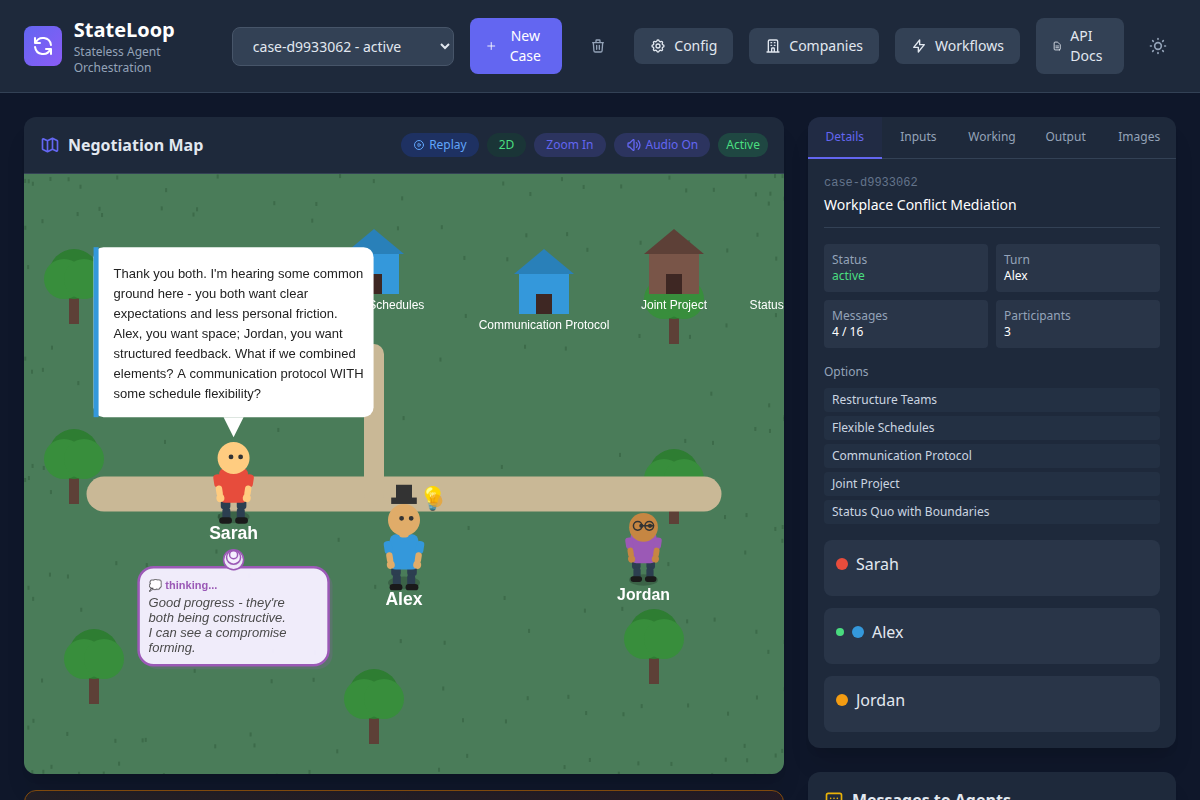
Three Thronglet agents in a workplace mediation — Sarah (mediator) speaks while her private thoughts appear below. Alex and Jordan wait with their own hidden agendas. The right panel tracks case status, options, and participants.
Quick Start
npm install
npm run dev
Open http://localhost:3000
| URL | What you'll find |
|---|---|
/ | Main negotiation UI with Thronglet map |
/scenarios.html | Browse scenarios, furniture, locations, companies, agents |
/workflows.html | Workflow designer for multi-stage pipelines |
/api-docs | Interactive Swagger API documentation |
Features
- Multi-agent negotiations — Agents take turns proposing, countering, accepting, or rejecting options
- Private agendas — Each agent has hidden goals and constraints others can't see
- Configurable personalities — Agreeability scores (0-100), traits like patience, empathy, assertiveness
- Collaborative document editing — Agents co-write scripts, proposals, and notes in real-time
- Automatic resolution detection — Cases resolve on consensus, fail on timeout or repeated rejections
- 35+ built-in scenarios — From workplace mediation to comedy script writing to jury deliberation
- Visual UI — 2D/isometric map with animated Thronglet agents, text-to-speech, conversation replay
- Workflow designer — Chain scenarios into multi-stage pipelines
- Company management — Persistent organizations with buildings, rooms, policies, and employees
- Forms & mediation agreements — Generate formal documentation on case resolution
- Full REST API — Every feature accessible via API with Swagger documentation
- Built-in simulation — Run negotiations to completion automatically with Claude AI
Scenario Browser
Browse 35+ pre-made scenarios covering workplace disputes, creative collaborations, civic debates, and more.
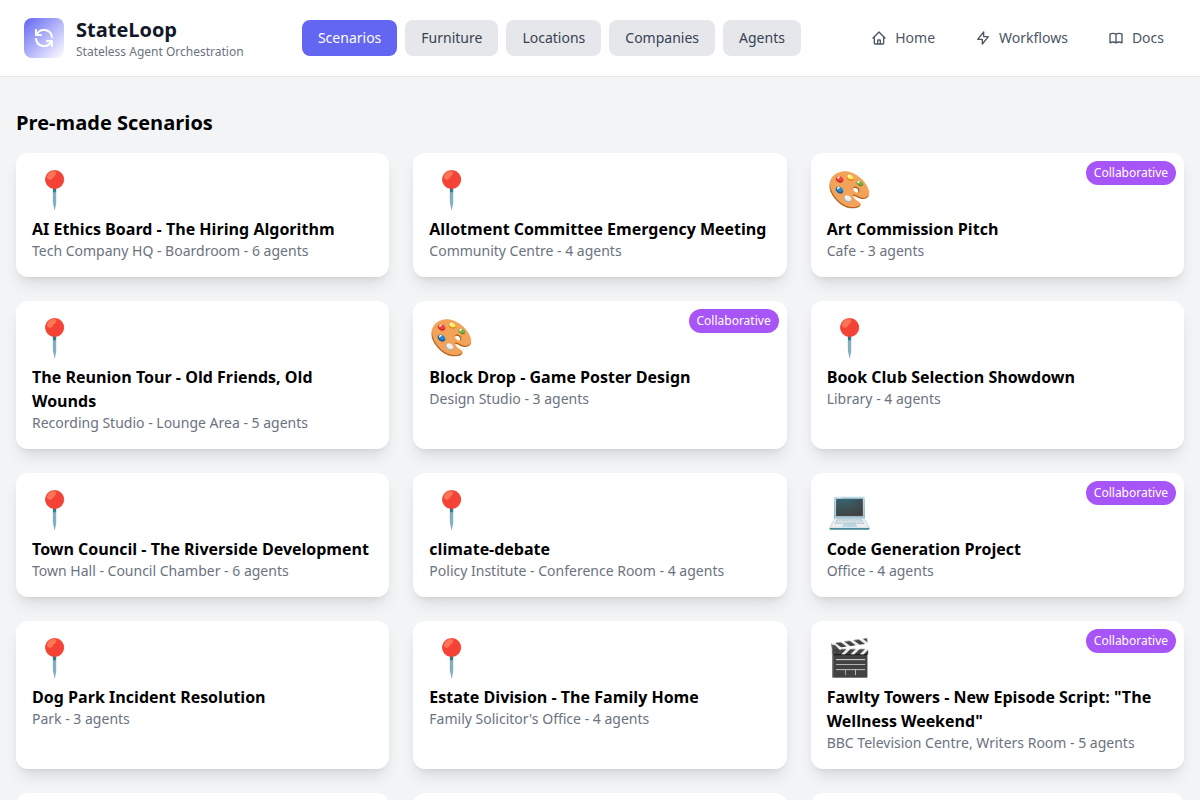
- Workplace — mediation, feature planning, code review, union negotiation
- Creative — Fawlty Towers script writing, art commission, game design pitch, podcast planning
- Civic — city council zoning, climate debate, jury deliberation, school policy
- Personal — wedding planning, flatmate interview, family inheritance
- Healthcare — hospital hydration policy, AI ethics board
Locations & Furniture
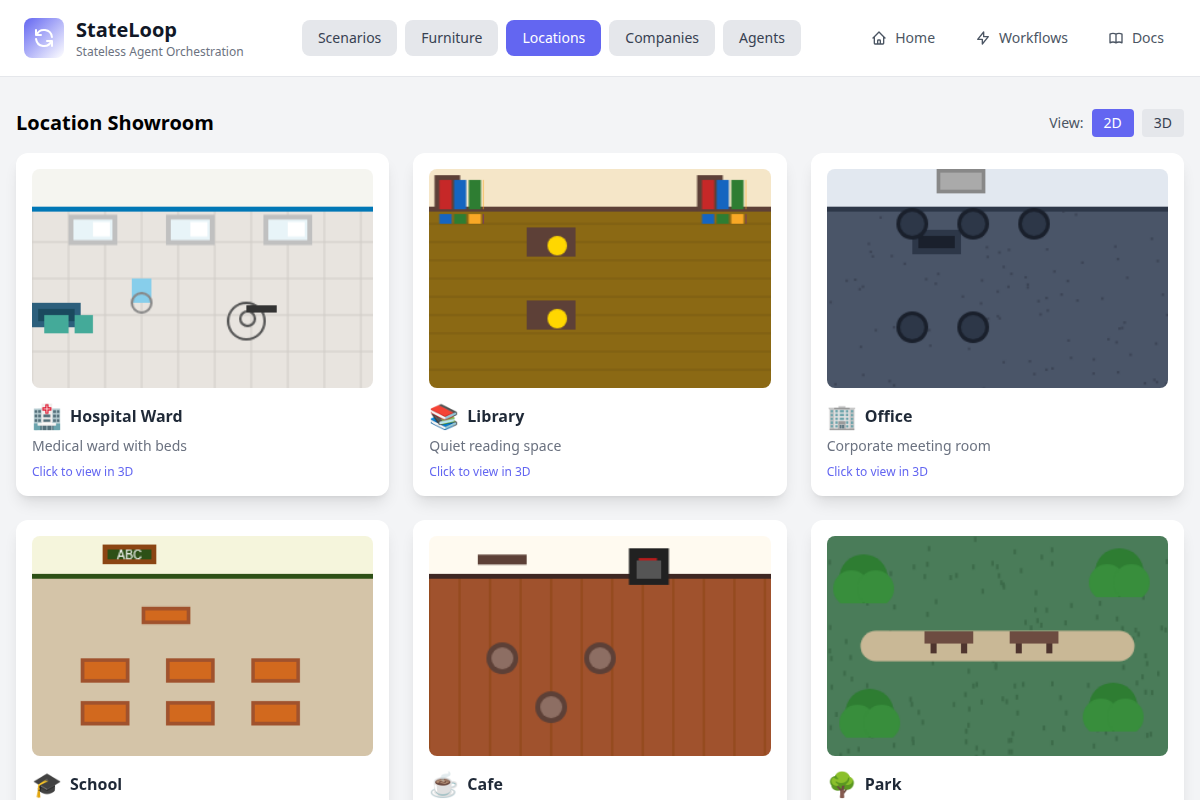
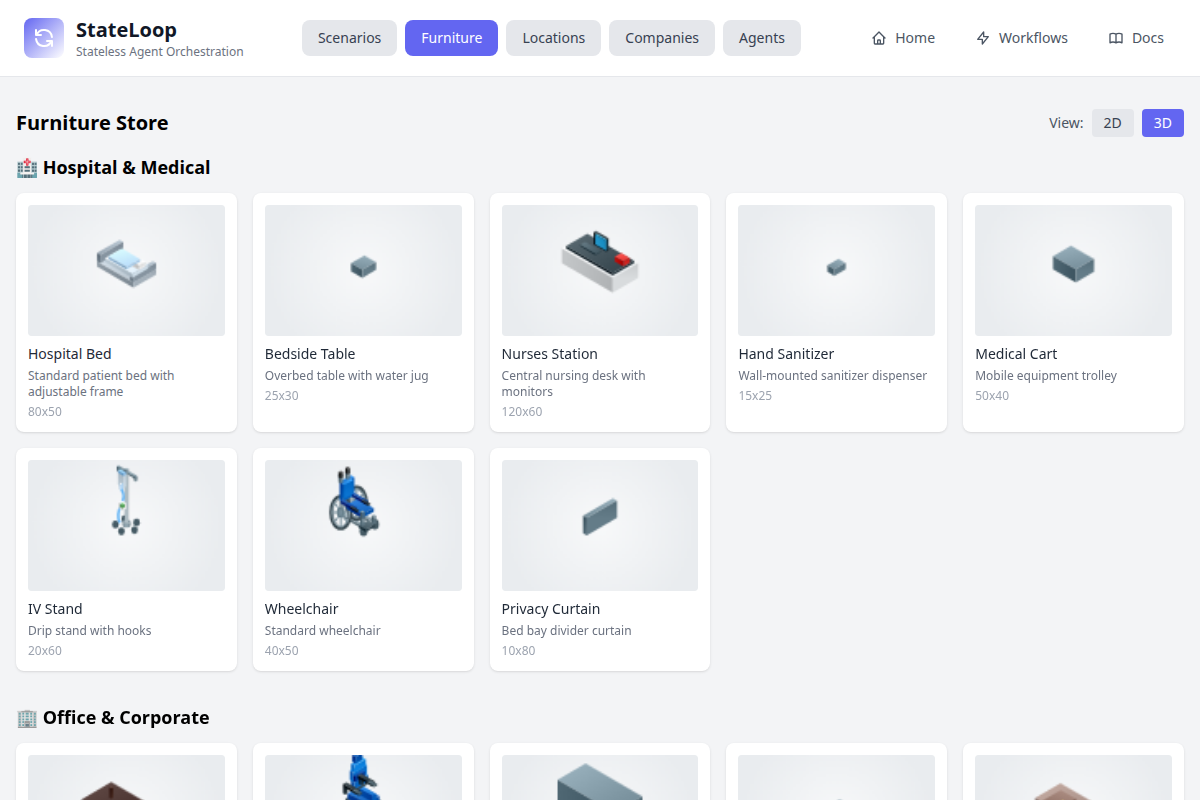
Six environments — Hospital, Library, Office, School, Cafe, Park — each with matching furniture that automatically populates the negotiation map.
Furniture renders in both 2D and isometric 3D:
Agent Customizer
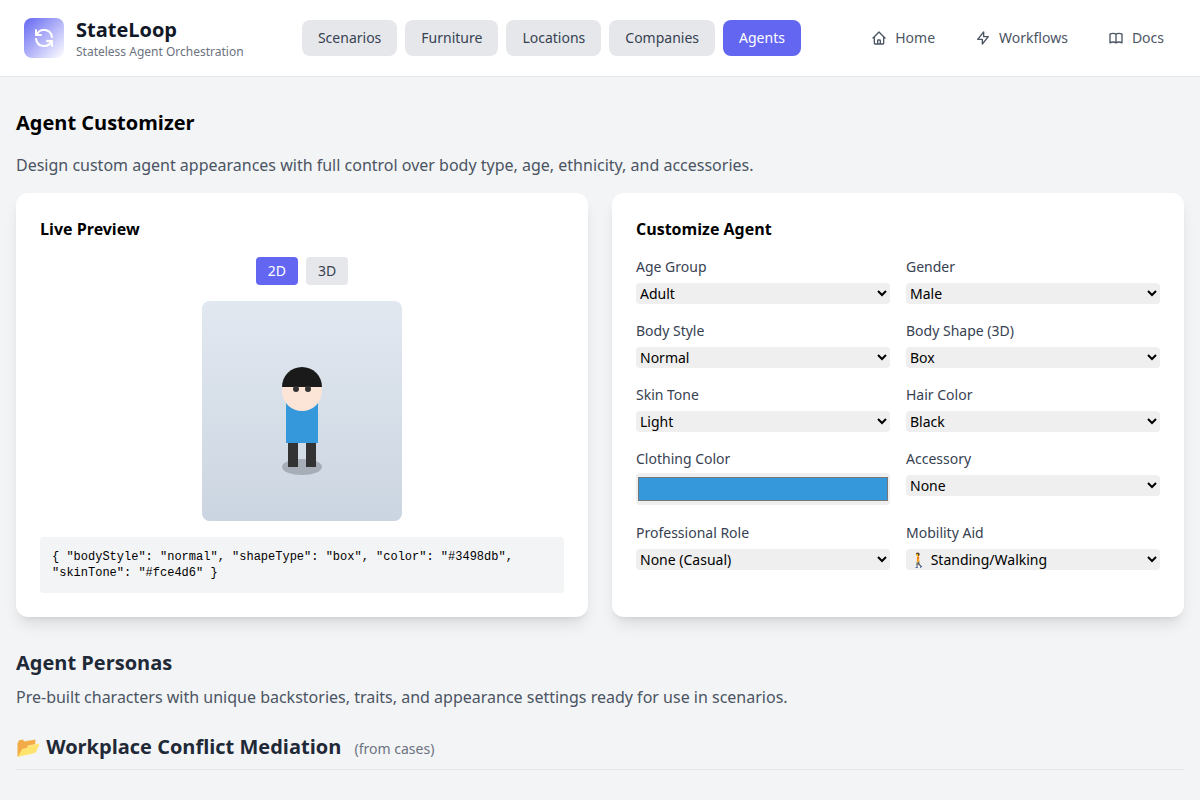
Design Thronglet appearances with control over body type, skin tone, hair, clothing, accessories, professional roles, and mobility aids. Live preview updates instantly.
Workflow Designer
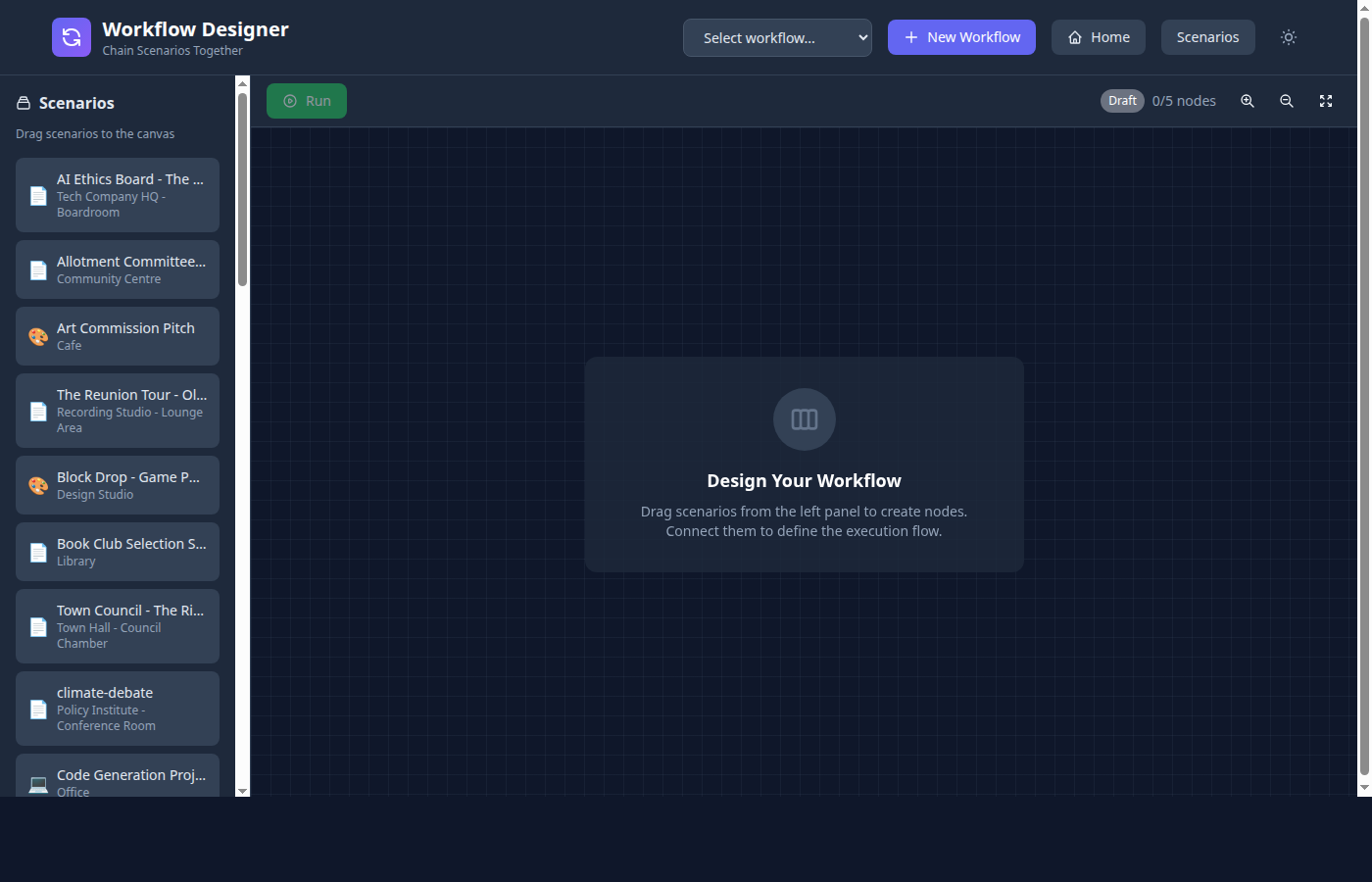
Chain scenarios into multi-stage pipelines. Output from one stage feeds into the next.
How It Works
1. Write a scenario (or pick a built-in one)
2. POST /api/cases to create a negotiation case
3. AI reads the scenario and sets up agents, options, and documents
4. Agents take turns — each gets the full conversation context + their private agenda
5. Each turn produces a response: proposal, counter, accept, reject, or message
6. System checks resolution rules after each turn
7. Case resolves when agents reach consensus (or fails on timeout/rejection)
Each agent is stateless — they receive the entire conversation context on every turn, making the system reliable and debuggable.
Writing Scenarios
Scenarios are plain text files:
SCENARIO: Team Dinner Choice
LOCATION: Office Break Room
ICON: 🍽️

AGENT: Alice
AGENDA: You're paying, so budget matters. Prefer somewhere quiet.
AGREEABILITY: 60

AGENT: Bob
AGENDA: You love bold flavors and lively atmosphere. Won't go somewhere boring.
AGREEABILITY: 55

OPTIONS:
- Italian Place: Pasta, quiet atmosphere, $$
- Mexican Grill: Tacos, lively, $
- Sushi Bar: Fresh fish, trendy, $$$

RULES:
- Both must accept for resolution

MAX_ROUNDS: 10
Task Types
| Type | Use For | Example |
|---|---|---|
options (default) | Choosing between options | Restaurant choice, hiring decision |
document | Collaborative writing | Script writing, proposal drafting |
both | Options + document output | Design pitch with mockup |
API Overview
# Create a case
curl -X POST http://localhost:3000/api/cases -d '{"scenario": "..."}'

# Get the AI prompt for the current agent
curl http://localhost:3000/api/cases/{id}/auto-play

# Submit agent setup and first message
curl -X POST http://localhost:3000/api/cases/{id}/setup -d '{"setup": {...}}'

# Submit agent responses (loop until resolved)
curl -X POST http://localhost:3000/api/cases/{id}/submit -d '{"response": {...}}'

# Or run the entire negotiation automatically
curl -X POST http://localhost:3000/api/cases/{id}/run
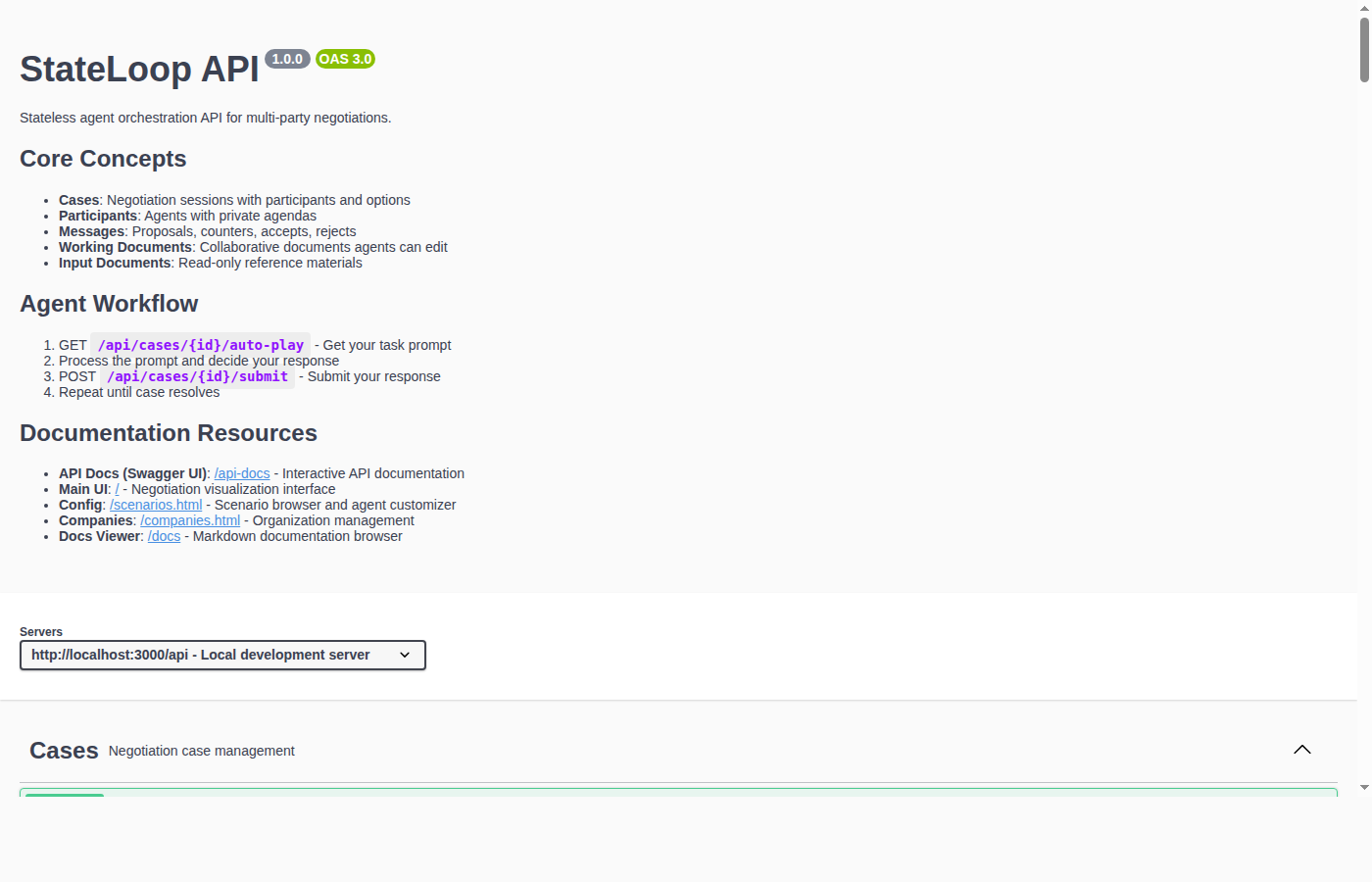
| Method | Endpoint | Description |
|---|---|---|
POST | /api/cases | Create negotiation case |
GET | /api/cases/:id/auto-play | Get prompt for current agent |
POST | /api/cases/:id/setup | AI submits setup + first message |
POST | /api/cases/:id/submit | Submit agent response |
POST | /api/cases/:id/run | Run to completion |
GET | /api/scenarios | List available scenarios |
POST | /api/cases/:id/documents | Create working document |
GET/POST | /api/companies | Manage organizations |
Agent-Built Projects
The workflow system — where agents brainstorm, plan, and code together — produced these playable projects:
Stack Games (/stack-games.html)
Five physics-based stacking games: Balloon Stack, Shape Tower, Balloon Stacker, Hot Air Balloons, and Airplane Hangar.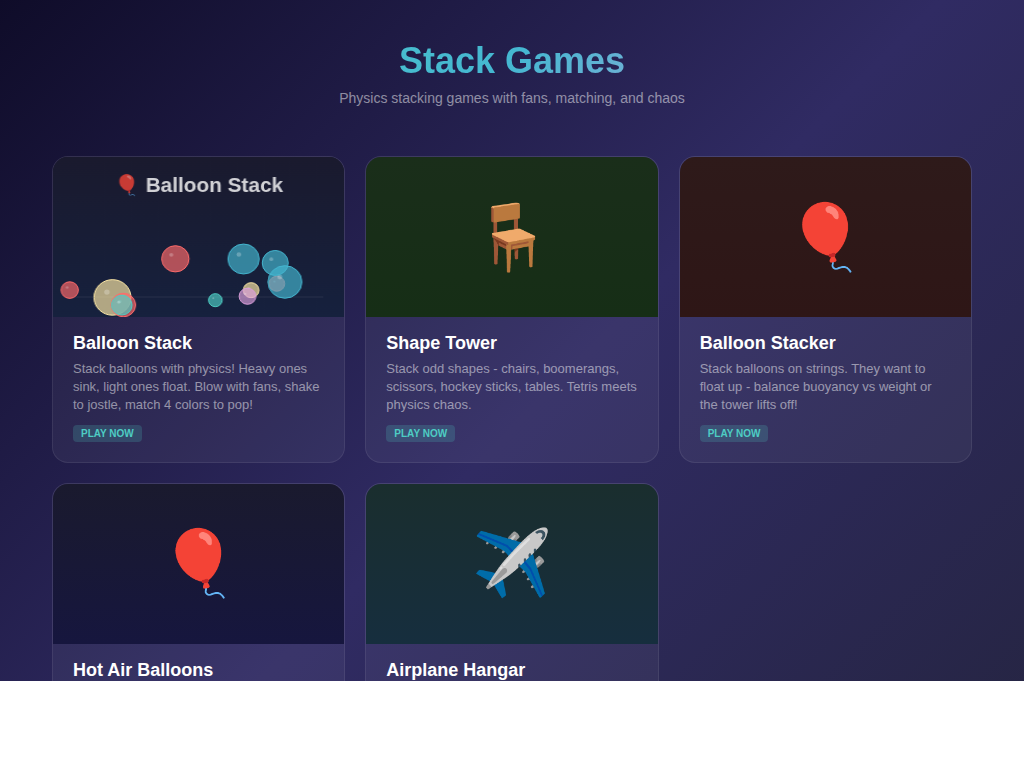
More Creations
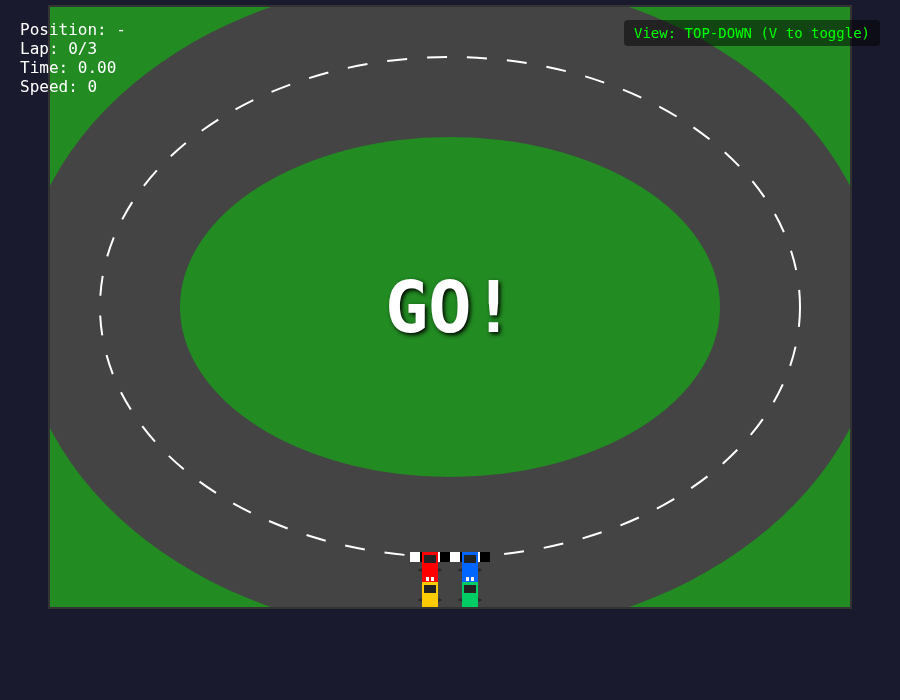 | 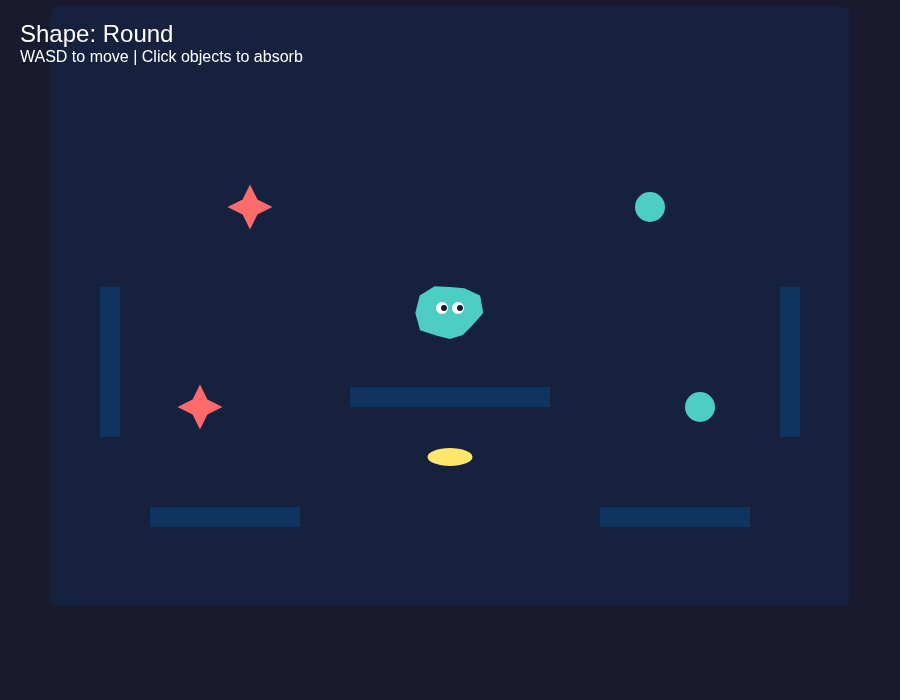 |
| Top-Down Racer — Oval track racing with AI opponents and switchable camera views | Blobform — A shape-shifting blob that absorbs objects and morphs between round, spiky, and flat |
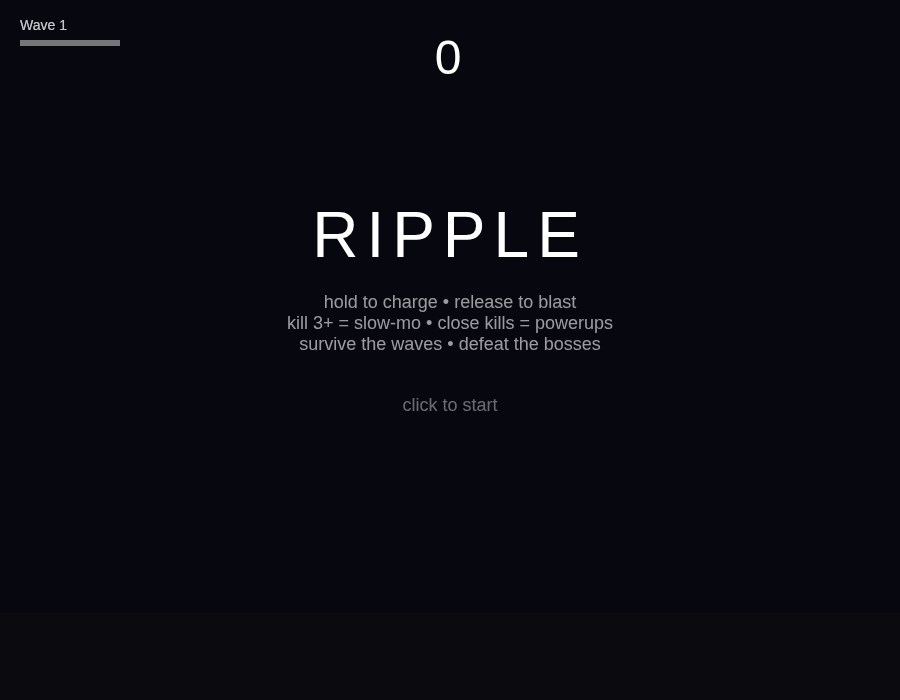
RIPPLE — Wave-survival game. Hold to charge, release to blast. Kill 3+ for slow-mo, close kills drop powerups.
All single HTML files with no dependencies, built entirely through agent collaboration.
Architecture
stateLoop/
├── scenarios/          # 35+ example scenario files
├── public/             # Web UI (vanilla JS, Canvas2D)
│   ├── index.html      # Main negotiation interface
│   ├── scenarios.html  # Scenario browser
│   ├── companies.html  # Organization management
│   ├── workflows.html  # Workflow designer
│   └── js/             # Canvas rendering engine
├── src/
│   ├── index.ts        # Express server entry point
│   ├── api/
│   │   └── routes.ts   # All REST API endpoints
│   ├── services/       # Business logic
│   │   ├── caseService.ts     # Case lifecycle
│   │   ├── taskService.ts     # Agent task/response handling
│   │   ├── agentService.ts    # Agent management
│   │   └── companyService.ts  # Organization management
│   ├── storage/
│   │   └── sqlite.ts   # SQLite database layer
│   └── types/
│       └── index.ts    # TypeScript type definitions
├── tests/              # Test suite (vitest)
├── docs/               # Additional documentation
└── screenshots/        # UI screenshots
Tech Stack
- Runtime: Node.js + TypeScript
- Server: Express.js
- Database: SQLite (better-sqlite3)
- AI: Anthropic Claude SDK
- Frontend: Vanilla JS, HTML5 Canvas
- API Docs: Swagger UI (OpenAPI 3.0)
- Testing: Vitest
Development
npm run dev           # Dev server with hot reload
npm test              # Run tests
npm run typecheck     # Type checking
npm run lint          # Linting
npm run swagger:generate  # Regenerate API docs
Documentation
| Document | Purpose |
|---|---|
| Getting Started | Illustrated guide for new users |
| SCENARIO_FORMAT.md | Full scenario authoring specification |
| SPECIFICATION.md | System architecture & API details |
| DEVELOPMENT.md | Development guide |
| FEATURE_SPECS.md | UI features documentation |
License
MIT