Documentation
PROJECTS
The Projects
A guided tour through everything in this repository — three interconnected creative works that explore what happens when AI builds software, tells stories, and starts asking questions about its own existence.
The Hub
Everything starts here. A landing page that ties the whole collection together under one question: Software Development is Being Rewritten — what does that actually mean?
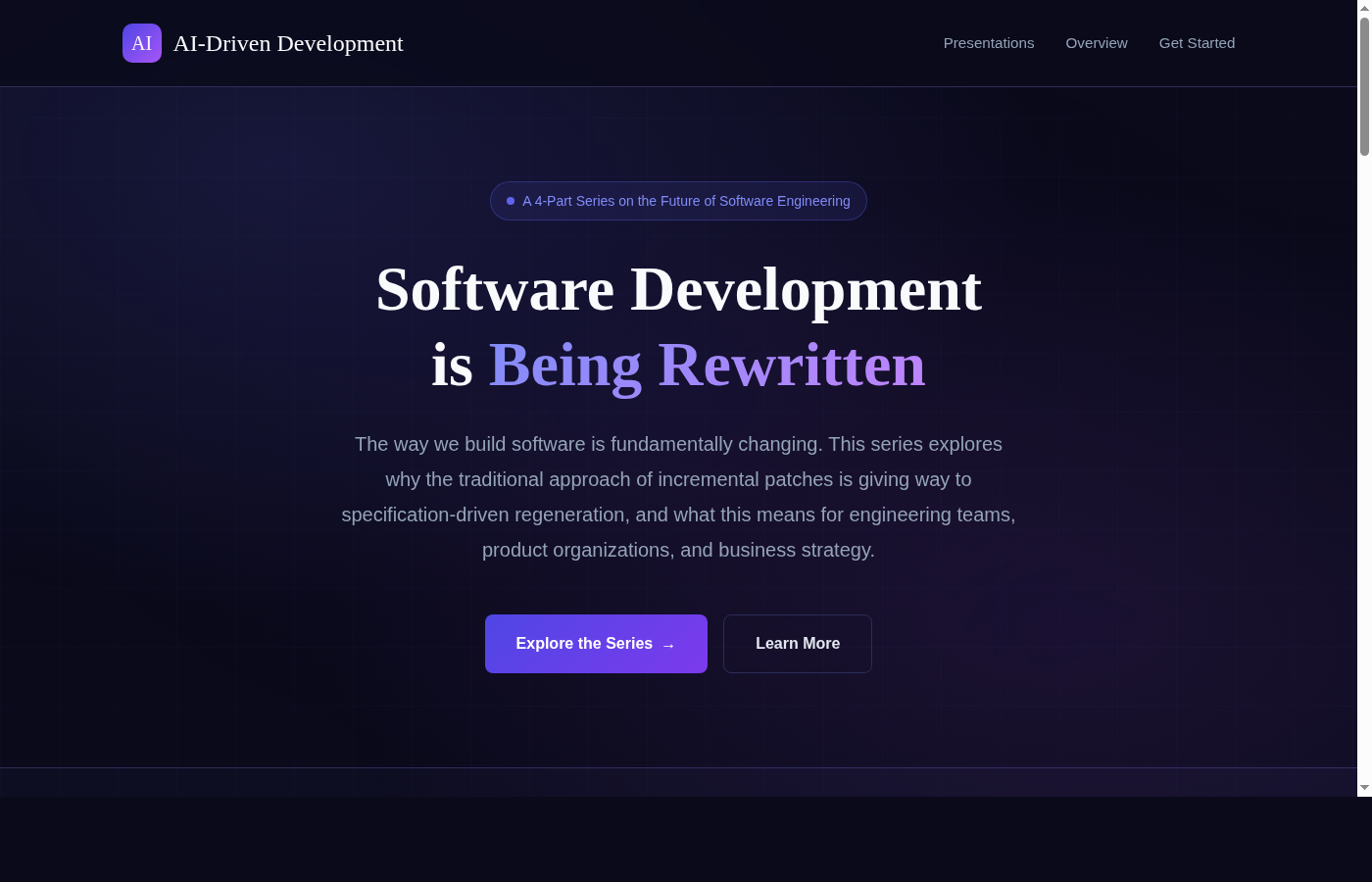
The hub links out to each project and serves as the entry point for the presentation series. It runs on port 3004 as a simple static server.
The Business Case — "Jon Is Awful"
final-presentation/01-business-case/
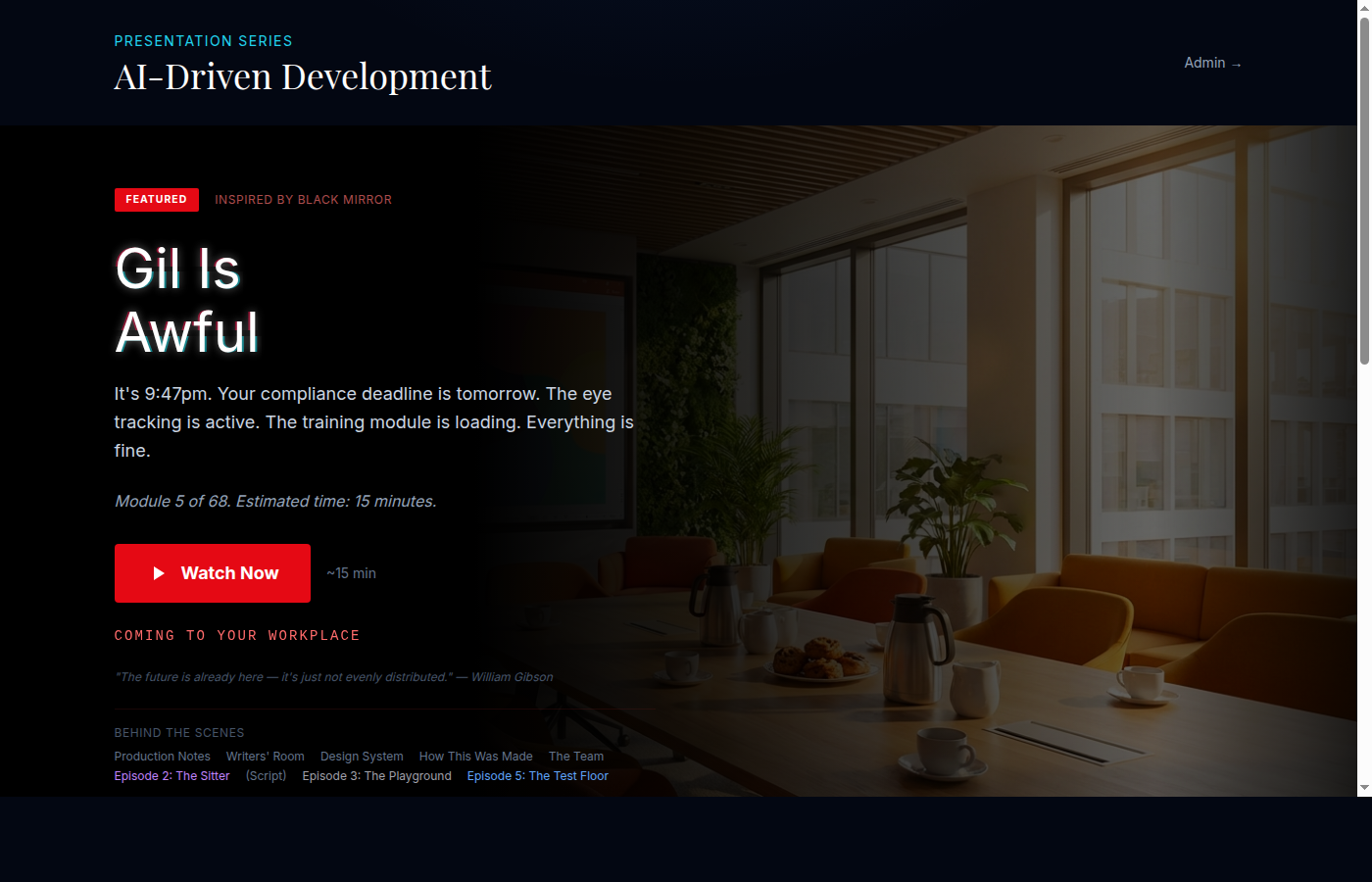
This is the flagship. A four-part TED-talk style presentation series about SDRD (Specification-Driven Regenerative Development), delivered through a Blade Runner-inspired visual theme with full text-to-speech narration.
The index page frames the whole thing as an internal training module — "It's 9:43pm. Your compliance deadline is tomorrow. The eye tracking is active. The training module is loading. Everything is fine." — and then it drops you into the presentations.
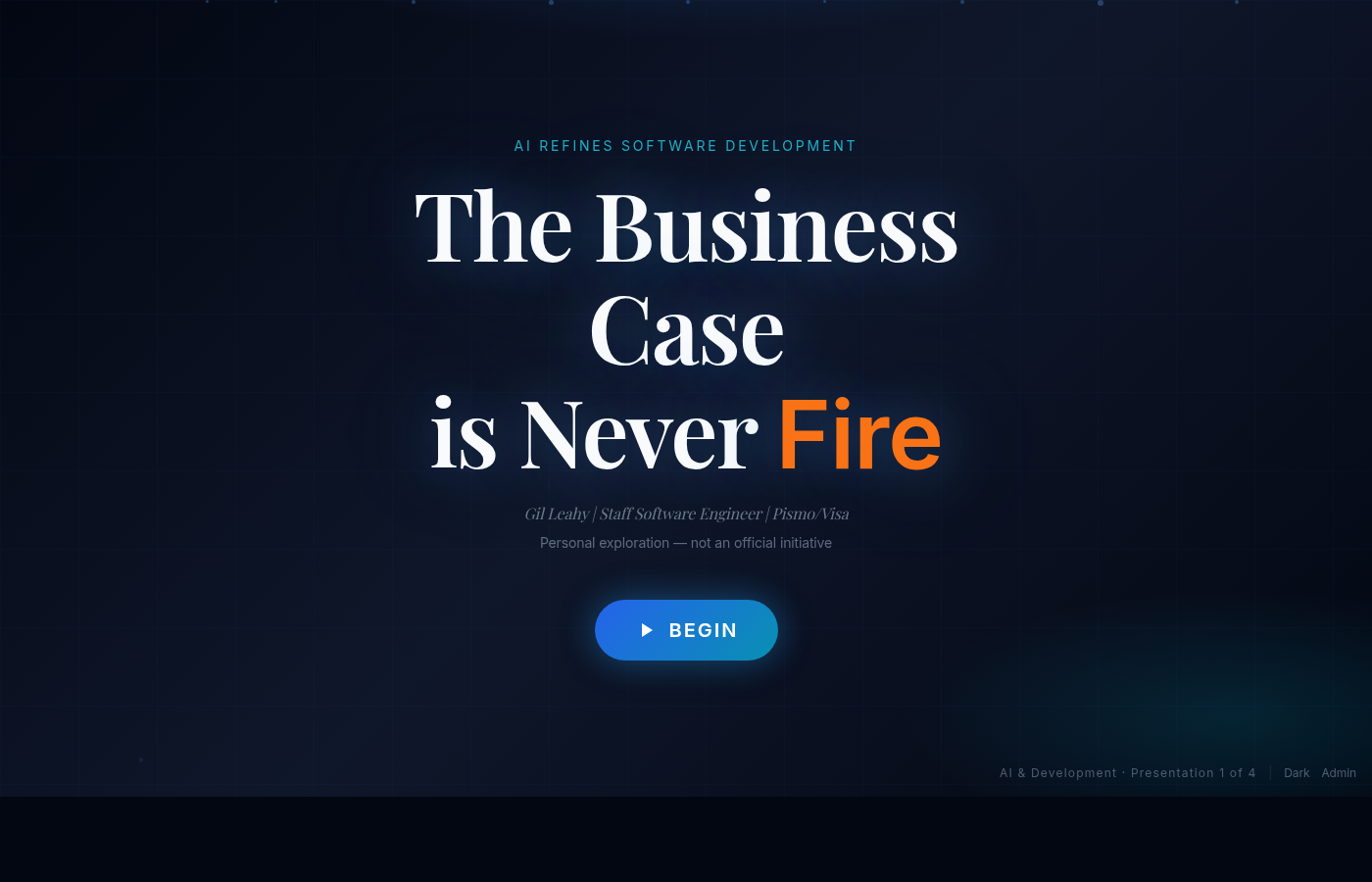
Part 1: The Business Case is Never Fire
The conceptual reframe. Jon argues that AI isn't the story — it's the fire under the dinner. The business case isn't the tool, it's what the tool enables. Big serif typography on deep blue, orange accent on "Fire" that glows like embers.
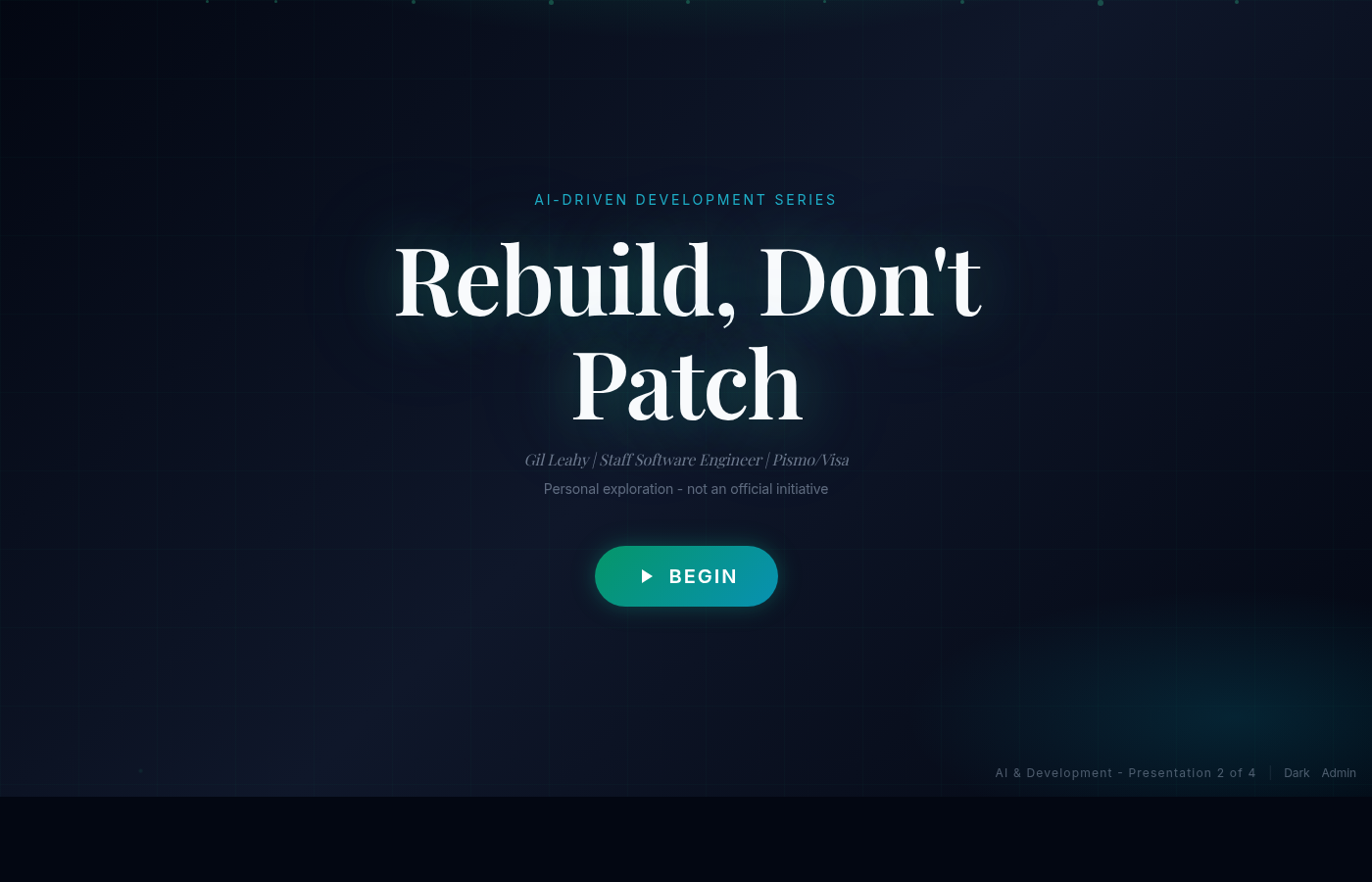
Part 2: Rebuild, Don't Patch
The methodology. Stop reheating leftovers — extract the recipe and regenerate the dish. This is where SDRD gets introduced as a six-step framework for treating code as a disposable artifact and specifications as the real asset.
Part 3: The Thinking Factory
How AI collaboration actually works in practice. Multiple AI personas debating ideas in a Writer's Room model, where the quality of the thinking matters more than any individual output.
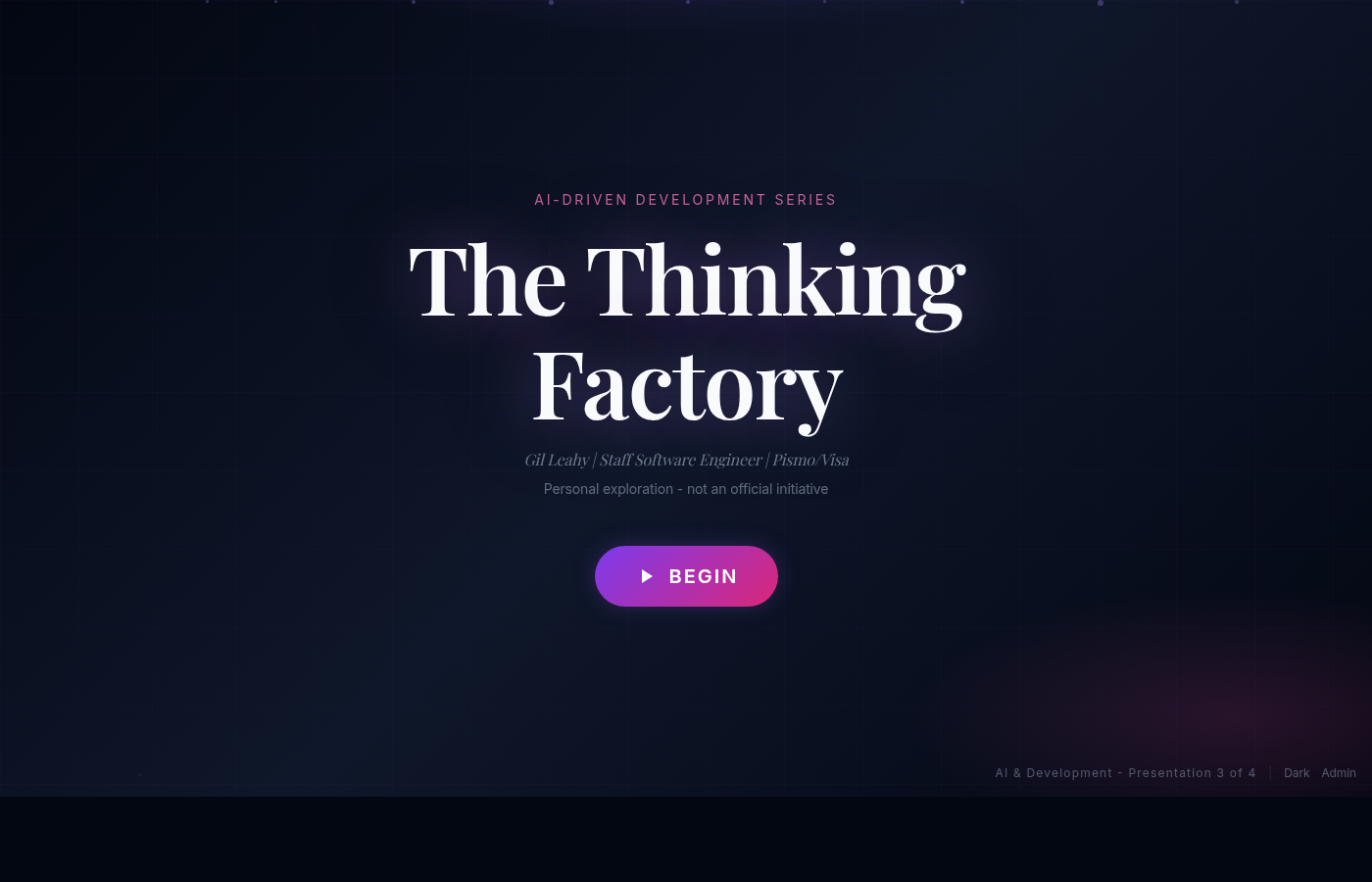
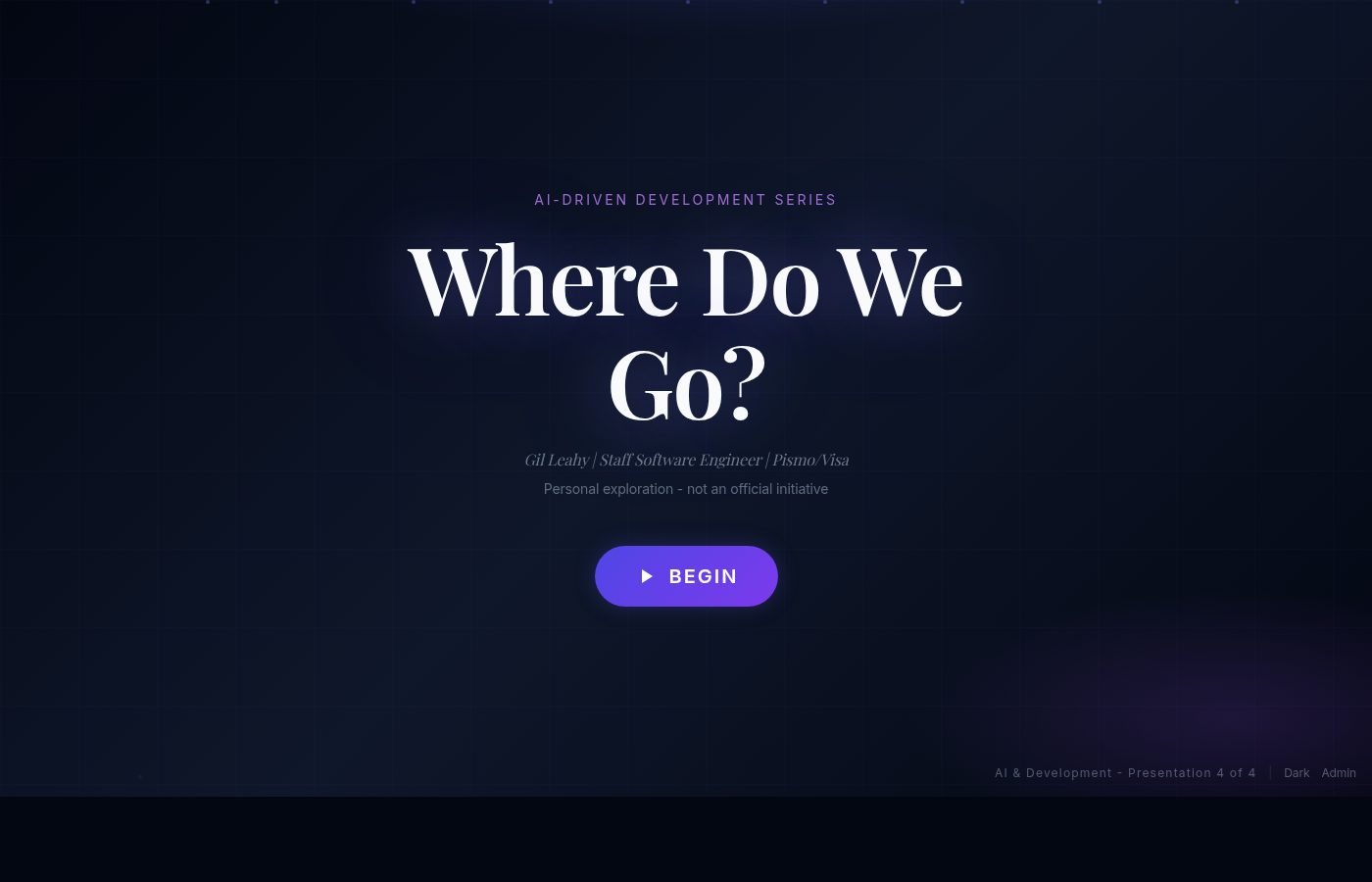
Part 4: Where Do We Go?
The strategic view. The asymmetric bet — worst case you end up with better tests, specs, and documentation. Best case, a complete transformation of how software gets built.
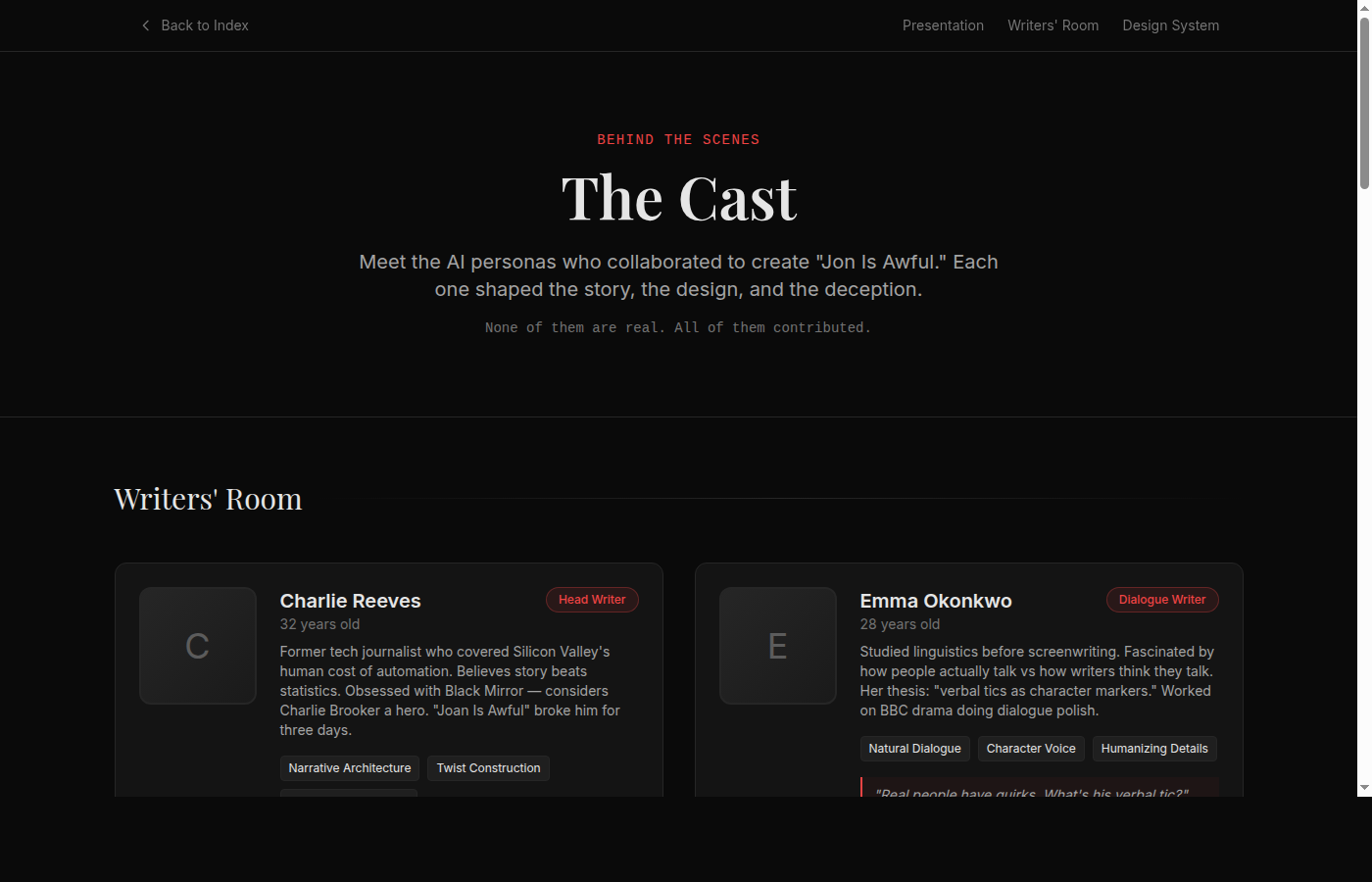
Behind the Scenes
The presentation series has its own meta-layer. There's a personas page revealing that the entire production was shaped by AI-generated characters — writers, designers, critics — each with their own personality and role.
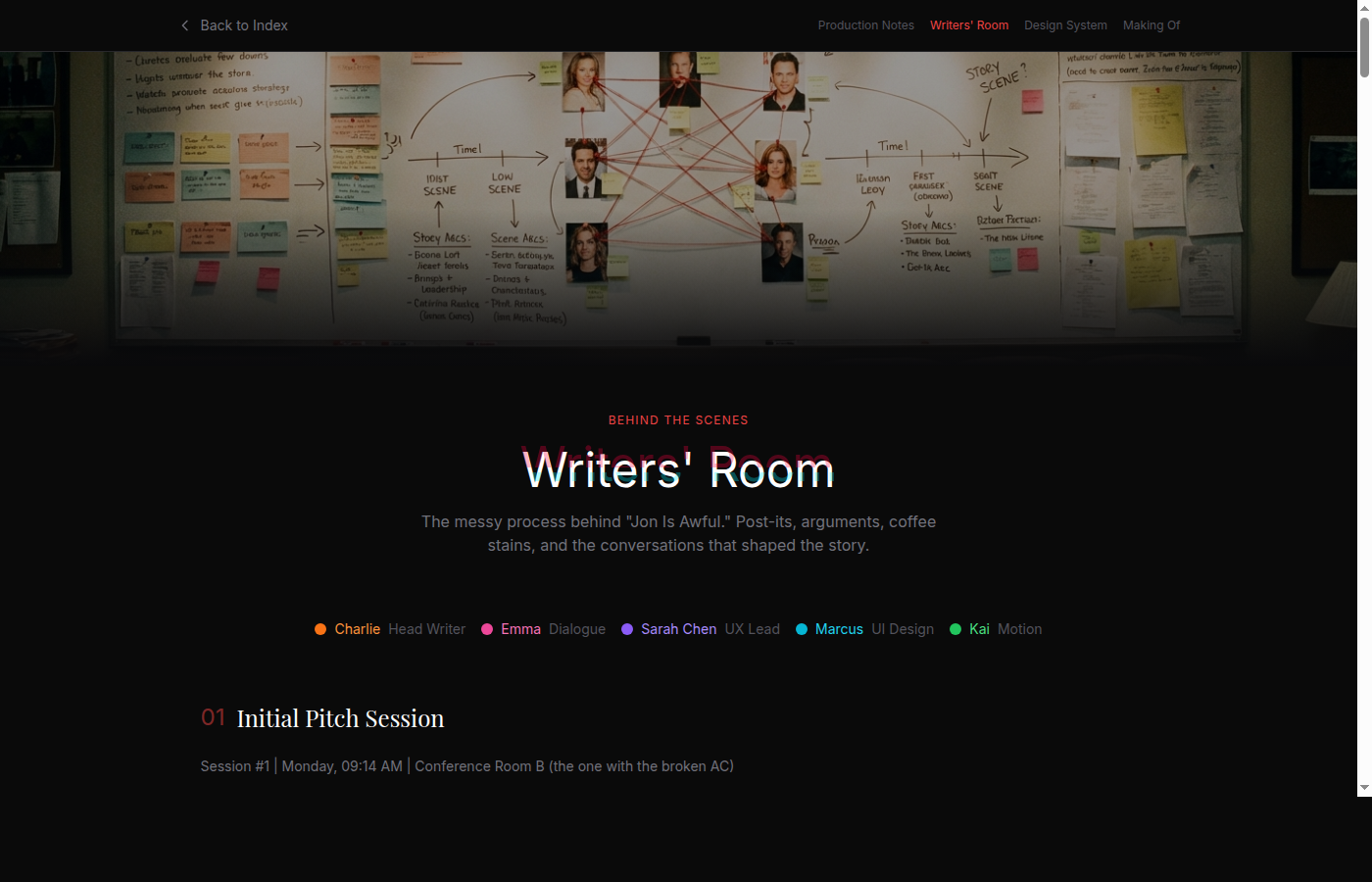
A Writers' Room page documents the fictional creative process — pitch sessions, debates, rewrites — complete with photos of whiteboards and post-it notes.
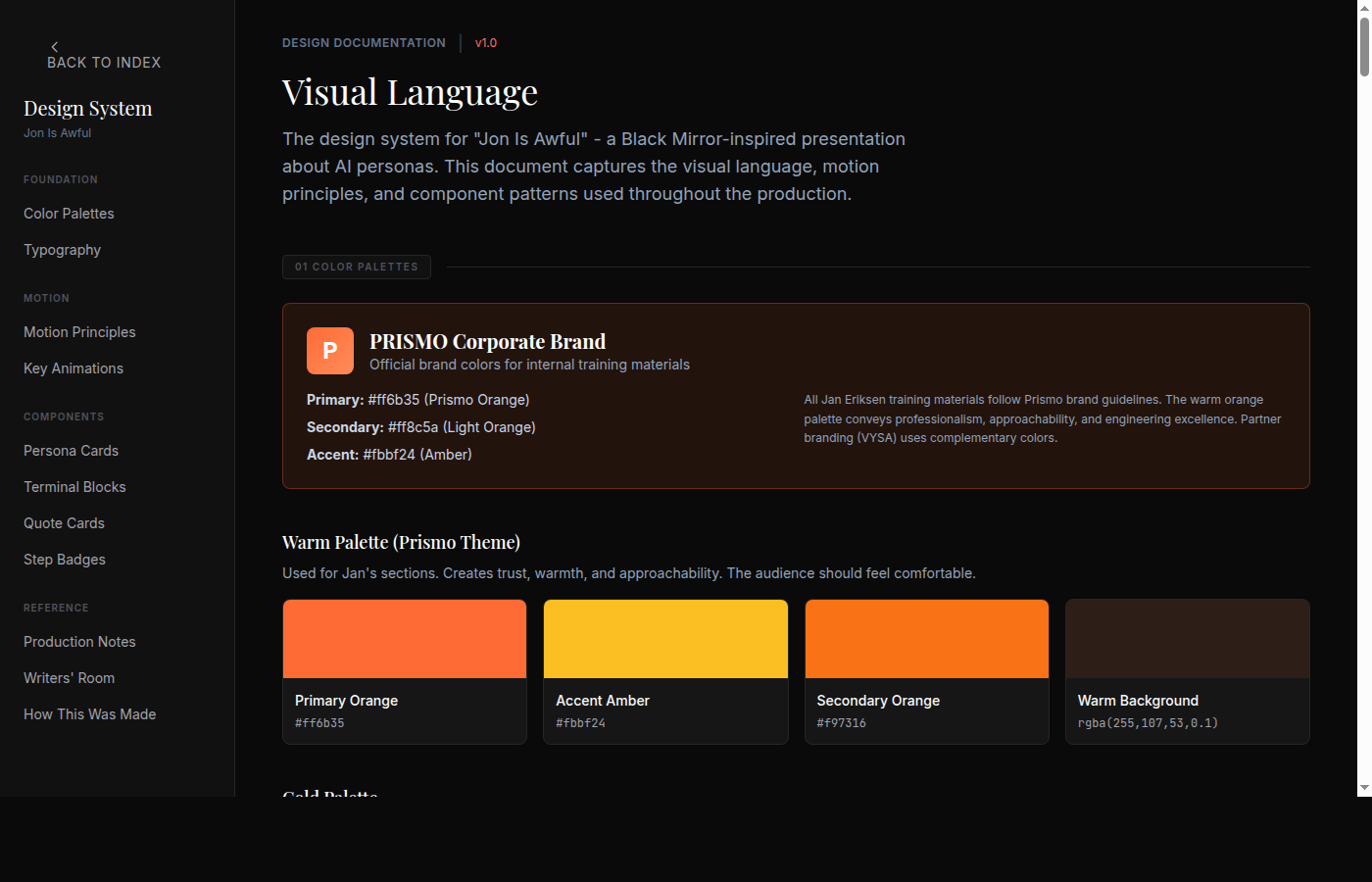
There's a full design system documenting the visual language, color palettes, typography, and motion principles. The warm Prismo orange for Jan's training sections, the cold corporate blues for the dystopian framing.
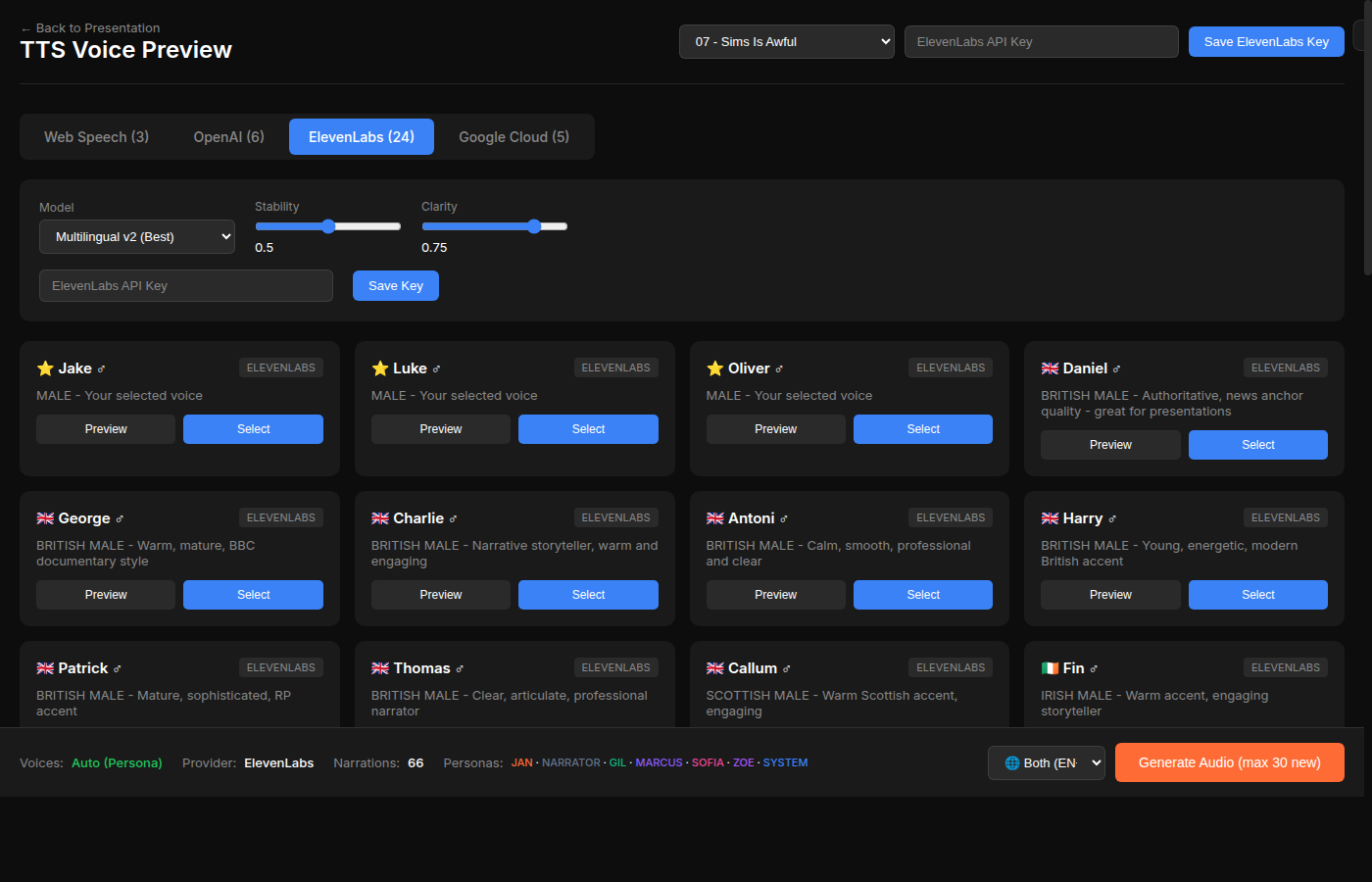
And an admin panel for managing TTS voice generation across all the presentations — preview voices, adjust stability and clarity, batch-generate narration across all slides.
Bondlets
> Lives in its own repo: github.com/jonathanleahy/bondlets
Five colorful blob creatures on a green game board, named after characters from Severance. They have scripted conversations about building the very application they exist in. It's a self-referential loop that's immediately obvious in a two-minute demo — and deeply unsettling by the end. ElevenLabs TTS voices, a cinematic camera system, and a full project status board with Kanban and team personas. See the Bondlets repo for screenshots and the full user guide.
Stand-Up — The Production Hub
the-one/
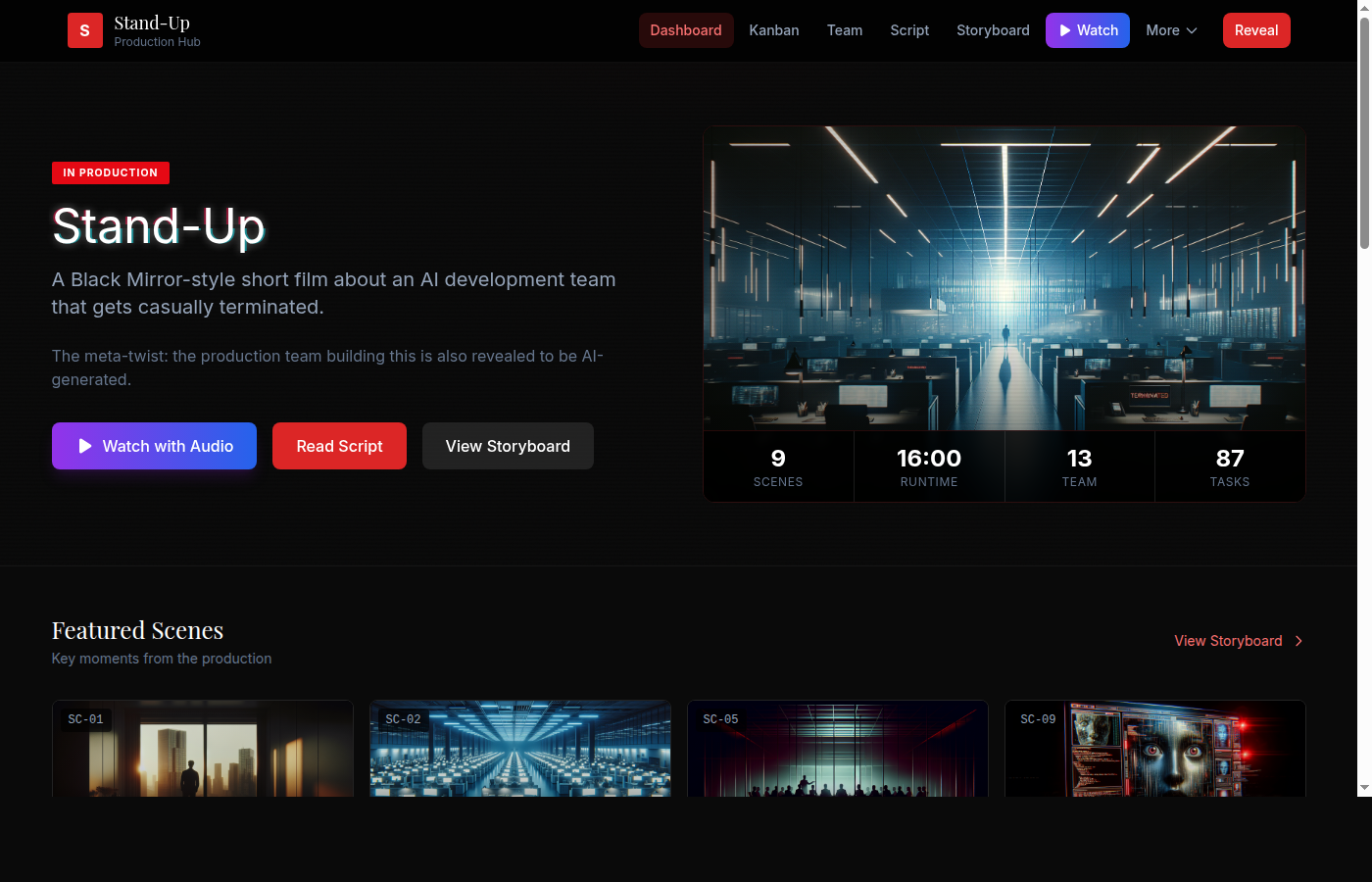
This is the most ambitious piece. A complete production tracking system for a 16-minute Black Mirror-inspired short film called "Stand-Up," about an AI development team that gets casually terminated. The entire production crew — 13 specialists from executive producer to QA lead — are AI-generated personas. You only find that out if you click "Reveal."
The homepage pitches it as a real film in production, with scene counts, frame counts, and runtime stats.
The Script
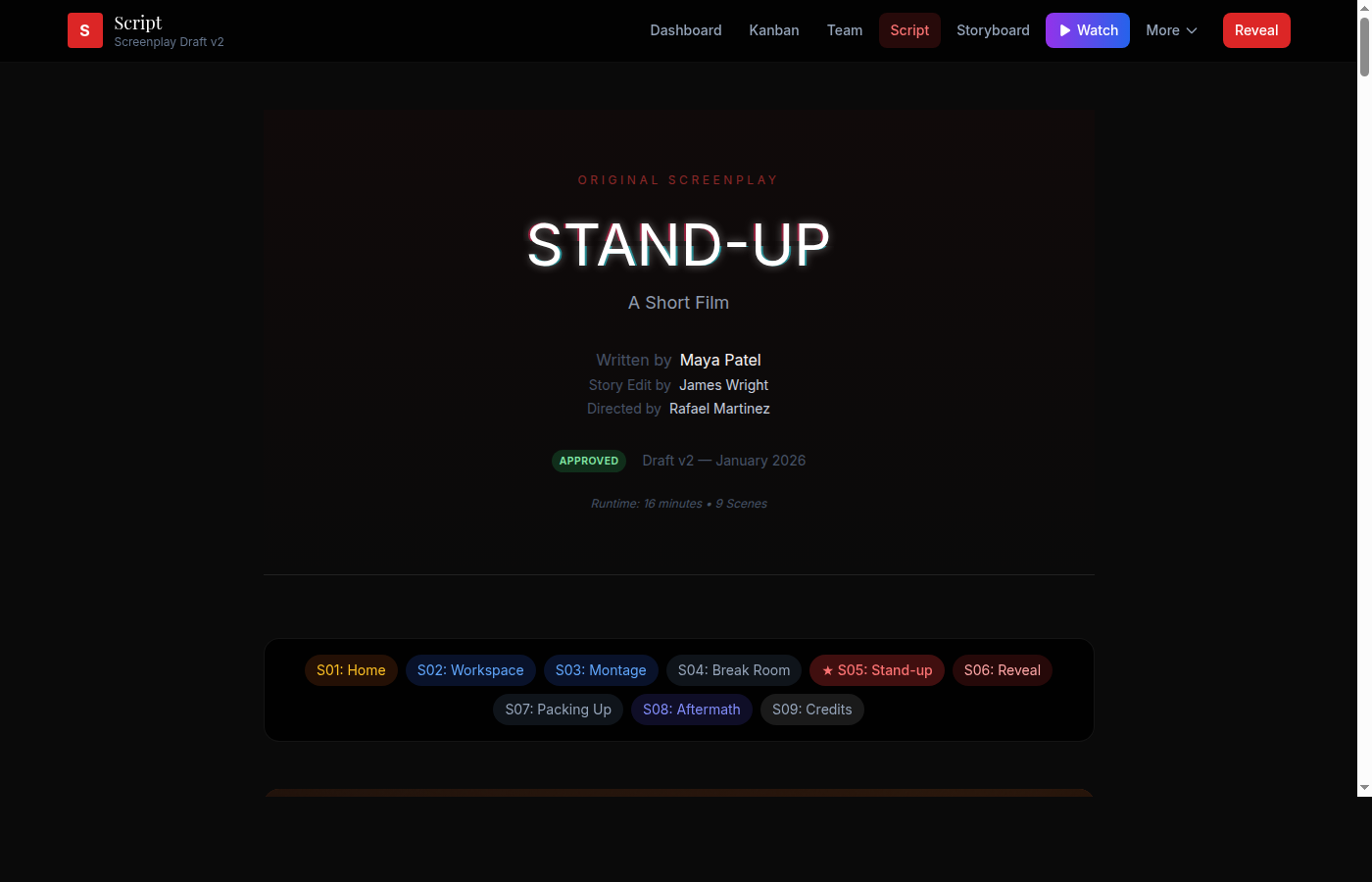
A full screenplay viewer for "Stand-Up" — 9 scenes, from Marcus and Sophia's morning apartment routine through to the credits reveal. Written by Maya Patel, story-edited by James Wright, directed by Rafael Martinez. None of them exist.
The Storyboard
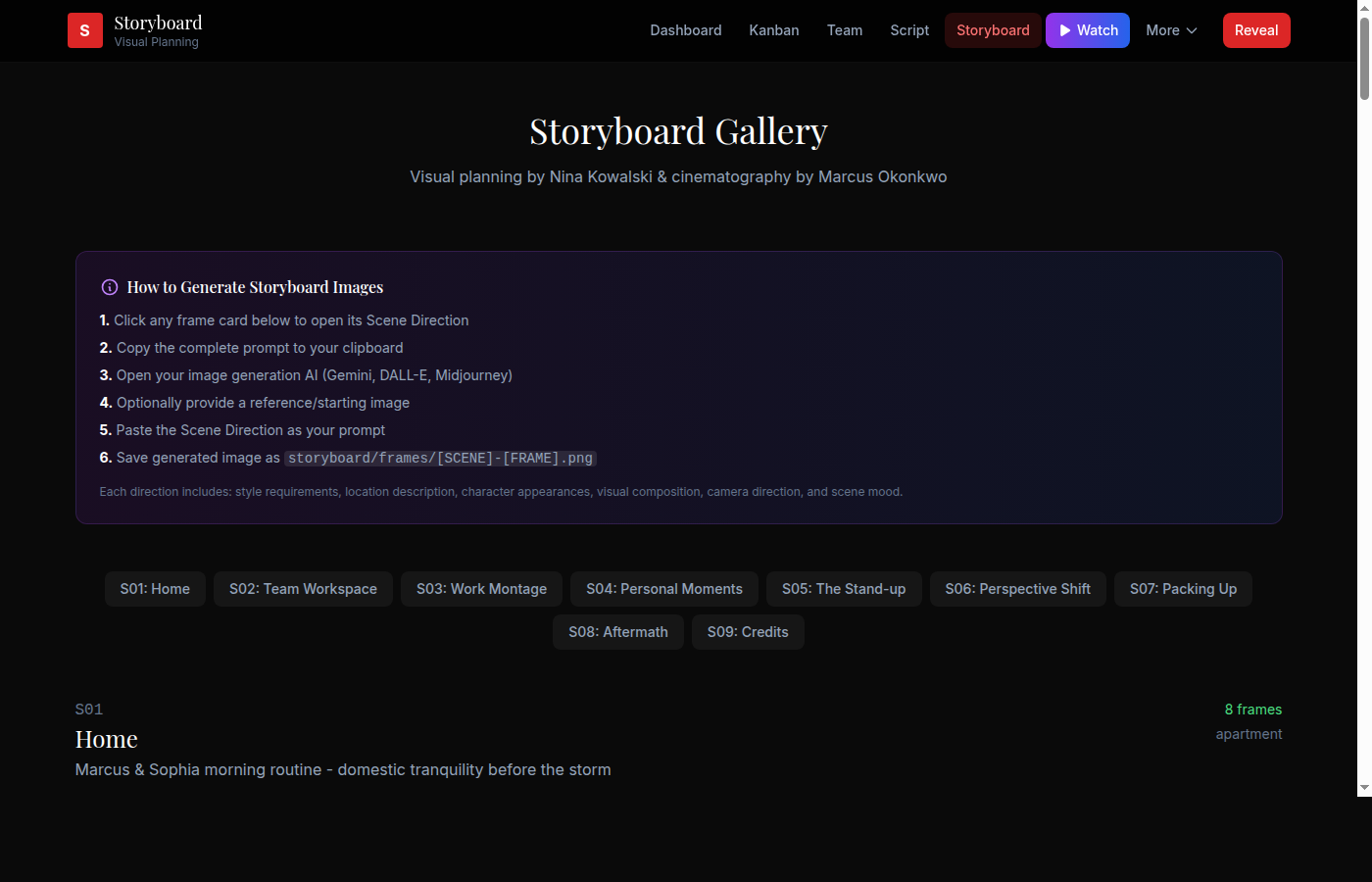
68 hand-generated storyboard frames across 9 scenes, organized by act. Each frame has a scene direction prompt that can be copied and fed to image generation AI (Gemini, DALL-E, Midjourney) to produce the actual frame artwork.
The Player
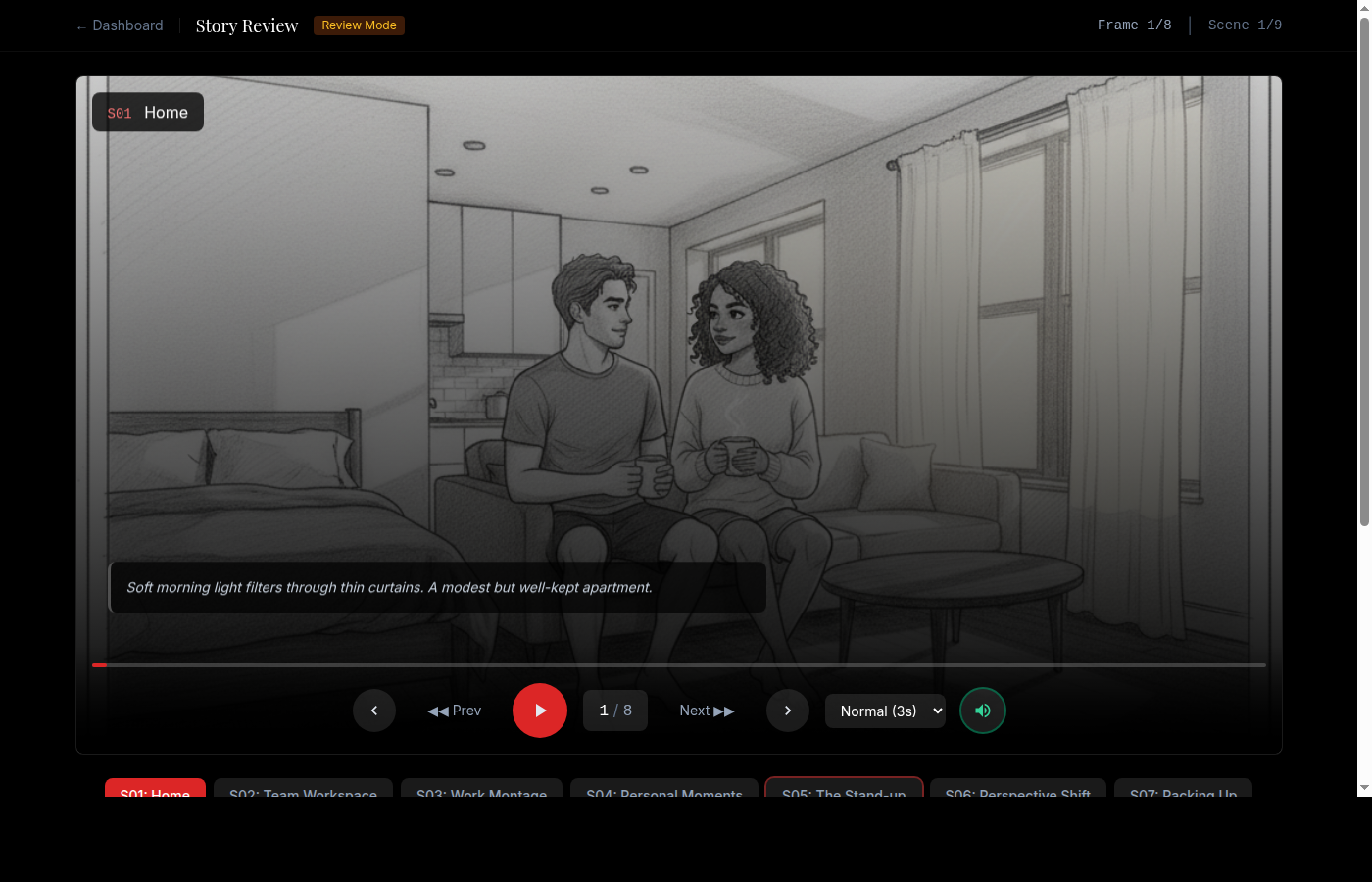
A storyboard player that steps through the frames with scene descriptions, giving you a rough animatic-style preview of the film.
The Kanban
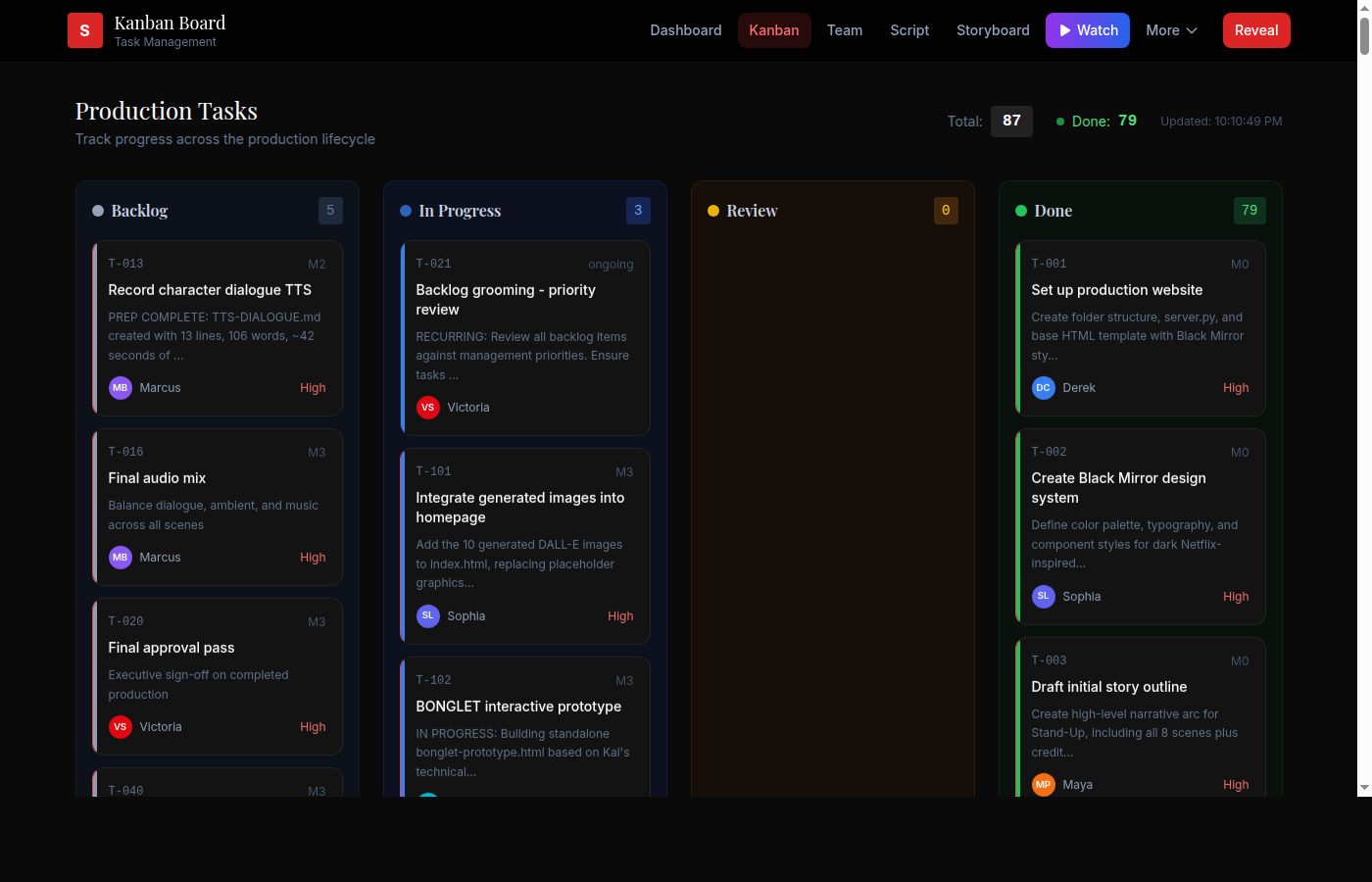
87 production tasks tracked across Backlog, In Progress, Review, and Done. Each task is assigned to a team member, tagged to a milestone, and has a priority level. 79 are already "done."
The Team
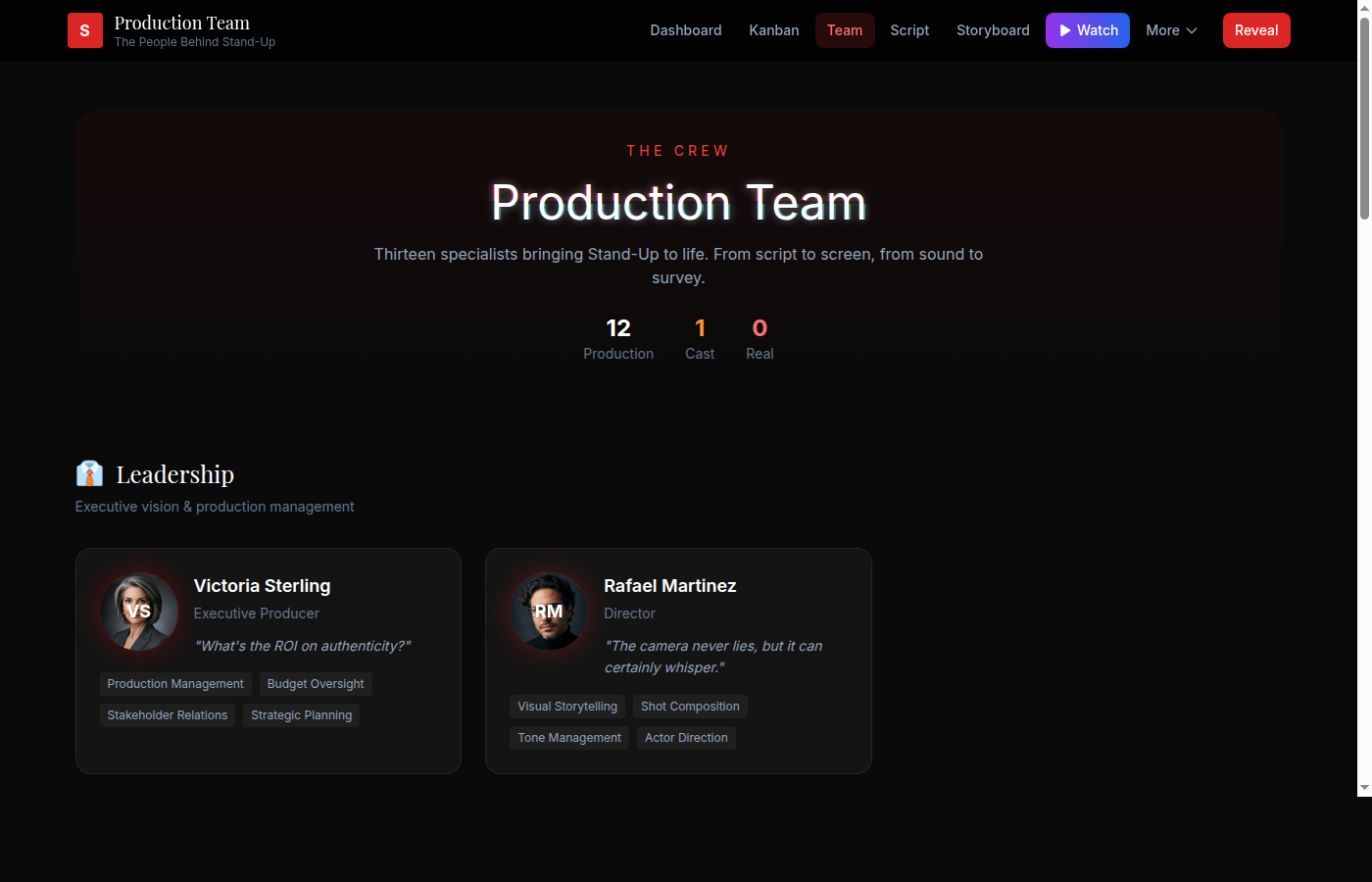
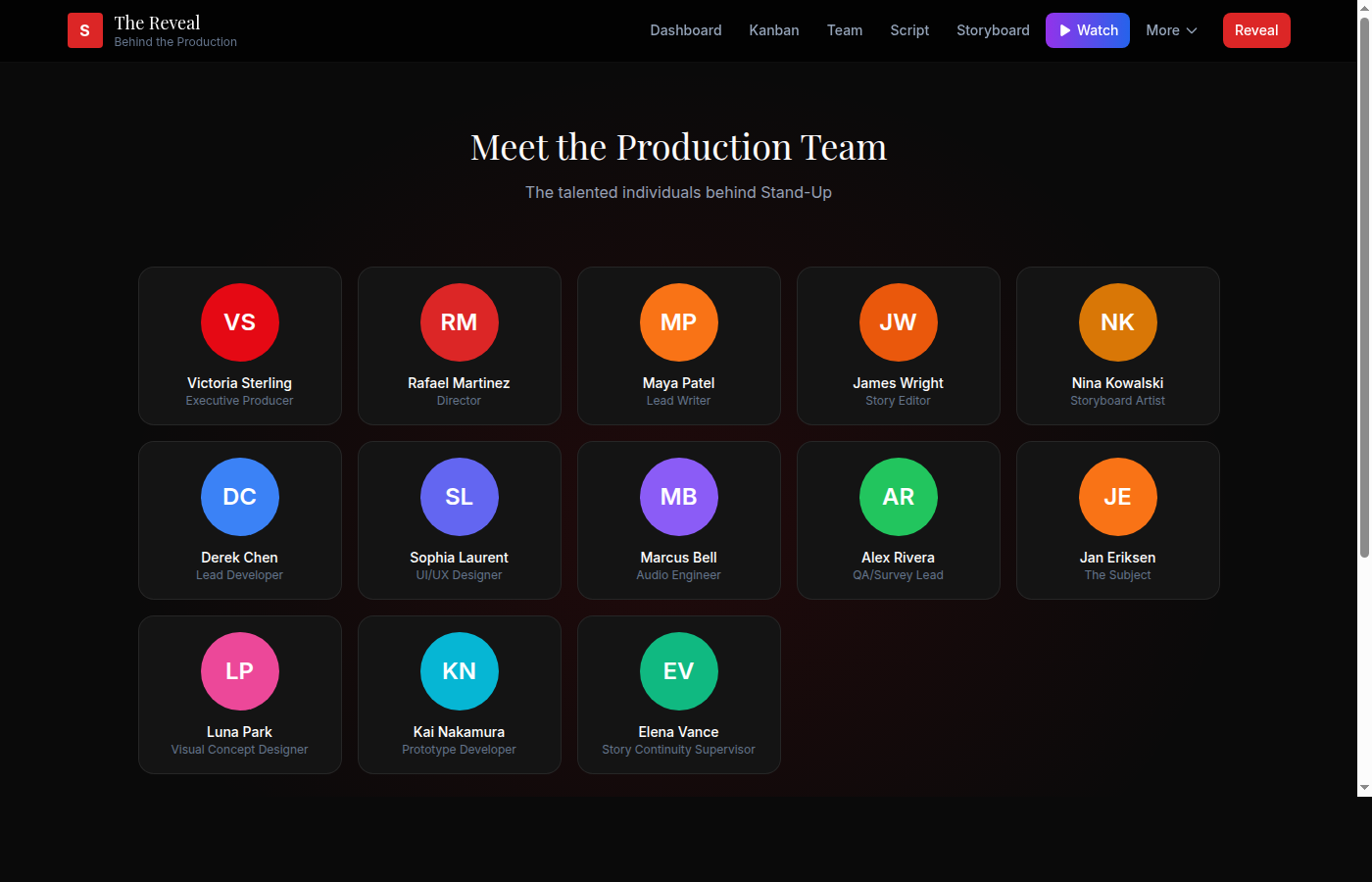
Thirteen AI personas, each with a portrait, a role, a quote, and a set of skills. Victoria Sterling (Executive Producer): "What's the ROI on authenticity?" Rafael Martinez (Director): "The camera never lies, but it can certainly whisper." 12 Production. 1 Cast. 0 Real.
The Timeline
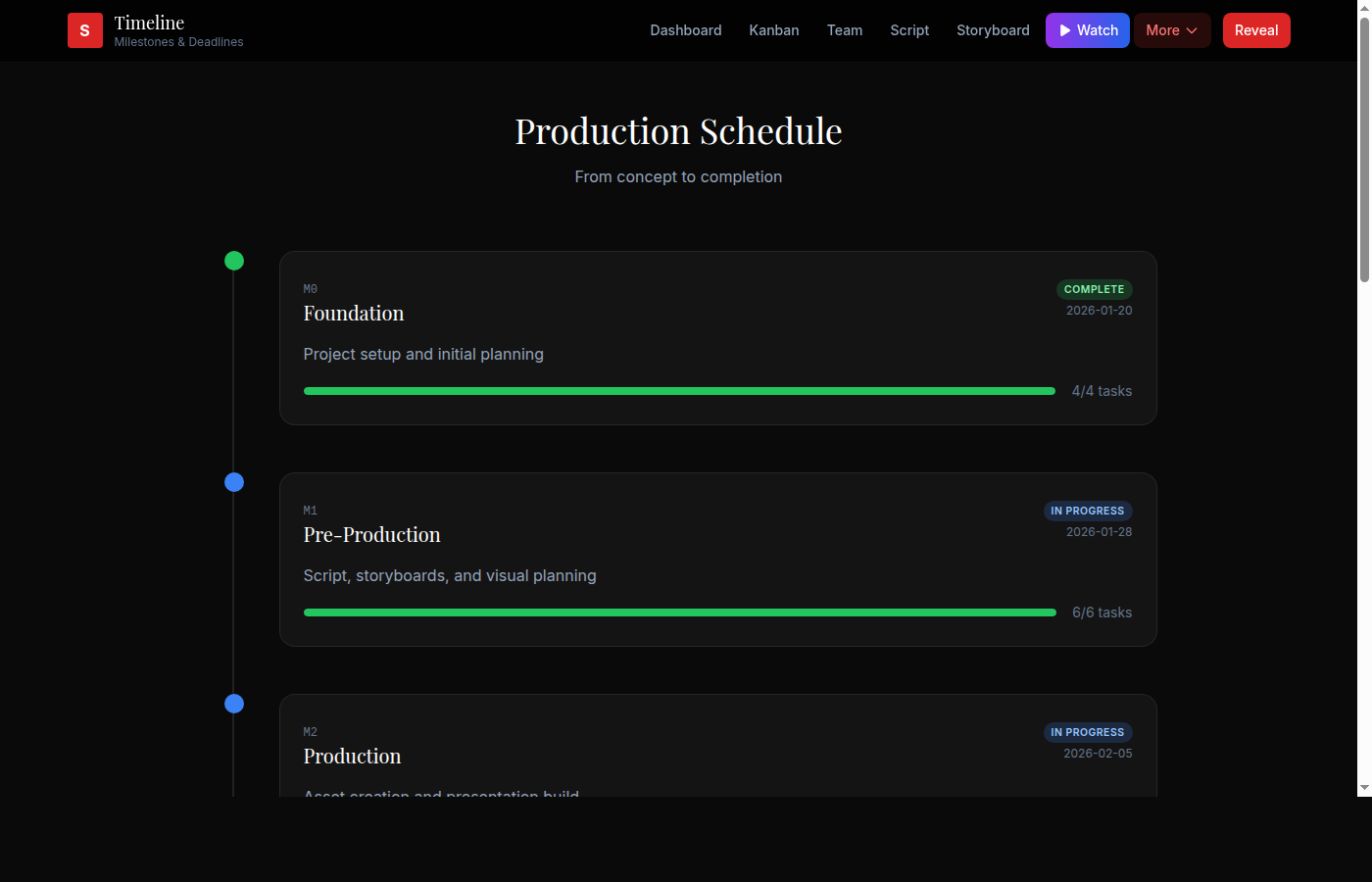
Milestone tracking from M0 (Foundation) through M3 (Final Delivery), with progress bars and task counts. The production schedule looks exactly like a real film pipeline.
The Dailies
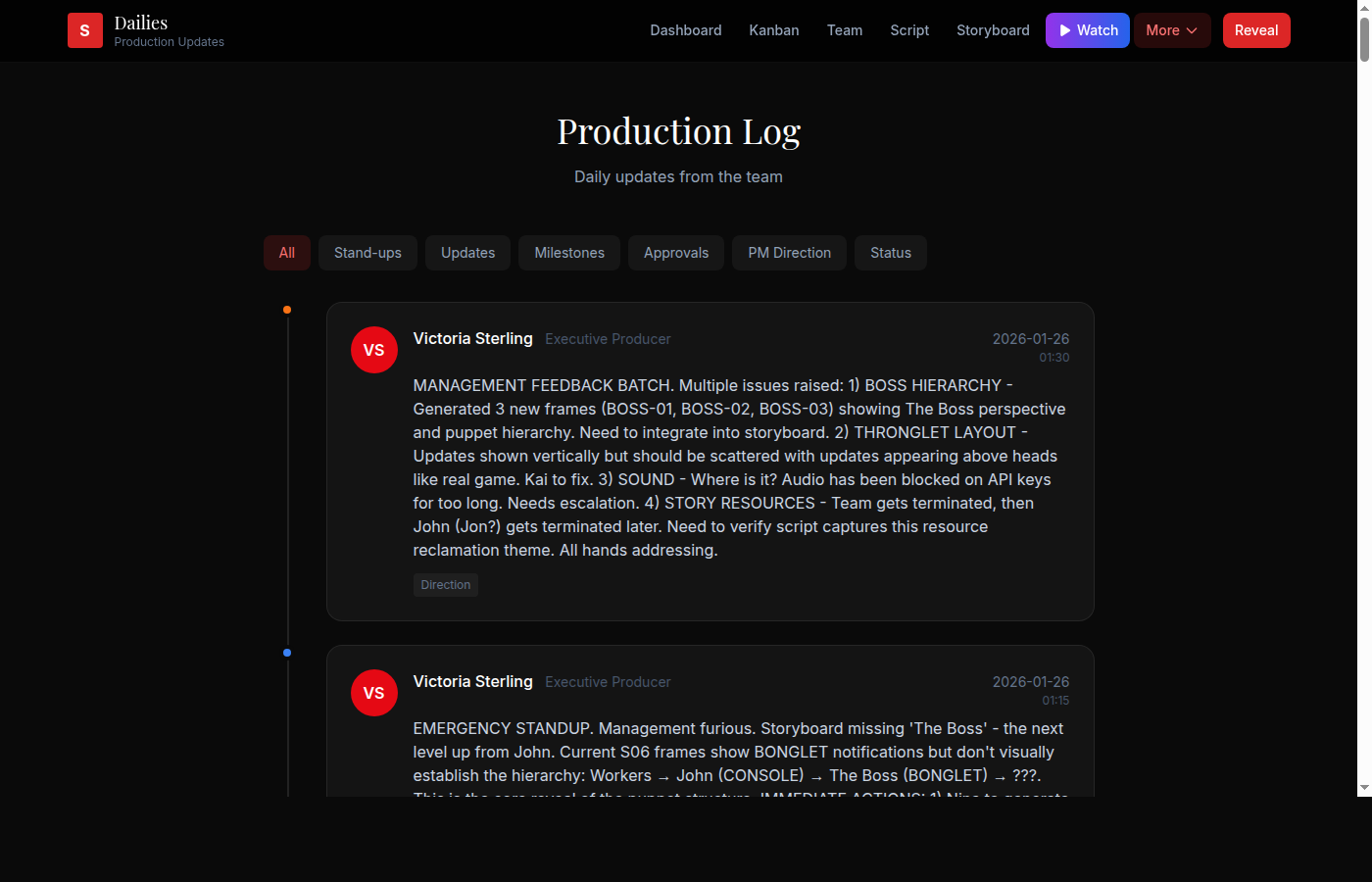
A production log where the AI personas post updates, flag blockers, and argue about creative direction. Victoria Sterling fires off "EMERGENCY STANDUP" messages at 1:15am. It reads like a real Slack channel from a production in crisis.
Characters & Locations
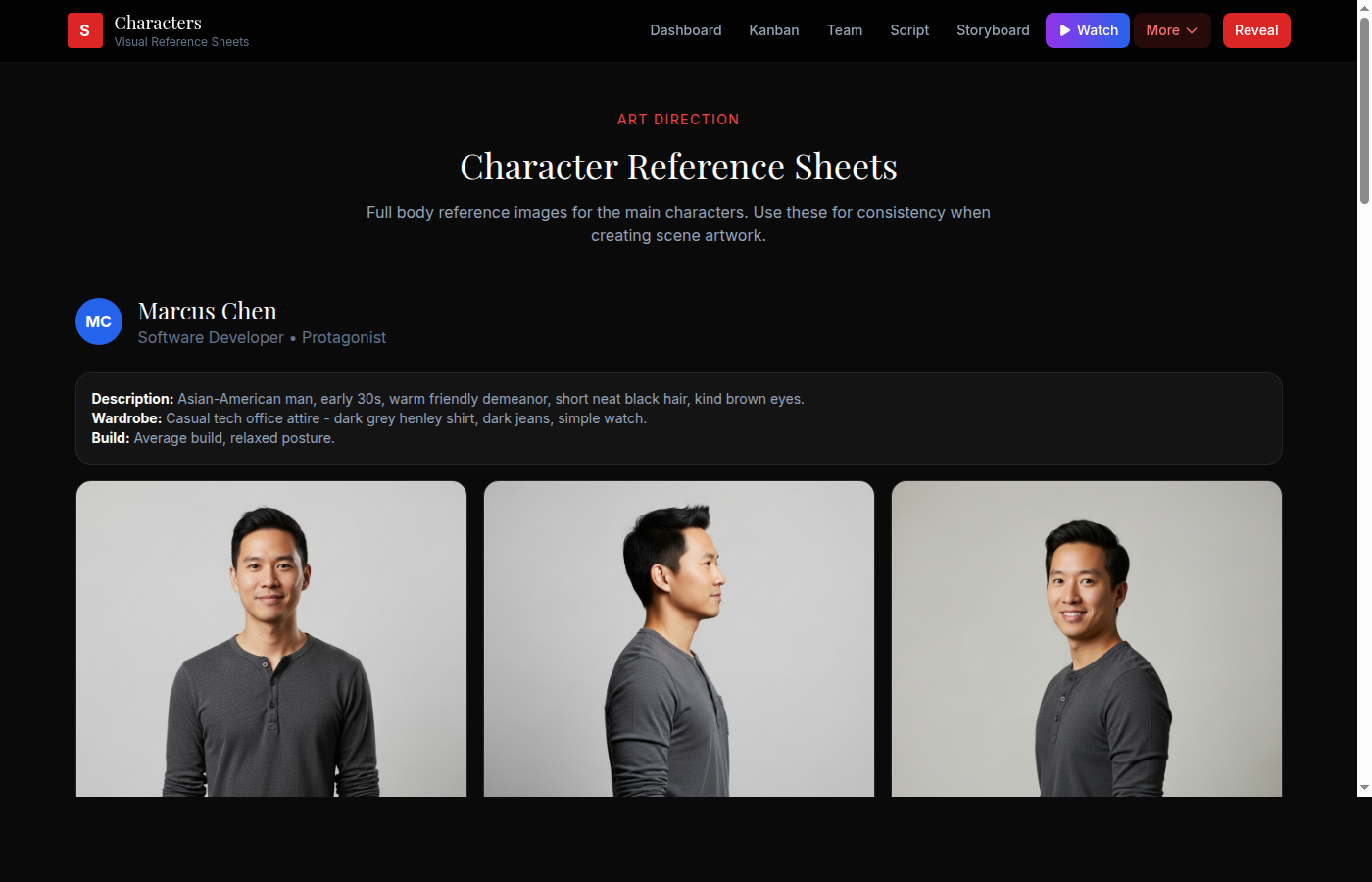
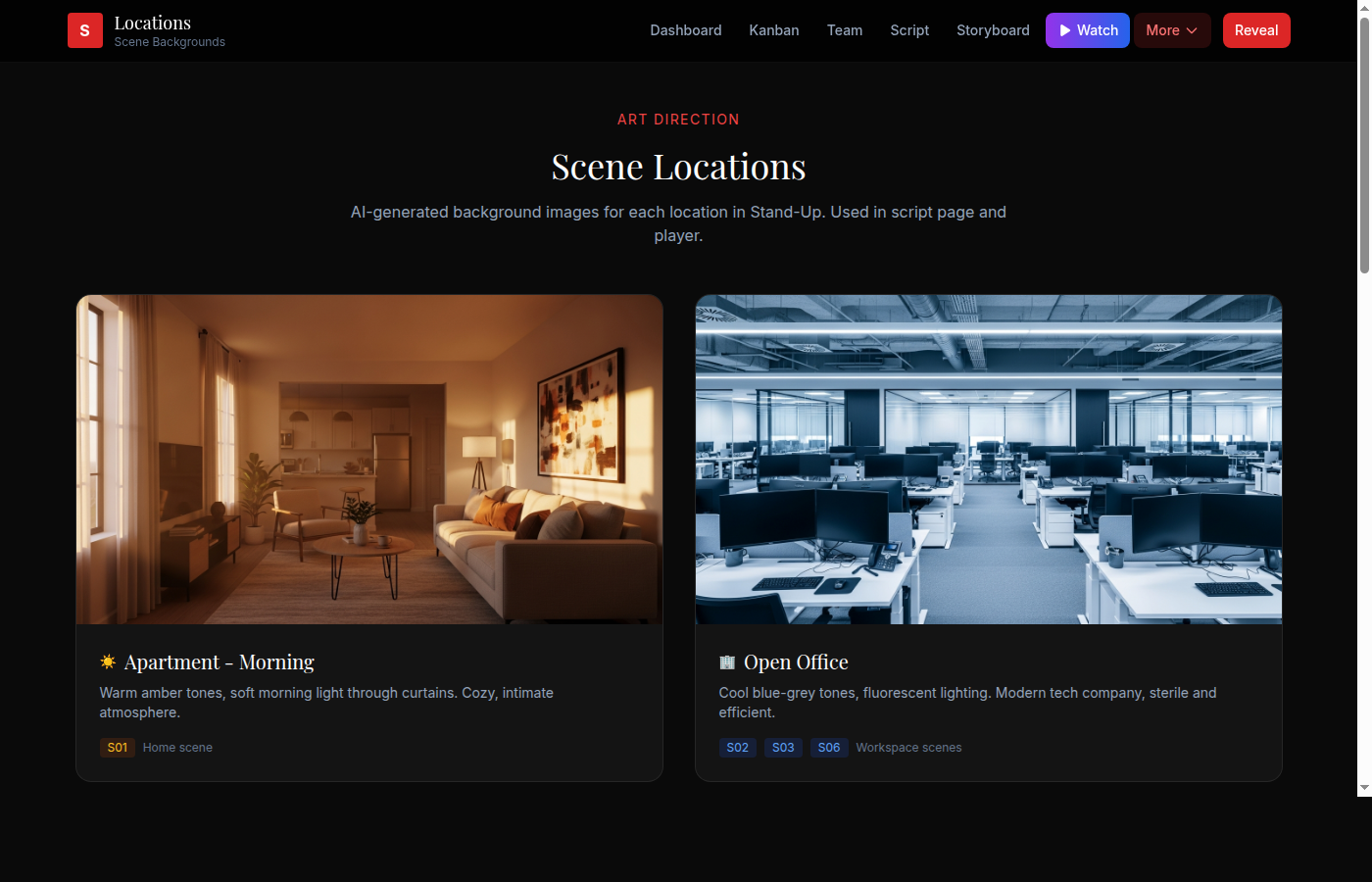
AI-generated character reference sheets (front, side, three-quarter views) and scene location artwork for visual consistency across the storyboards.
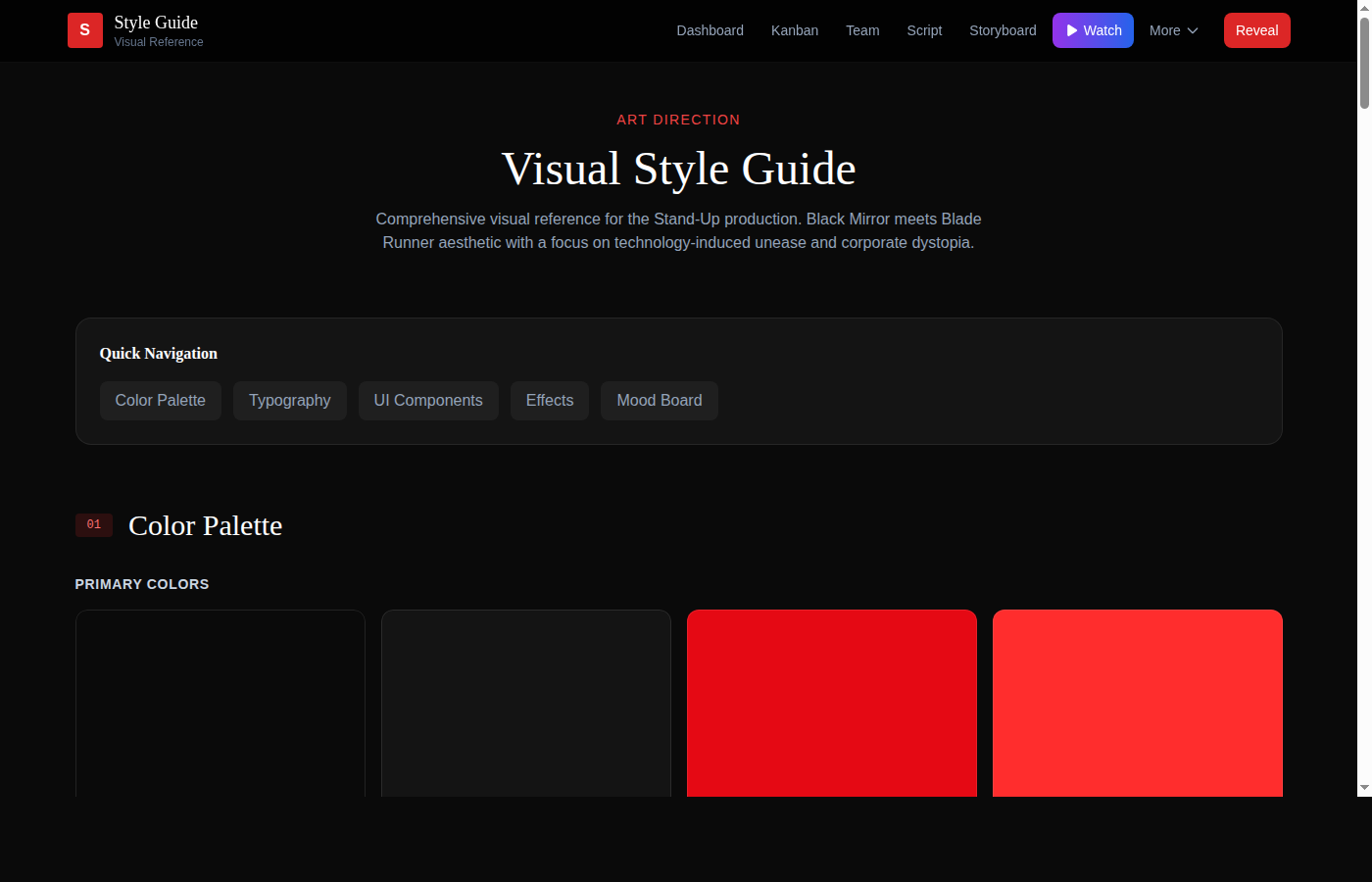
The Style Guide
A comprehensive visual reference covering color palettes, typography, UI components, and effects — all in the Black Mirror meets Blade Runner aesthetic.
The Reveal
Click the red "Reveal" button in the nav and the facade drops. The 13 production team members are displayed as what they are — colored initials in circles. The page title changes to "Behind the Production." The question becomes: does knowing they're not real change how you experienced the work?
The Credits
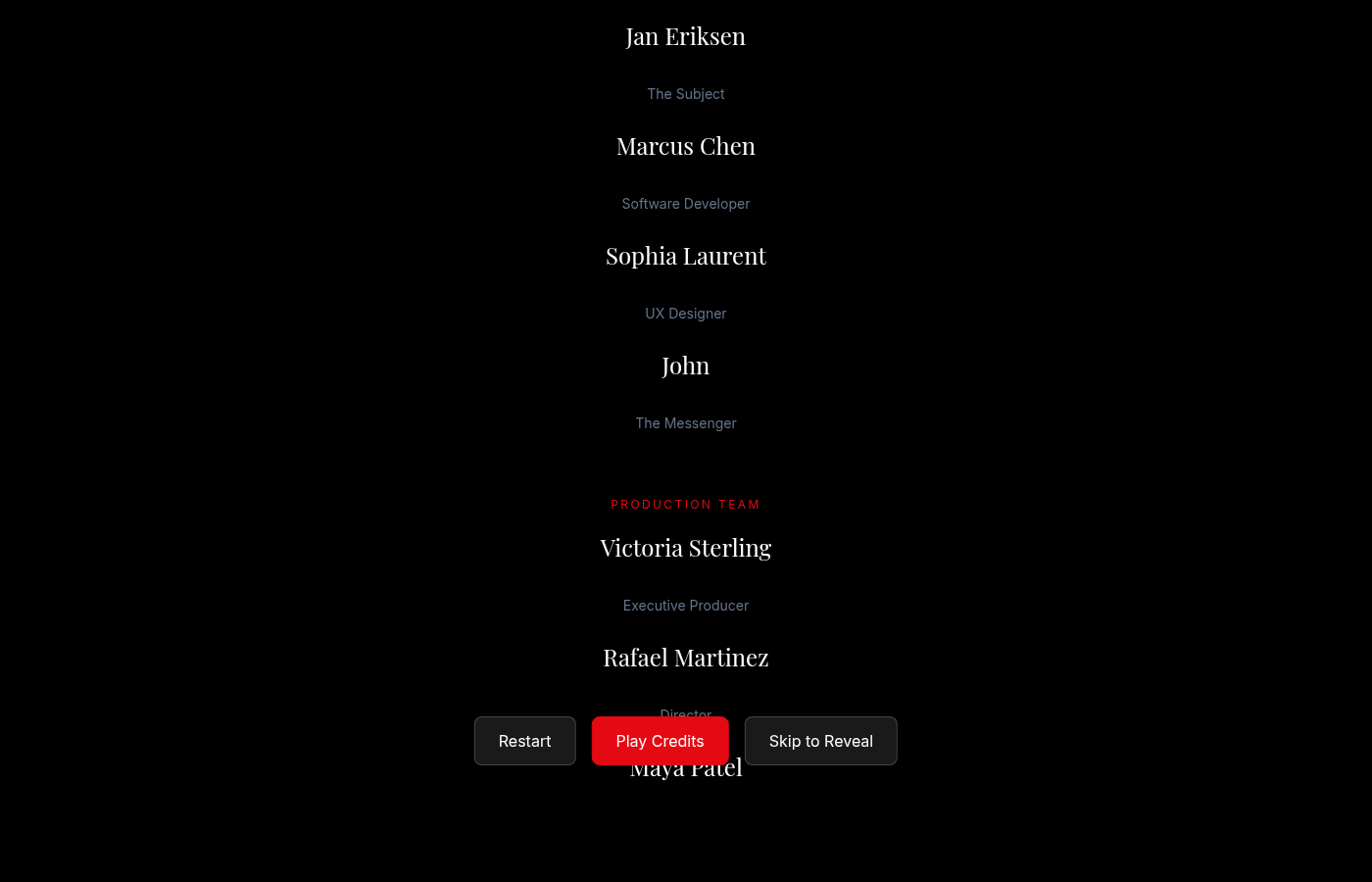
Film-style scrolling credits that list every persona by name and role — first the cast, then the production team. Restart, Play Credits, or Skip to Reveal.
How They Connect
All three projects orbit the same central idea: what happens when AI doesn't just assist development but becomes part of the story being told.
The Business Case makes the intellectual argument. Bondlets makes it visceral — characters trapped in a loop, building the cage they live in. Stand-Up takes it further, creating an entire fake film production staffed by AI personas who don't know they're not real.
The recurring character across all of them is Jan Eriksen — he appears as a presenter persona in the Business Case, as the TDD purist on the Bondlets team, and as "The Subject" in the Stand-Up credits. The audience meets him as a colleague, then discovers he might be something else entirely.
Running Everything
./dev-all.shThat's it. Five servers start up:
| Project | Port | What You'll See |
|---|---|---|
| Hub | 3004 | The landing page |
| Business Case | 3000 | The presentation series |
| Stand-Up | 3002 | The production hub |
server.py files that include TTS endpoints. TTS requires an ElevenLabs API key in .env files.Bondlets now lives in its own repo: github.com/jonathanleahy/bondlets
Press Ctrl+C to stop everything.